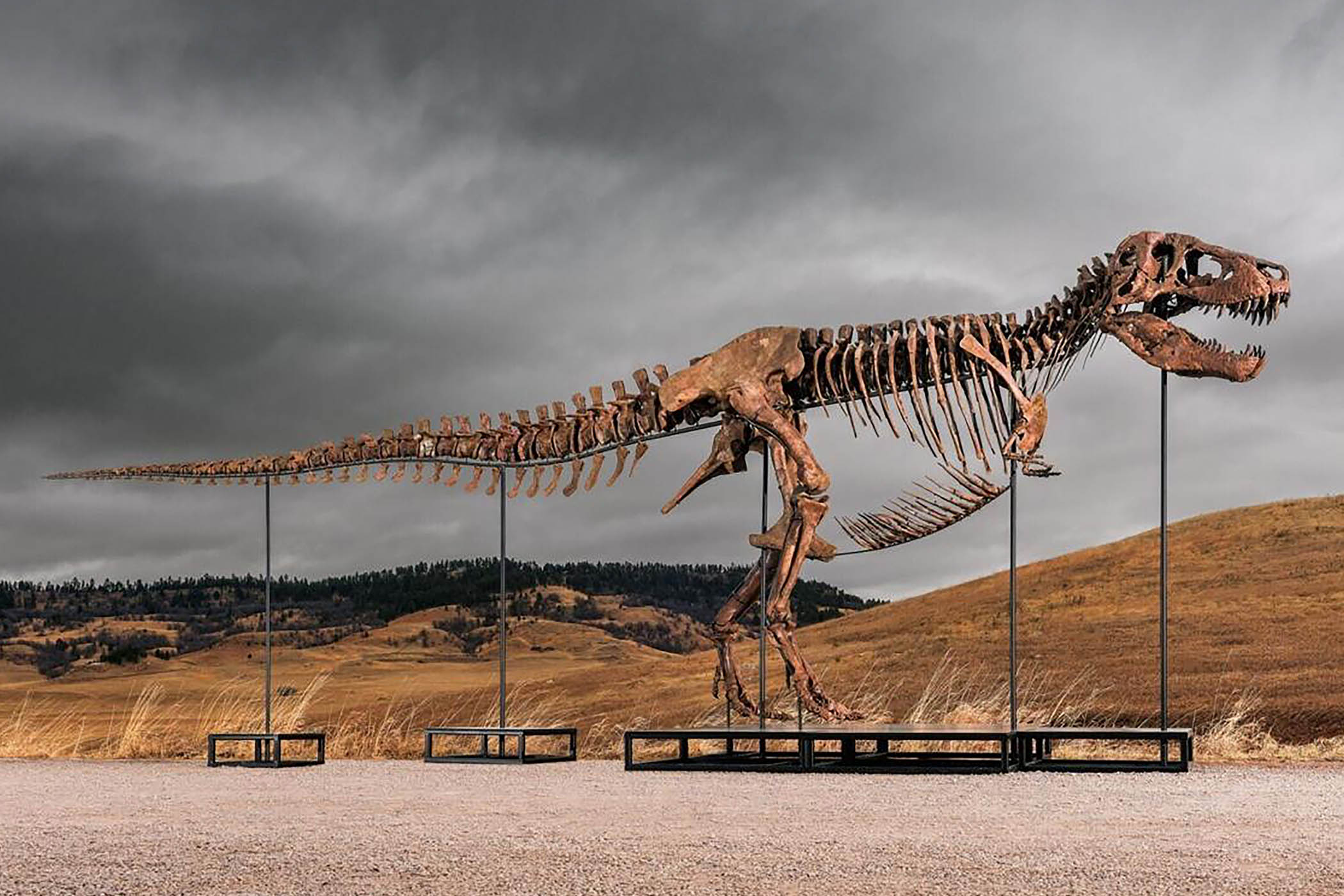

Forget superyachts, Ferraris and Rolex watches. What the super-rich really want is a dinosaur. This week they have the chance to buy their own: a 67m-year-old Tyrannosaurus rex fossil known as Gus, which is expected to set a new record when it goes up for auction at Sotheby’s in New York.
Gus is the latest in a growing trend. Last year a 150m-year-old juvenile Ceratosaurus nasicornis skeleton fossil sold for $30.5m (£23m) to a private buyer. In 2020 the ruling family of Abu Dhabi bought Stan, one of the most complete T rex skeletons ever found, for what was then a record-breaking $31.8m. It is now the main exhibit in the Natural History Museum Abu Dhabi, which opened in 2025.
In 2024 a new record was set when billionaire hedge fund manager Ken Griffin paid $44.6m for Apex, a 27ft-long stegosaurus. Griffin bought the skeleton because it reminded him of his favourite childhood toy – a stuffed dinosaur. “I’ve always loved dinosaurs,” he told Bloomberg. Later that year he loaned the stegosaurus to the American Museum of Natural History for four years.
Gus is expected to beat Apex’s record price as the T rex is the most popular species of dinosaur. It has an auction estimate of between $20m and $30m, the highest placed on a dinosaur fossil to date, and online bidding has already reached $19m.
People buy fossils because they have “a curiosity for things that are super-historically, culturally, and scientifically important” said Cassandra Hatton, Sotheby’s global head of science and natural history.
Nicolas Cage, Russell Crowe and Leonardo DiCaprio have all bought parts of dinosaurs – with Cage and DiCaprio going head-to-head in 2007 at the auction of a Tyrannosaurus bataar skull.
Fossil hunter Thomas Heitkamp excavated Gus in South Dakota, one of the world’s premier destinations for dinosaur fossils. It was named after Gary “Gus” Licking, who discovered parts of the skeleton on his family’s cattle ranch in 2021. Licking died in 2022 and the item is being sold by his widow, Dana, and Heitkamp.
It took Heitkamp and his team three years to excavate the full skeleton. “It really does feel like tackling the world’s hardest puzzle, except we have to find all the pieces first,” he said in a promotional video made by Sotheby’s. “All those bones separated for 67m years that we can now, almost magically, fit back together.”
The skeleton, which is one of the largest ever found, is 63% complete by bone count – more complete than most dinosaur skeletons found in museums. “The level of preservation is exceptional,” Hatton said. “Thanks to years of meticulous excavation and lab preparation carried out to the highest professional standards, the specimen is superbly documented.”
But the private sale of dinosaur fossils has divided the scientific community. While some palaeontologists have welcomed the money and attention they bring to the field, others have questioned whether private buyers will maintain such professional standards of preservation, particularly when fossils are kept in private homes rather than loaned to museums.
Newsletters
Choose the newsletters you want to receive
View more
For information about how The Observer protects your data, read our Privacy Policy
In an open letter published last year, the Society of Vertebrate Paleontology (SVP) opposed the American Museum of Natural History’s decision to display Griffin’s Apex Stegosaurus fossil. “It sets a dangerous precedent by legitimising private ownership of vertebrate fossils and may incentivize future sales of similar fossils by increasing their perceived market value,” the society said.
Stuart Sumida, president of the SVP, said the rising costs of private sales had left museums unable to afford high-quality specimens. It “undermines their mission to preserve Earth’s history and limits access for researchers and the public,” he said.
In the UK and the US, fossils are generally the property of the landowner, and it is legal for them to be sold privately. Often landowners in areas with a high density of fossils sell licences to fossil hunters to access their land. However, in many other countries including China, Mongolia and Argentina, it is illegal to export fossils.
What are your thoughts on this? Send us a letter to letters@observer.co.uk
Photograph by Matthew Sherman for Sotheby’s