
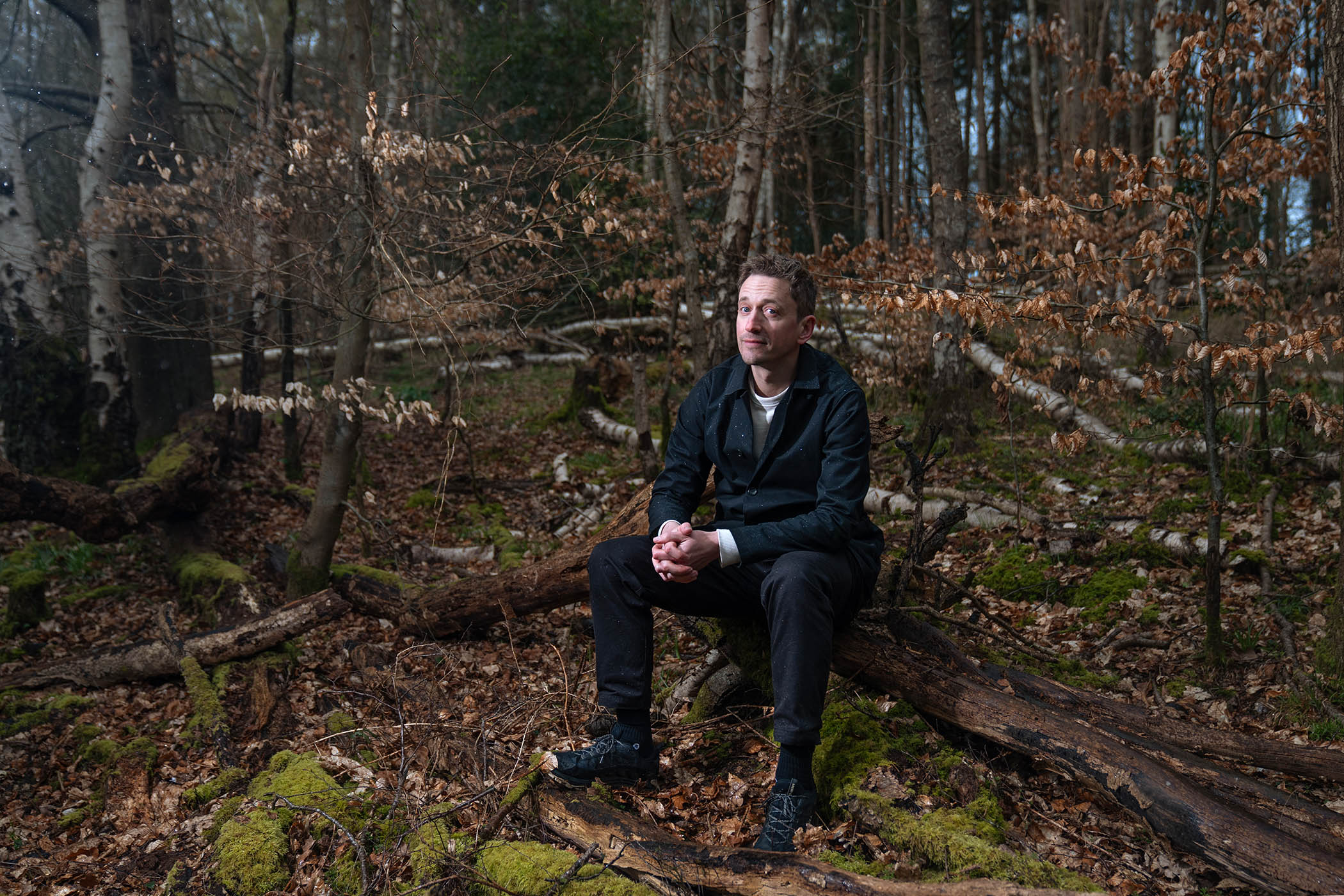
Portraits by Tom Pilston for The Observer
The award-winning comedian and broadcaster John Robins was three when he downed the dregs from a can of Harp Lager. The curly-haired toddler on the cover of his new memoir, Thirst, is proof.
At seven he necked a glass of wine, at 13 he inhaled petrol and a year later he was choking on vomit in his sleep after four ciders, four beers, some aftershave and a bottle of Archers. He deploys his trademark black humour to thank the friend who saved his life: “If she hadn’t had the wherewithal to turn me over then I would have died from alcoholism aged 14, and the world would have been cruelly denied over a thousand podcasts of variable quality.”
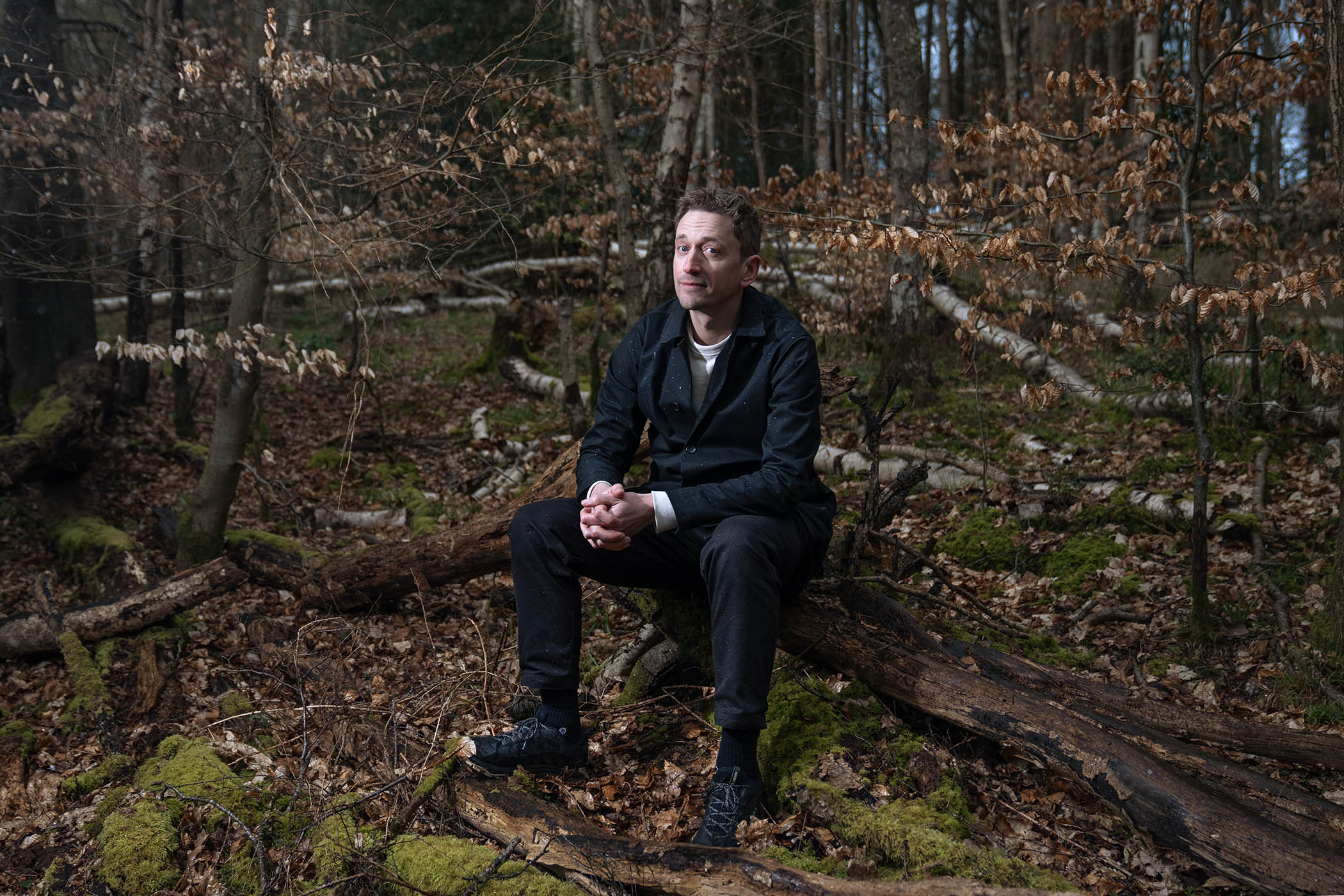
Thirty years on and three-and-a-quarter years sober, Robins is taking me on a woodland walk in the Chilterns, one of his favourite pastimes. His fantastic twice-weekly BBC podcast with fellow comedian Elis James, called simply Elis James and John Robins, had more downloads in the last quarter than In Our Time and Sounds of the Sixties. It was the most popular podcast of all for the under-35s and regularly features in The Observer audio critic Miranda Sawyer’s best shows of the year.
Earlier this month, as part of an exclusive-packed Patreon channel, came the duo’s new online show, The Adventures of Elis and John, and Robins launched the sixth season of the Significant Productions podcast How Do You Cope?, where he sensitively interviews high-profile guests about tough challenges they’ve faced in their lives (this season’s roll call includes Anthony Scaramucci, Esther Ghey and Richard Osman).
Robins’s regular comedy persona is more intensely funny: a music-loving Alan Partridge crossed with a neurotic boffin, as happy reviewing service stations as quoting TS Eliot or enthusing about Queen or the US indie band Geese. We meet at his small, pretty house in Buckinghamshire on a wildly changeable spring day where the weather swings from icy hailstones to baking sunshine.
Robins is quieter than I expected, somewhat inscrutable. He vapes often. I’m reminded of a passage in his book: “When I am around people I don’t know, at some point I will tense up, my body and mind will feel like concrete.”
Eighteen months sober myself, I tell him how I spent Christmas devouring an early proof of his book, in which he brilliantly nails alcohol’s “mystery, its terror, its havoc, its strange meditations”. His writing shifts between magical descriptions (finding a perfect pub was like “looking for the rip in the air, some secret exit where we could slide out of our lives”), ribald comedy (the chapter on his haemorrhoids – what he calls “bumageddon” – is painfully funny) and devastating confessions, such as when he tells his close friend, the comedian Lou Sanders, that he wants to drink himself to death. “Lou didn’t say anything at first,” he writes. “She held my hand and we cried.”
He finished voicing the audiobook of his memoir this morning, he says, a few minutes into our chat. That must have been tough. “There were certain bits I knew would be a struggle to get through, because when you’re saying something you have discovered in the act of writing, it feels very powerful,” he says. In the book, he describes his childhood traumas as “a few skeletons here and there”. I suggest he had more to contend with than that.
He writes about how his father left his family in Thornbury, near Bristol, when Robins was six, and moved to Canada, claiming that “God had told him to”. Robins’s mother worked three jobs to keep the family going (soon after, she trained as a counsellor). Dad returned briefly a year later, a man Robins barely recognised at the school gates, with an “enormous beard”, telling his son that God had told him to grow his hair until the world ended. “Quite a lot for a seven-year-old to get his head around really,” he writes with an unbearable poignancy. Then the scalpel-sharp comedy returns. “Men, eh?! What ARE we like?”
Newsletters
Choose the newsletters you want to receive
View more
For information about how The Observer protects your data, read our Privacy Policy
Then came a noise-averse stepfather, a recovering alcoholic whom Robins nevertheless thanks in his acknowledgements for “doing his best”.
“There’s a hell of a lot more stuff that isn’t in the book, because otherwise the book would never end,” he admits. “But I’ve learned just because you’re being honest about some things doesn’t suddenly mean you want to open your kitchen cupboards and tell people to raid the pantry.”
He is similarly discreet about former partners. For four years he went out with the comedian Sara Pascoe: she is mentioned by name only in relation to their 2016 joint appearance on BBC1’s Mock the Week, although he notes he still lives in the home they shared, and discusses how the split inspired his 2017 Edinburgh Comedy Award-winning show, The Darkness of Robins. He doesn’t name his “then fiancée”, the designer Coco Fennell (“a depressing phrase: ‘then fiancée’… it only ends one of two ways, and I ain’t married!”), sister of film director Emerald, but describes life with her family during lockdown as his behaviour deteriorated. “On this incredible journey of falling in love,” he confesses, “alcohol was more important to me than showing up.”
His pre-sobriety podcasts still exist online. While writing the book, he listened to the 2022 “An Odyssey to…” episodes of the Elis and John podcast, which documented solo holidays to Ireland and Scotland a few months before he gave up drinking for good: “What isn’t captured on the recordings – thank God – is that I was crying a lot.”
I listened to these episodes on my drive up today, I tell Robins. He sits straighter. “What did you think?” I tell him I loved his service station reviews but was unsettled by the many references to alcohol and by how clearly unhappy he was.
He responds in an unexpected way: “Part of me is really nostalgic for that trip, because recovery isn’t simple. It’s not as easy as ‘alcohol is really bad. I stopped drinking. Life is really good’. Sometimes I want to do that trip all over again – get into my car and bugger off for two weeks and get hammered in places where no one knows me.”
He puts his vape in his pocket – it’s time to head out. “But I was trying to run away, and when you try to run away from yourself, you’re always there.”
We cross the road towards wet green fields. Robins tells me how the outside world has often provided him with comfort, first through playing near his mother’s friends’ farmhouses, then through Cubs and Scouts, and most recently through his training for the London Marathon, which he ran as an ambassador for the charity Standing Together Against Domestic Abuse, raising £81,095.
“I know it sounds glib, but when I come back from [working in] London, and I’m overwhelmed with all sorts of emotional and intellectual anxieties, I can come to a place where none of that actually exists, where I’m noticing this beautiful tree or flower or leaf that will never look like this again.” He looks up. “Like that bird there – one of them might be dead tomorrow, but there will always be birds… thinking about things like that gives me enormous freedom in life. It makes me realise you’re not the star of your own film. You’re just an extra in an enormous film.”
We approach the trees and return to the drink. Robins talks perceptively about the “very dark, toxic” glorification of alcohol in the 1990s, when he was a teenager, when “drinking to the point where you throw up and pass out was a badge of honour”. He is also sharp on the “horrible idea that women could gain equal footing with men as long as they were as drunk and outrageous”, that it was “basically the male world saying: ‘We’ll let you in as long as you aren’t in control, and you might not remember what’s happened.’”
Robins would often drink alone in his room while he was an English literature student at St Anne’s College, Oxford in the early 2000s. He says he recently went to a reunion that profoundly depressed him. “I was struck by how, for people who came from money or privilege, it was just a sort of stepping stone among stepping stones. For the rest of us, it offered the idea that you were exceptional and that your life was going to be exceptional. And then the day that you leave, you’re thrown off the side of the boat.” After university, working as a part-time labourer and then a bookseller, he spiralled into even more excess.
At 22, he gave up drinking – albeit for only 18 months – the same week he attended an open mic comedy night. A week later, he went behind the microphone for the first time, discovering that stand-up was “an adrenaline and dopamine rollercoaster to rival any drinking spree”. Twenty years later it would be a different community that saved him from drinking. He writes of his 12-Step meetings: “Driving to a community centre or church hall to share my head with other people who have heads like mine… has turned out to be one hell of a defence.”
Comedy brought Robins new friends too. Within months, he was a housemate of Russell Howard and Jon Richardson and a friend of Elis James, a regular on the circuit in south Wales and the south-west of England, with whom he’s still very close after 20 years. He admits that he had only “one ask” when he signed up with James’s agent in 2014: “To do a radio show with Elis.” After five years co-presenting at XFM and more than 500 shows with the BBC, their chemistry still crackles with warmth. Robins was even James’s best man at his wedding to fellow comedian Isy Suttie in 2024.
“He’s an incredibly special person and I have never met anyone like him,” James tells me a few weeks later over email. “His [best man’s] speech was an absolute work of art. It was basically a tender, funny, very human stand-up set about friendship, and the amount of work he’d put into it was staggering.” James thinks their podcast works well because of their differences (“I can never predict how John will react to something, whereas I’m as predictable as scotch eggs at a buffet”) and because of their “great, kind friendship”, which the listeners “can tell is authentic”.
In 2024, the pair won Moment of the Year at the Aria awards for an episode of How Do You Cope? in which Robins talks to James about finally giving up alcohol in November 2022. This came nine months after a doctor had told Robins to sort his “fucking life out”, a blackly funny interaction that opens the book, and after a sobriety podcast made Robins realise he had no other options.
I tell Robins I’m struck by the number of letters read out on the Elis and John show that thank the pair for lifting their spirits. “One of the great strengths of audio is that it can be much more real than TV and film,” he replies. “It’s not better or more entertaining, necessarily, but it is real, and it’s so much more intimate.” He has noticed lots of visualised podcasts being commissioned in recent months: “It’s so interesting how the sort of snake is eating its tail – it’s like the whole industry is struggling because they’ve sort of lost contact with trusting creatives. TV or film today doesn’t really offer connection; it offers escape. But people want connection.”
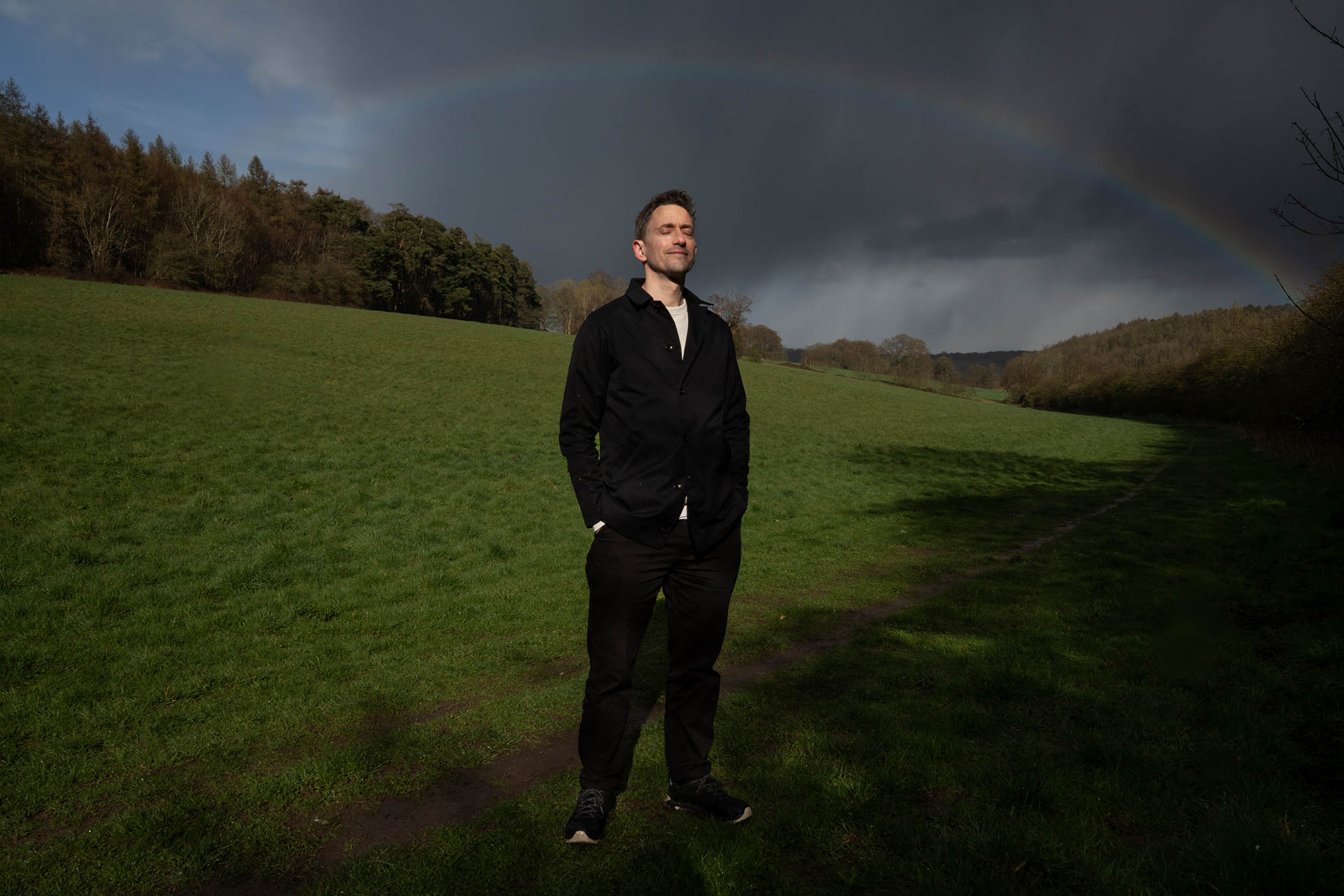
A rainbow appears as we walk back to Robins’s house, like an unsubtle metaphor. He poses daftly for the photographer, throwing his arms out. We talk about what his evenings at home look like now, without pints of rum and Diet Coke or cans of cider or Guinness: crosswords in bed, ambient music with lyrics after 8pm (“so much of my drinking intersected with some quite depressing music,” he admits) and quite often a Roald Dahl audiobook. “I’m learning from him how children interact with the adult world and how adults interact with the child’s world,” he says. “There’s more in that, perhaps, than we think.”
What are his hopes for his own book? He laughs. “To set it free from my brain. I feel like I’ve lived with it for a long, long time. I'm just looking forward to people having their own relationship with it, to be honest.”
Back home, boots off, he seems brighter. He records a generous video for my son, a big fan of his, and signs it off with the words: “Be nice to your mum for the rest of time.” I’m reminded of a powerful passage near the end of his book: “I still cry out of nowhere sometimes and feel so intensely that I will always feel this way and that there’s no point, so I might as well drink. But I don’t. Because I know it will pass. And it passes.”
Thirst: Twelve Drinks That Changed My Life, by John Robins, is published by Viking on 7 May (£20). Save 10% at observershop.co.uk. Free UK standard P&P on online orders over £25