
Listen to Foundling here or wherever you get your podcasts
Jennifer had warned Jess not to look for her birth father, but the urge to fill the void that had followed her since childhood propelled Jess on. She couldn’t have known the scale of the fallout her search would cause...
Jess had several leads. She had been told that Jennifer, her birth mother, was in a relationship in 1987, around the time Jess was conceived, with a man who had an unusual surname. And Jess’s DNA test had suggested she may have some “Germanic” genes.
She found the five adult children of the man with the unusual surname on Facebook. They all seemed to live in the same town as their father – in the town where Jennifer grew up and now lived. Jess messaged them. She was deliberately vague about what she was looking for, suggesting she was researching her ancestry.
Only Adam, the eldest, replied.
“He put two and two together,” Jess says now. “Then went: ‘Are you actually looking for your father?’”
Adam, it turned out, was also into family history, but had done his DNA test with a different company from the one Jess had used to find her birth mother’s family.
So once again she found herself spitting into a vial and sending the sample off to a laboratory, anxiously waiting for the result to come back. When it did, it confirmed that Adam was her half-brother and that they shared a father, Louis.
Adam told his father – and in the middle of August 2022 Jess texted him. “Hi, it’s Jess, bit of a crazy day all round,” she wrote. “I’m sure it’s come as a shock to you.”
According to Jess, he replied: “It’s knocked me sideways. I just dunno what to say at the moment. I’m sure you understand, but it’s so nice to hear from you.”
Newsletters
Choose the newsletters you want to receive
View more
For information about how The Observer protects your data, read our Privacy Policy
Louis had been with his long-term partner, Debbie, with whom he has five children, since they were teenagers. When he told her he wanted to talk to her about something but didn’t want the neighbours to hear, she was immediately suspicious. He suggested they drive to a pub in the countryside, where he told her about Jess. Debbie asked him how old she was and realised Jess was almost exactly the same age as their second child.
“I did feel like smashing a glass over his head, to be honest,” Debbie says now. She described Jess’s arrival as being like a grenade going off in the family.
“My heart just dropped, because I’m just thinking, ‘What on earth – how, when, what?’” Kim, one of Debbie and Louis’s daughters, says.
Louis insisted he knew nothing about Jess’s existence until Adam told him. But Debbie knew that Louis had been serially unfaithful to her, and their relationship, which was already fragile, unravelled.
In the meantime, Jess formed a bond with both Kim, who was in her 30s, and her younger sister Chloe, who was in her early 20s.
When they first met in person, they went for lunch in a pub and enjoyed a muddy walk together.
“We came away going, ‘God, we’re so alike,’” Jess says. “Everything we discussed, we were on the same page. And it was beautiful.”
Chloe was open with Jess about how she had struggled with her mental health since she was 13. This had included attempts to take her own life and spells in hospital. By the time Jess had come into her life, Chloe had been under the care of the NHS’s mental health services for the best part of a decade.
Two years earlier her counsellor had been a woman in her mid-50s called Jennifer. Chloe really liked her; she’d been kind and responsive. She’d given both Debbie and Chloe her telephone number and told them to ring her if they ever wanted to. Chloe had done so numerous times.
Chloe saw Jennifer for a year, but even after Chloe was discharged from her care, Chloe knew Jennifer was there if she needed her.
But when Debbie learned from Adam that Jess’s birth mother was also called Jennifer and worked in mental health services, the penny dropped. How many mental health nurses in a small town could there be with the first name Jennifer?
Without realising it, Chloe had been sharing her deepest anxieties with a woman who had had a secret relationship with her father. A woman who had had his baby, abandoned it, and never told a soul.
“She was angry because she’d trusted Jennifer,” Kim says.
Jess showed me a message Chloe sent her soon after she found out that Jennifer was Jess’s birth mother. It reads: “I feel so betrayed. She would have known who I am.”
Chloe and her family did have grounds to believe Jennifer knew who she was treating. For a start, there was the unusual “Germanic” surname which would have appeared in Chloe’s medical notes alongside the names of her parents.
And although it was Debbie who would usually accompany Chloe to her appointments with Jennifer, Louis would often drop them off and pick them up. On these occasions, he’d sit in the clinic’s waiting room until they emerged from their session.
One time Debbie remembered seeing Jennifer and Louis speaking to one another. She thought it was a bit odd that they seemed to know each other, but brushed it off.
A number of psychologists and mental health clinicians I spoke to all said the same thing: if the medical records of anyone you know, however tenuously, comes on to your desk, you report and recuse yourself from treating that patient.
Kevin Gournay is a psychologist and, like Jennifer, a registered nurse. He’s in his 80s now and has a reputation as a pioneer of mental health nursing in the UK. He was clear that Jennifer’s decision to treat Chloe sounded like an overwhelming conflict of interest and a serious breach of the nursing code of conduct. “It’s unethical because you’ve got one person with all the power,” he says.
For months Chloe did nothing about Jennifer. Then in the spring of 2023 she filled in an online complaint form on an NHS website.
Two months later, the chief executive of Derbyshire NHS wrote back offering her an apology for any distress caused, but concluded that there was no conflict of interest. To Chloe and her family, this sounded a lot like a dismissal of their case.
Six months on, Chloe seemed to be in a good place. She was busy finishing university and living with her boyfriend. She messaged Debbie to say that they had had an offer accepted on a house which they were keen to buy.
But one Friday in November, Debbie returned from walking her dog to find two police officers outside her house. “They asked if they could they come in. And: ‘Do you want to sit down?’ I said: ‘No, I don’t want to sit down,’” she says.
The officers told her that Chloe, who was 23, had been found dead.
After Chloe’s suicide, Debbie and Kim wrote to the NHS to complain further. But the NHS, while acknowledging that Jennifer did know Chloe’s father and should have discussed this with her manager, stuck to its line: it wasn’t a conflict of interest. “It is not felt that this would have changed the decision for Jennifer to continue to support Chloe,” the NHS trust said.
The way Debbie and Kim see it, Jennifer’s treatment of Chloe destroyed her trust in the medical profession that was caring for her and stopped her asking for help when she needed it.
For Jess, who had built a close relationship with Chloe for the brief 15 months they had together, she lost a family member who she had only just found. Jess had spent nearly three decades looking for an answer to the question: why did her birth mother abandon her as a baby? We contacted Jennifer a number of times while reporting this story, but she didn’t want to talk. She has never given Jess an explanation for why she abandoned her or her half-sister Helen 15 months later.
Instead of answers to the question of why, Jess found a birth mother and father, two grandparents, eight half-siblings, and an aunt and an uncle. She feels fortunate to have met some of them at least. But was it all worth it?
“My life before all of this was much more simple. It was a happy life,” she says now. “If I knew how traumatic it was going to be, I wouldn’t have done it. No way.”
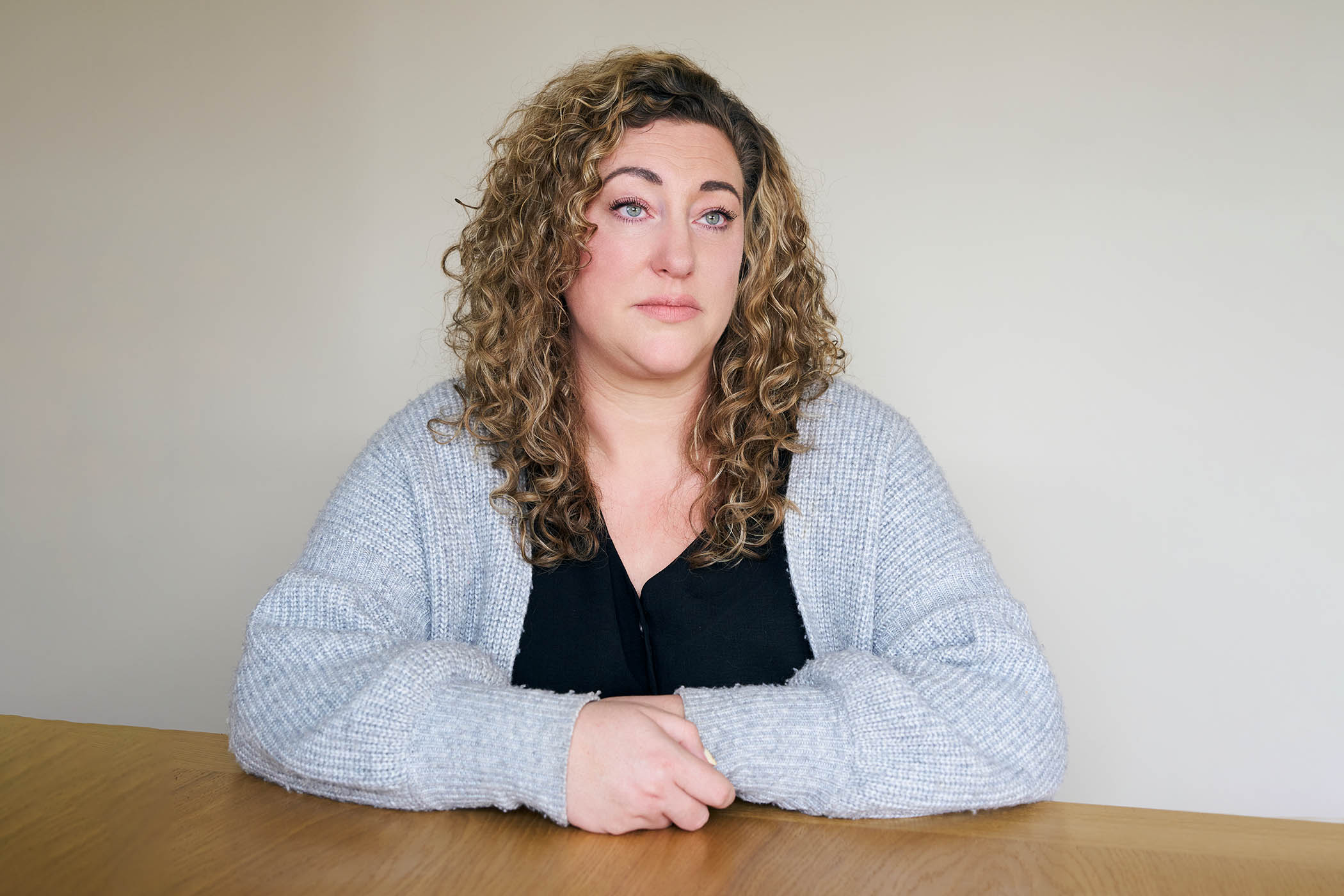
Photograph by Suki Dhanda for The Observer
In the UK and Ireland, Samaritans can be contacted on freephone 116 123, or email jo@samaritans.org or jo@samaritans.ie. In the US, you can call or text the National Suicide Prevention Lifeline on 988, chat on 988lifeline.org, or text HOME to 741741 to connect with a crisis counselor. In Australia, the crisis support service Lifeline is 13 11 14. Other international helplines can be found at befrienders.org