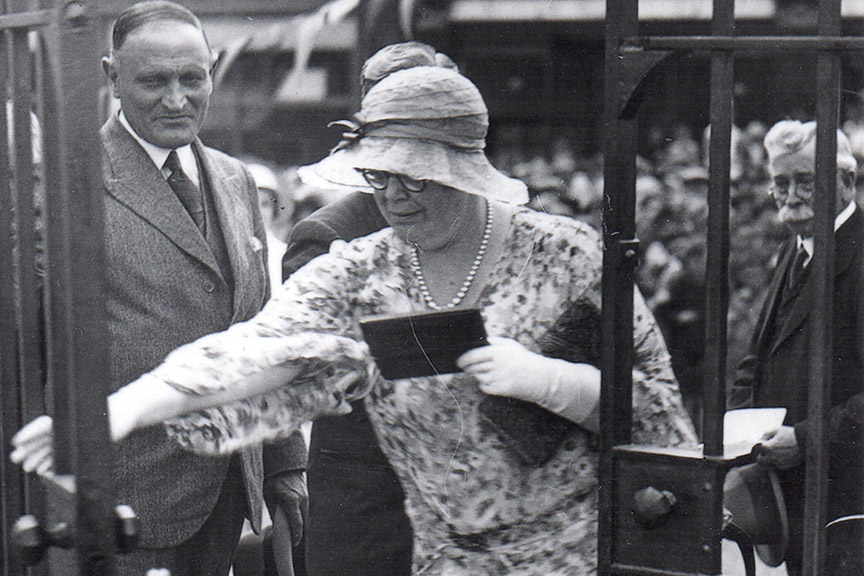


When Eileen Elgar was in her 50s, she told her daughter she thought she could improve the work of JRR Tolkien. “Well, if you’re so insistent, why don’t you just write to him?” her daughter said. So Elgar did just that – reaching out in the 1960s to initiate an almost decade-long correspondence and an unlikely friendship that lit up Elgar’s life and informed Tolkien’s writing. This week a collection of five letters and six books exchanged between the pair will go on sale at Sotheby’s in London.
Tolkien was inundated with letters from fans – including the former Crown Princess of Denmark and the author Iris Murdoch – almost as soon as the first part of The Lord of the Rings was published in 1954. But Elgar stood out. Her original letter, and suggestion for improvement, has been lost, but the pair continued to write to each other not only about Tolkien’s work but also their personal lives, including Tolkien’s anxieties and his grief following the death in 1963 of his close friend CS Lewis.
“[Elgar] had the balls to actually say what could be better” in the author’s work, said Pieter Collier, a Tolkien expert and book collector. “I believe she was one of the very few people he could think of as a peer… she should get much more credit and respect for her communications with him. He actually listened to what she said.”
In a 1963 letter to his grandson, Tolkien described Elgar as “highly intelligent and well read”, though sadly “stone deaf”. Elgar’s hearing was permanently damaged by an ear infection she contracted as a child, which left her struggling to communicate with those around her. She had won a place at Girton College, Cambridge, to study classics but did not complete her degree. “Being female [at Cambridge] was hard enough, but being deaf was too big a block,” said Collier. “One cannot help wondering what kind of scholar she might have become had deafness not isolated her from academic life.”
Helen Dutfield, Elgar’s granddaughter, said: “Because she couldn’t hear, and most people wouldn’t write down [and she couldn’t] lip read, she developed this very rich fantasy life.” As a grandmother, she was difficult, Dutfield added. “I think she thought I was a bit stupid. And I think she thought my mother was a bit stupid as well.”
But Elgar found an intellectual match in Tolkien, who, alongside more personal communications, sent her an unpublished chapter of his work The Silmarillion, a book of mythology that Tolkien worked on for nearly 60 years, and was released by his son only in 1977, four years after the writer’s death.
Elgar lived near the Miramar Hotel in Bournemouth, where Tolkien used to holiday with his wife, Edith, and in the early 1960s he began to visit her in person. Because he could not communicate using sign language he wrote her long, elaborate notes. His daughter told Collier he would spend hours with Elgar, often filling page after page in a writing pad. Both Elgar and Tolkien were fascinated by different forms of communication, and in The Lord of the Rings he invented different sign language forms for his elves and dwarves to communicate.
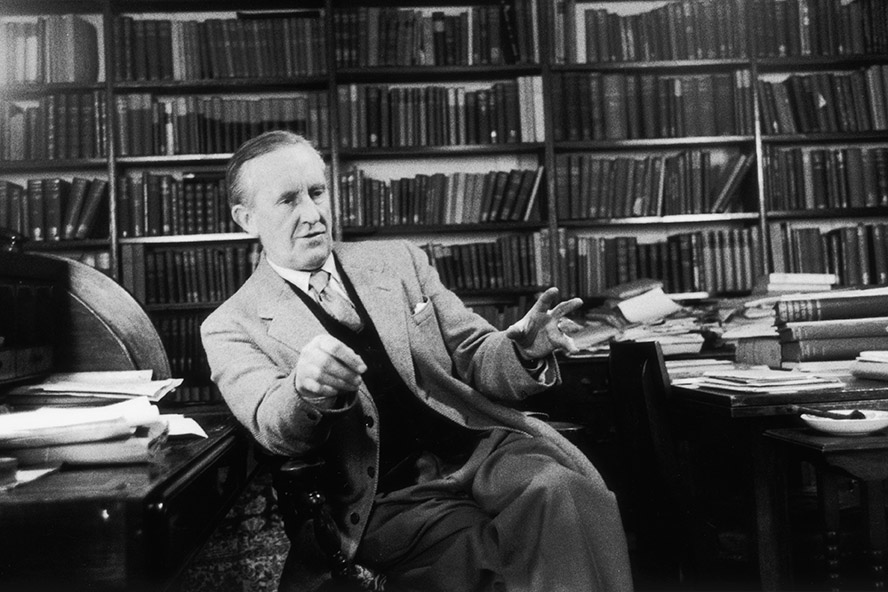
Tolkien in his study, December 1955
“Imagine it: Tolkien is on holiday, he’s off, and he goes to Elgar and they’re working together, communicating through these little papers for hours. It’s not something you do with fans. He truly respected her,” Collier said. Just one of these notes remains, discussing the creation of the dwarves in Tolkien’s work.
Grace Khuri, who has recently completed Oxford’s first doctoral thesis on Tolkien, suggests the pair “could relate to each other, they could commiserate on ageing”. The resulting letters are “quite poignant”, she said.
Tolkien discusses Lewis’s death in one of the letters up for auction, written in December 1963. “I have been very much bereaved by the death of my friend,” he wrote, at the same time sending a first edition copy of his book The Adventures of Tom Bombadil and his “best wishes” for Christmas. Later, in a July 1972 letter sold as part of an auction in the 1980s, he told Elgar about the death of his wife the previous year and compared her to the elf princess who falls in love with a mortal man in The Silmarillion. “[Edith] was my Lúthien Tinúviel, with her river hair and fair face and bright starry eyes,” he wrote.
Newsletters
Choose the newsletters you want to receive
View more
For information about how The Observer protects your data, read our Privacy Policy
Collier said the market for Tolkien materials, which are increasingly rare, is “very hot these days”. In 2024 Sotheby’s sold a set of 21 Tolkien letters from the estate of the composer Donald Swann for £228,000, although this latest smaller collection – being sold by Elgar’s family – is expected to go for less.
Collier fears the high prices will cause such collections to vanish from public view, meaning scholars will have less opportunity to study them. Letters such as Elgar’s offer a rare glimpse not only into how Tolkien worked through his ideas but also how he conducted his life, helping people understand “the man behind the books”.
“They all will get snapped up in private collections when they should be on display. Then they disappear for years,” he said. “It’s such a shame.”
Photograph of Eileen Elgar courtesy of the Elgar family. Tolkien photograph by Haywood Magee/Getty Images