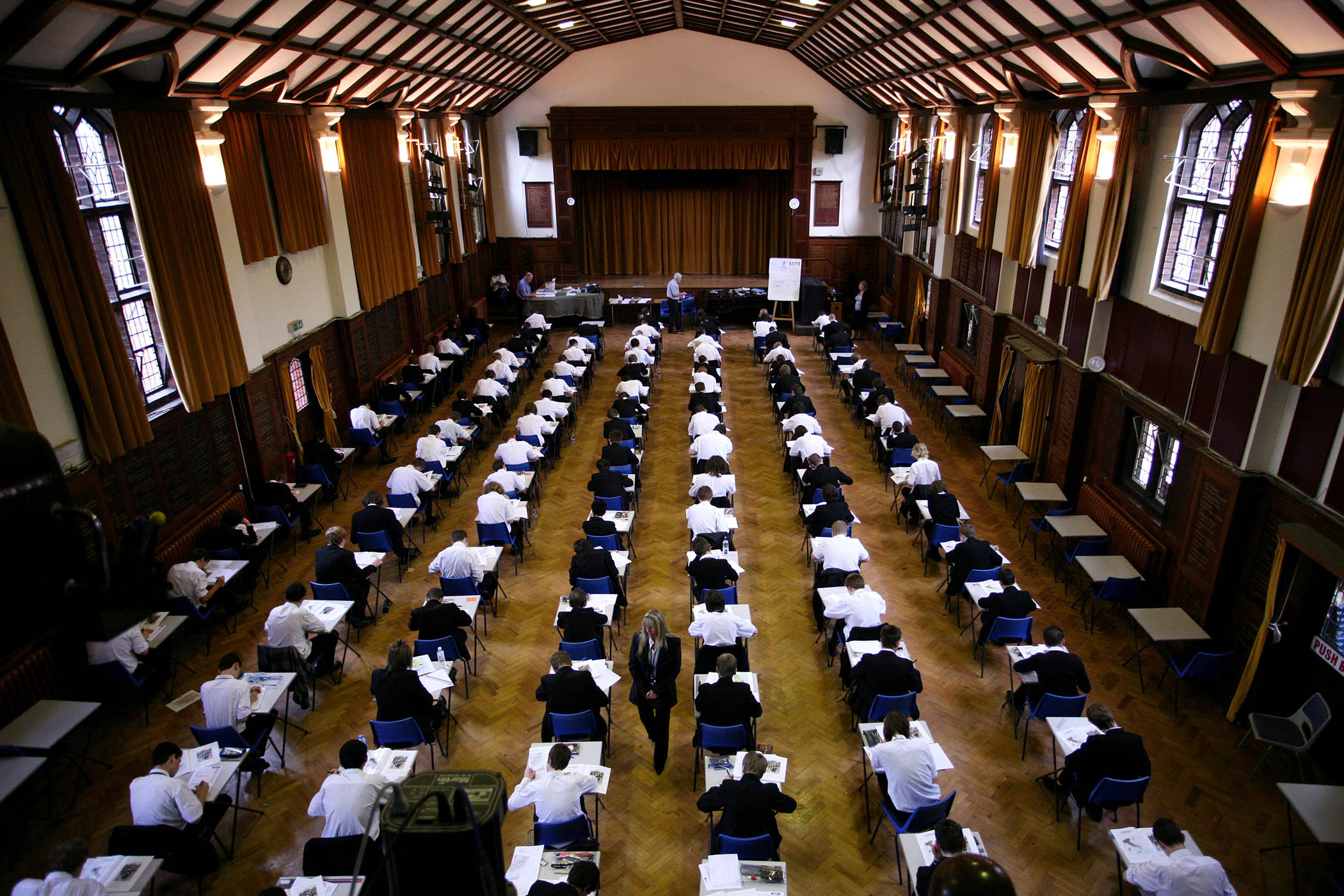


Children could be taking half their GCSEs and A-levels on screen within a decade, the head of the UK’s biggest exam board has said.
Colin Hughes, chief executive of the AQA, said replacing some pen and paper exams with digital assessment would make the system “more secure”, “more resilient” and “fairer”, especially for pupils with special educational needs and disabilities (Send).
“We’re not advocating this because we’re digital maniacs – we’re advocating it because we genuinely believe that the system will be greatly improved,” he said. “We’d expect that in the next 10 to 15 years we’d be doing a third or half of exams online, but no more.”
Exams are turning into a political battleground. Bridget Phillipson, the education secretary, has said the government is determined to use technology “to spread opportunity and modernise our education system”.
The Conservatives, meanwhile, have tabled amendments to the children’s wellbeing and schools bill that would protect paper exams and give parents the right to opt out of screen-based homework.
In December, Ofqual, the exam regulator, launched a 12-week consultation on the introduction of onscreen exams. Under the proposals the four exam boards delivering GCSEs, AS and A-levels in England would be allowed to create two onscreen specifications each. The most popular subjects – those with more than 100,000 entries – would be banned, however. Students would also not be able to use their personal devices in exams.
Hughes said the AQA was ready to deliver parts of Polish and Italian GCSEs on screen. But he warned that there was an “excess of caution” from the government about the move. “If you step very tentatively into a territory like this, what you do is convey to people you’re alarmed and anxious, and the reality is there is nothing to be alarmed and anxious about.”
Last year, the AQA, which sets more than half of all GCSE and A-levels, collected 180m exam papers over seven weeks. They were driven from schools all over the country to a purpose-built scanning centre in Milton Keynes to be converted into digital documents and sent by computer to markers. Moving to digital exams would be safer than transporting papers in vans and halve carbon dioxide emissions, Hughes said.
“And it’s fairer because a very large proportion of students who have some kind of need at the point of doing the exam – large script, or having things spoken to them – overwhelmingly, those things are much easier to address and tackle using machinery.” Hughes added that onscreen exams would also make it “much harder” to cheat.
Singapore, Finland and Estonia have all introduced onscreen exams. In the UK students, parents, employers and teachers have concerns but “they absolutely want it to happen and they think it’s inevitable and necessary”, Hughes said.
Newsletters
Choose the newsletters you want to receive
View more
For information about how The Observer protects your data, read our Privacy Policy
He insisted it was important not to let a fear about the impact of social media on the young distract from the potential benefits of technology in education. “That is such a monumentally silly non sequitur because sitting on your mobile sending messages back and forth to each other on social media is fundamentally different from using [a device] as a learning machine,” he said.
Alex Russell, chief executive of the Bourne Education Trust, which runs academies across Hampshire, London and Surrey, said onscreen exams could help bridge the “huge performance gap” that exists for Send children in exams. “Technology allows you to be much more adaptable to particular needs – things like the colour of the screen or the size of the font or speech facilities create much more accessibility,” he said.
“The government has got to be much bolder, much quicker and invest much more to allow this to happen.”
However, Anthony Seldon, a former headteacher and political historian, warned against abandoning paper testing altogether. “We are still in the foothills on exams. I think there is a strong case for some handwritten exams to reduce cheating, but also because manual dexterity is an essential human skill which is at risk of being lost, to our peril.”
Launching the onscreen exams consultation, Phillipson stressed any shift towards such assessments had to be “phased, controlled and, above all, fair”.
Ian Bauckham, Ofqual’s chief regulator, insisted there must be “rigorous safeguards” to protect the integrity of exams.
The Conservatives believe all exams must remain paper-based. Laura Trott, the shadow education secretary, said: “Research shows writing by hand supports memory and deeper learning in a way screens simply don’t. At a time when there is growing concern about the impact excessive screen use is having on children's attainment and wellbeing, it makes no sense to push high-stakes exams on to devices without clear proof it improves outcomes.”
Nick Gibb, the former Tory schools minister, said: “If exams no longer require pupils to write, are schools going to abandon teaching children to write? We need to be sure exam boards are acting in the interests of students rather than the interests of their profitability. And to act in the interests of students, they need to ensure their policies are in tune with the cognitive evidence of how children learn.”
Photograph by Chris Ratcliffe/Bloomberg via Getty Images