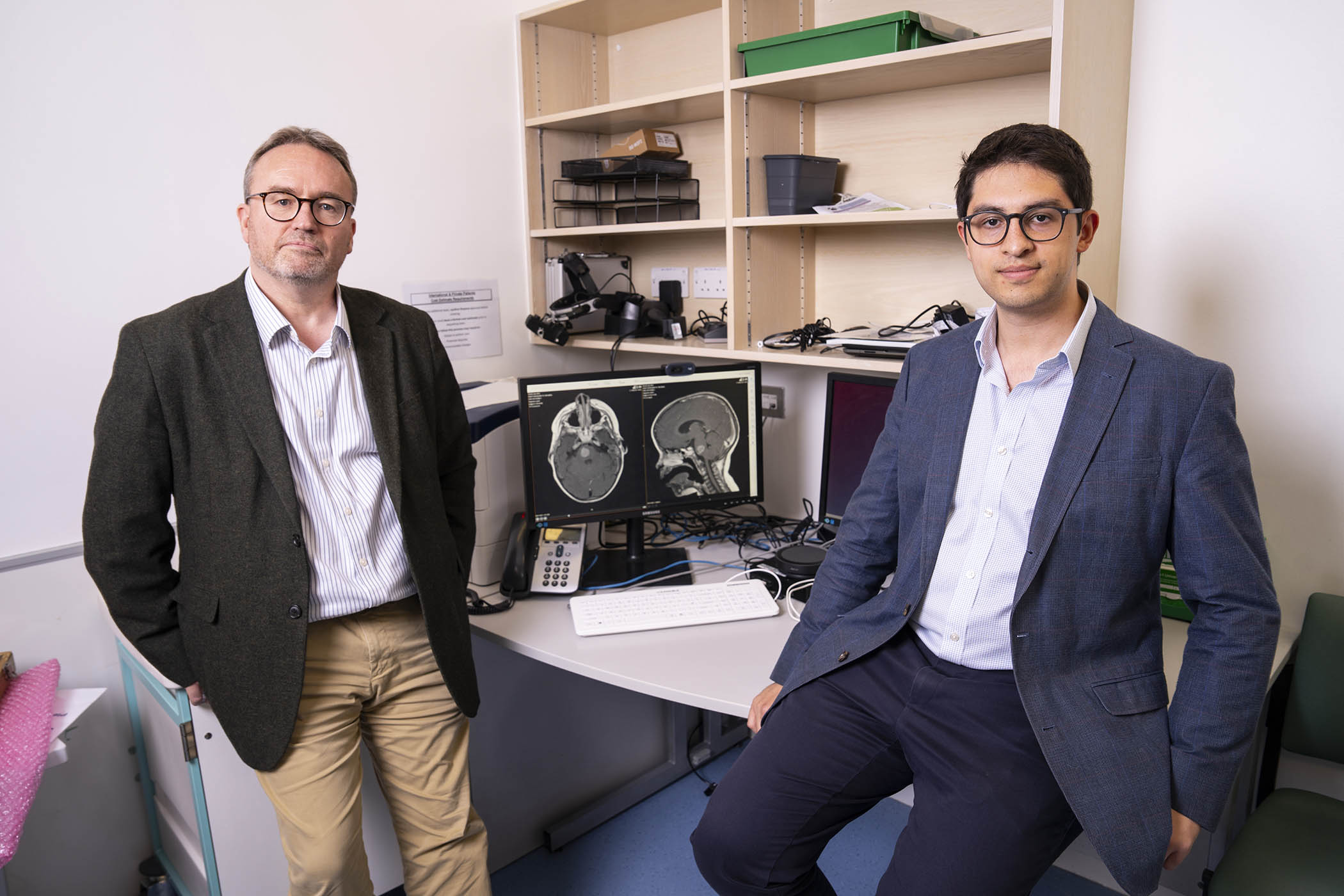


Two medical students have made a “landmark” breakthrough in tackling the deadliest form of childhood brain cancer, a little-understood disease which has thwarted researchers for decades.
Jai Sidpra and Valentina Lind, both 26, managed to map how diffuse midline glioma (DMG) spreads through children’s brains, carrying out research during breaks in their medical training at University College London and Great Ormond Street Hospital.
DMG – and its subtype DIPG – is impossible to remove surgically because it starts in the brainstem and grows into a tumour network that spreads through the brain. Most children die within 12 months and only one in 100 survives for at least five years.
The students’ discovery gives hope to families affected by DMG because by mapping the tumour network for the first time, they have found that the cancer has a hidden vulnerability. In parts of the network that are packed with connections, children were more likely to survive if those connections were weakened or interrupted during surgery.
“We might be able to see if [removing tissue from] those specific connections, and not other areas of the brain, might help prolong survival,” Lind told The Observer. An alternative would be attacking those connections using a drug, if one can be found.
The students – Lind is in her fourth year and Sidpra his fifth – are part of Darren Hargrave’s group at the UCL Great Ormond Street Institute of Child Health. The professor of paediatric neuro-oncology was senior author on a paper revealing their findings that was published in Nature last week.
‘Having a better understanding of how the tumour interacts with the host is vital, and that was the hope behind this project’
‘Having a better understanding of how the tumour interacts with the host is vital, and that was the hope behind this project’
Darren Hargrace, Professor of Neuro-oncology
“I would argue [DMG] is the worst cancer there is,” Hargrave said. About 60 children a year are diagnosed in the UK, with 600 in the US and 600 in Europe. “We’ve been trying everything for 40 years – CAR-T cells, gene therapy, small molecules. Neil Armstrong’s daughter died of this disease. We’ve managed to get someone to the moon and back but we’ve made little progress with this disease.
“Radiotherapy has been the only treatment we’ve had, and that has been palliative. And the age it affects children is usually about six to eight. So it’s devastating. Having a better understanding of how the tumour interacts with the host is vital, and that was the hope behind this project.”
For years, surgeons did not try to operate on children with DMG because it was considered to be too dangerous. The cancer starts in the pons, deep inside the brain in a region that regulates breathing, consciousness and movement.
In 2012 researchers found a way to take biopsy samples, as well as some from autopsies, and managed to discover DMG’s genetic foundation. Then in 2019, a team at Stanford University in California, led by Michelle Monje, discovered that DMG tumours in mice hijack brain cells to help them grow.
Newsletters
Choose the newsletters you want to receive
View more
For information about how The Observer protects your data, read our Privacy Policy
Sidpra and Lind, who have a background in studying the connectivity of the human brain, decided to focus on how tumour cells connect with human brain cells, and how that changes across childhood.
By examining brain maps for 1,000 healthy children and comparing them with images and clinical records of nearly 300 children who had brain tumours, Sidpra and Lind made two important findings.
First, that DMG tumours do not spread randomly. “If you look at different cohorts of children from different centres, tumours look the same,” Sidpra said. “They grow in a very characteristic pattern along brain networks.” That makes it easier to predict how the tumour will progress.
Secondly, they found that tumours with stronger connections to the brain are more deadly. When surgeons had operated on children, if they had – unknowingly – removed tissue at a point where there were lots of connections within the tumour, that helped the children survive longer.
Hargrave’s team will soon begin investigating whether these findings can be translated into therapies, but he hopes that they will be relevant to other cancers too. There is growing evidence that tumours throughout the body can communicate with the nervous system and co-opt it to help them survive and grow.
“We believe it’s highly relevant to adult brain cancer and possibly other paediatric tumours as well,” Hargrave said.
Monje described the work as a “landmark study”.
Sidpra was inspired to study this incurable disease during his work experience placement at Gosh as a 16-year-old, when he encountered a young boy with a similar brain tumour. The gravity of the condition hit the schoolboy when he heard medical staff discussing test results.
“Things became apparent that this was a really significant disease, and they were talking about how they would tell the family, and the kind of impact it would have,” he said. “I was quite a similar age. I’d already wanted to study medicine, but that made me want to do more research.”
Meeting families affected by DMG and DIPG had also inspired them, Lind said. “They said the work that we did really brought them hope for future therapies. From that point, I’ve been committed to neuro-oncology. That’s really stuck with me.”
Neither of them has had much time for more traditional student activities. During the day, they make ward rounds “seeing patients, being with doctors at the bedside, taking histories – essentially just learning what it’s actually like to be a doctor”, Lind said. “That’s nine to five every day, and then in our spare time, we’ve been trying to continue this work, so the past year has mainly been finishing up the paper.” They have also been working on the first clinical trial in Europe examining how Neuralink brain implants can help treat paralysis.
They have had a bit of spare time though. “We’ve also supervised a few younger medical students this year to complete projects in the group. That’s been really rewarding as well,” Lind said. There’s also the task of applying for jobs as junior doctors. To an outsider, their CVs seem robust.