

I was very anxious last Monday. No real reason, just the usual January sludge; feeling like I’d squandered another year, the awareness of time spent foolishly, the world ending. One nice turn, though, was that in America it was a national holiday, and that meant my boyfriend and I had the day to ourselves. We went to a film, for a long boozy lunch, and then back to my place to huddle in bed, appalled by the Arctic conditions. In the late afternoon, while we were still ensconced, I asked if he knew anything about the Beckham family saga. I knew he didn’t; I was just looking for a chance to do a dramatic reading of Brooklyn Beckham’s Instagram stories.
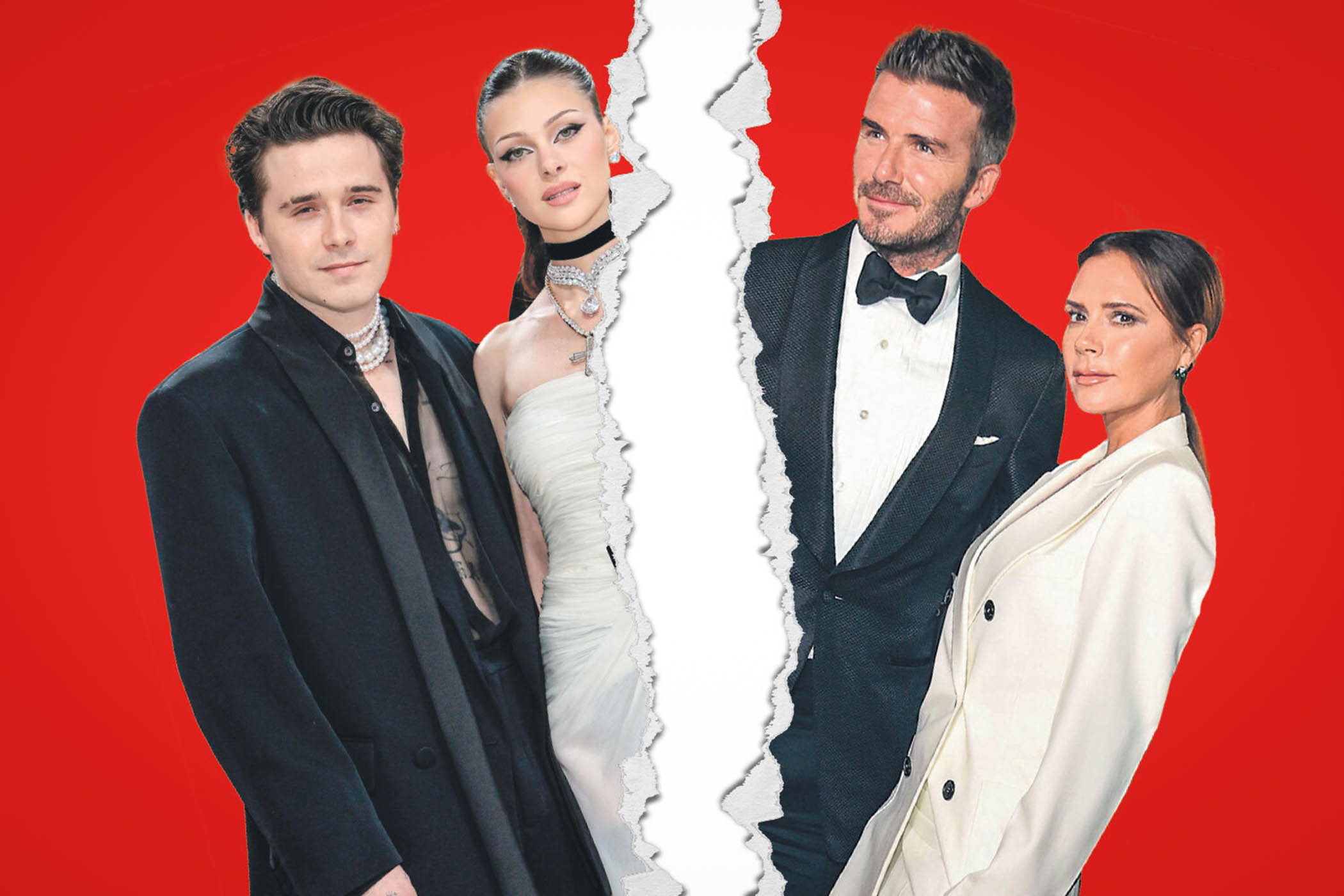
After much speculation about a Beckham family feud, cemented by Brooklyn’s non appearance at his father’s 50th birthday party, it had finally become overt. Their firstborn detailed a litany of offences against David and Victoria, and said he was not interested in reconciling. He implied strongly that the family’s shows of unity and closeness were staged for publicity’s sake, and he accused his mother of ruining his wedding to Nicola Peltz by upstaging her and nicking the first dance. The inappropriate dance! We gasped. Laughed about the idea of me, a few decades from now, calling the baby name I have for my stepson while he tries to shimmy away into his wife’s embrace.
In a group chat, I marvelled that it was the only thing I’d seen in ages which was so universally discussed by everyone I know. My friend Charles said: “It’s the first piece of juicy news that is completely free of existential jeopardy,” – for us anyway, if not the Beckhams.
That was it exactly – it was comforting to see so many people I know reacting in unison to something that didn’t have to do with our own impending doom. Everything we have witnessed together in the past few years have been not only depressing but signs the world as we knew it has concluded. Whatever stupid thing that unites us in the same way, an event that is not the foreshadowing of our children languishing in a fascist post-water world in 2060, is wonderful to participate in.
Then Charles, of Nigerian descent, really made me laugh: “The Brooklyn Beckham drama,” he said, “It all reads very Nigerian to me. Familial disputes over seating arrangements, possessive mothers, liberal use of the word ‘evil’ to describe people you just don’t like.”
It was comforting to see so many people I know reacting in unison to something that didn’t have to do with our own impending doom
It was comforting to see so many people I know reacting in unison to something that didn’t have to do with our own impending doom
I am not part of a dynasty myself, but my mother was famous in our hometown for being a laugh, and beautiful. She allowed my brothers and me to bring our friends back after a night out in our early adulthood, but would amiably rap young men on their knuckles if they were being annoying. Once, outside the club, my best friend watched my mam do cartwheels after the bar had closed. After a certain point, I asked her to stop counting. I’m very comfortable with having a mother who is cooler than me, and more charismatic, and certainly better at gymnastics. What she has in her favour in terms of our relationship is that she never tried to project her charisma on to me. She allowed me to be an awkward and shy adolescent, and she allowed me to try out any number of things when I was a teenager, without compelling me to commit to them.
I was thinking about this when reminded of Brooklyn Beckham’s famously can’t be arsed photography, that silhouetted elephant. He was 17 when that book was published. Correctly, people have lampooned what a ludicrous waste of materials it was to publish someone like him, so inadequate and silly. When I was 15, I once idly said I would like to get into photography, and my mother bought me a pretty decent camera for Christmas. I used it that night for taking close-ups of myself crying, after being mocked by my brothers for losing at Monopoly. That was as good as my photography career got. What if she had propelled me to choose it, publicly, as a career, instead of rightly seeing that I should try it out first, and embarrass myself, in private?
Part of what makes the Beckham drama so grimly compelling is that a family like theirs is its own institution, and seeing their seam ripped open is exhilarating. Like a parallel royal family, there is a whole infrastructure around them to keep their image and their privacy, such as it is, intact. Privacy is a strange concept in these families, zealously guarded but an existential contradiction in terms. Celebrities, including the royals, exist in a necessary state of denial whereby their incessant visibility is underwritten by the fantasy that they are also, with their money and power and influence, able to keep themselves essentially secluded; that the true self is protected. And the tragedy of celebrity is that this is a lie. Human beings are not so complex, so able to be codified. When the world sees you, your body, they are in fact seeing you, no matter what ostensible guards you have up to deny this. We are only ever ourselves. I don’t mean that being able to look at a famous person allows you to truly understand them, any more than I truly understand the man I buy milk from at the corner shop, but the fact is that we – the real us, the core, hurting, incoherent us – are not divisible from the image we wish to project.
The other thing which exhilarates us is to see a kept boy break free. This is not to praise him, or indicate that he’s brave – his exit involves, after all, marrying into another infinitely wealthy family, rather than setting out on his own and earning money as the rest of the planet must. Nevertheless, he is straying from a path that was constructed for him before he was born. Victoria and David Beckham sold photographs of his infant self for enormous sums of money, and continued to profit from what he added to their reputation throughout his childhood. Who is it, exactly, that owns a human being? Your parents are responsible for your existence so they are, in the language of such commercial matters, the generators of your particular value. We agree that children are incapable of making significant decisions, which is why there are laws about when they can vote and drink and join the army and have sex. But there are no laws against taking a decision on their behalf to publicise their one and only face, the one they will still have when they are old enough to decide how to live.
It would be too convoluted to effectively legislate against a parent doing more or less what they want with the image of their child, but it does strike me as odd to be allowed to personally accrue wealth with it, for this to be a widely tolerated venture with no regulation about how that wealth is dealt with. The sacred family unit must not be interfered with by the state, at least not when they are rich. Maybe it’s because I grew up in a motley family of halves and steps, but the idea of the family as a separate entity from the society which surrounds it is very strange to me. Now that I have stepkids of my own, this has become ever more true. The idea of personally benefiting in any way from the existence of my boyfriend’s kids would be deranged to me, and I don’t see why that would be different if I had given birth to them.
Newsletters
Choose the newsletters you want to receive
View more
For information about how The Observer protects your data, read our Privacy Policy
The rivalry between mother and wife speaks to an anxiety about what it is, exactly, that quantifies love
The rivalry between mother and wife speaks to an anxiety about what it is, exactly, that quantifies love
There are biological imperatives which drive us to look after our own immediate family above others, and yet we would do well to recognise that this doesn’t indicate that we own them. Most of us have no parallel to relate to when it comes to the vast excess of the Beckham family and the problems which accompany it, but I believe part of why we are so drawn in by it is that we all struggle to some extent with proprietorship and personhood. In Brooklyn Beckham’s case, there is a well-known quandary: is your loyalty to your wife or your mother? This is the stuff of stand-up comedy, of novelty greeting cards, and soap opera plotlines, but the reality of this friction is genuinely intriguing. Take a look at any of the thousands of posts about this latest instalment of the feud and you will find comments scolding Brooklyn for being so short-sighted as to prioritise Nicola Peltz Beckham over his mum.
The rivalry between mother and wife speaks to an anxiety about what it is, exactly, that quantifies love. We know that the presence of love is an essential element of a healthy, functioning human being’s life, but what sort of love exactly? This is a question we all wrestle with – who to love, and how much – but it must be further baffling to find a healthy way to love when the attention of the world is focused on your dynamic – further again when that very love is at least in part an element of what attracts one’s audience. The sentimental wash on family versus spousal love is obfuscatory, the implication being that when we meet our spouse, they are sublimated into the expanse of the unit we grew up in, and that the love we feel for them is somehow of a kind with the love we feel for our biological family.
The anxiety, of course – not to get too pound-shop Freud about it – has to do with the proximity of sex and familial bonds. The obvious fact that sexual intercourse had to take place for a family to exist is necessarily blocked out by the collective consciousness, because the asexual love of a family unit is compromised by acknowledging it. We have found our ways, as a culture, to enable that denial, most obviously by the simple fact that, historically, by the time a woman’s son was getting married, she was obliged to be elegant and dowdy rather than beautiful and erotic. Now we are in new terrain. Brooklyn Beckham may be the most famous test case for a new culture, one where nobody gets old if they can help it.