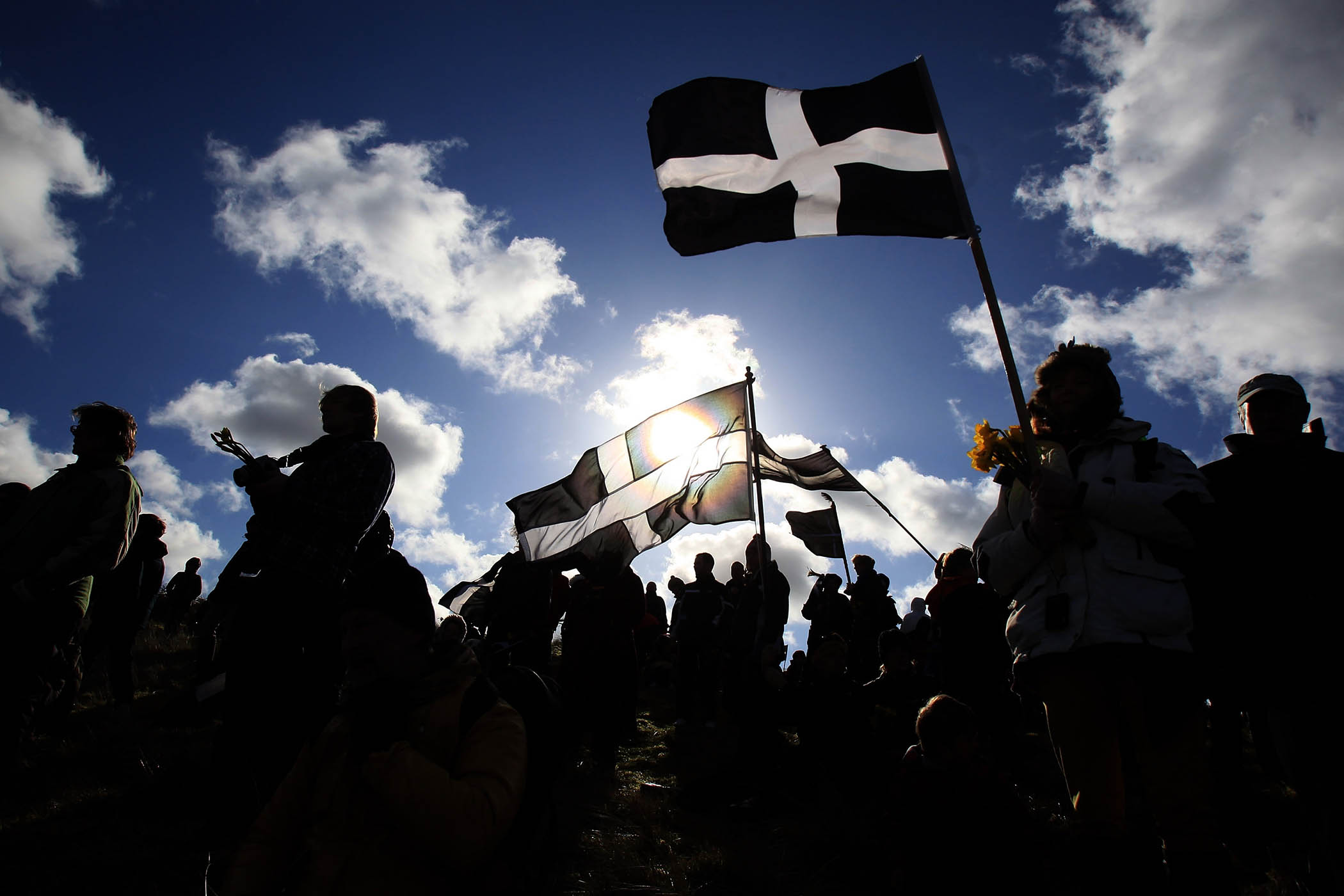
In 1904, the academic Henry Jenner wrote: “Why should Cornishmen learn Cornish? There is no money in it, it serves no practical purpose, and the literature is scanty and of no great originality or value. The question is a fair one, the answer is simple. Because they are Cornish.”
He was part of a group of men struggling to keep the language alive and, more than a hundred years later, dozens of people are continuing this fight. On a very hot sticky day in the multimillion-pound Kresen Kernow archive building in Redruth – blissfully air-conditioned – I sat in on a class of adult learners brushing up on their vocabulary. I left with a bunch of words I will likely soon forget. There’s gwiwer (squirrel), pymp (five) and the almost untranslatable glas, which is green, blue, grey and silver all in one – someone described it like this: “Whatever the colour the sea is, it’s glas. Whatever colour the sky is, it’s glas. The trees are glas. Any growing, living, leafy thing is glas.” The word glas operates in the same way in other Celtic languages, such as Welsh and Breton. Glas acknowledges that colours are much more complex than we usually give them credit for, that they’re fluid and alive, not static and still.
After class, I went into town. The archive building had shone with money – the wooden panelled floors were so shiny they might as well have been sparkling – but there seemed to be far less investment in the shops that lined the main high street.
Cornwall is not a wealthy area and has been described as a place of “pretty poverty”: the scenic views surrounding the lush summer homes of English holidaymakers disguise local challenges. Still, although I am not Cornish, I was warmly embraced by Cornish speakers and activists. Cornish nationalism seems more inclusive than other forms of nationalism that are growing in popularity across Europe. A bard from the Gorsedh Kernow, a society that promotes the Kernewek language and culture, said to me, smiling: “Our language and our culture are for anyone who wants them.”
Speaking to people about identity and belonging got me thinking about my community – or lack thereof. At school, you spend time with people you have little in common with beyond the fact that your parents conceived and gave birth to you around the same time. Now, at my advanced age (I’m in my twenties but fear, as someone born in the 1990s, I’m basically geriatric compared with my 21st-century peers), it takes a considerable amount of effort to find friends. To keep loneliness at bay, I’ve started watching other people watch films. YouTube reaction channels get billions of views. It’s like watching a film with friends, albeit friends who don’t know I exist. We laugh and cry at the same moments, and I nod along (or fast forward) as they start talking about personal issues that are tangentially linked to the plot. These are fleeting, artificial moments of connection that bring me quiet joy until I shut my laptop and find myself alone again.
I did recently attempt to make friends IRL. I went to a speed-friending event in Hackney, which the group running it described as an “evening of platonic love affairs”. I had some good conversations, but it’s been a few days and none of us has got back in touch with each other so I doubt we’ll be BFFs. One chat got off to a particularly awkward start. Seemingly unprompted, my partner, who was not of west African descent but clearly aware that I am, blinked and said suddenly: “So, do you like jollof rice?” Sometimes too much speed means there’s the danger of getting run over.
I went to an acquaintance’s birthday party two nights ago – a long three-hour dinner – and walked away, after a deep conversation, with plans to meet a new friend for coffee soon. There’s still hope!
Photograph by Matt Cardy/Getty Images
Newsletters
Choose the newsletters you want to receive
View more
For information about how The Observer protects your data, read our Privacy Policy