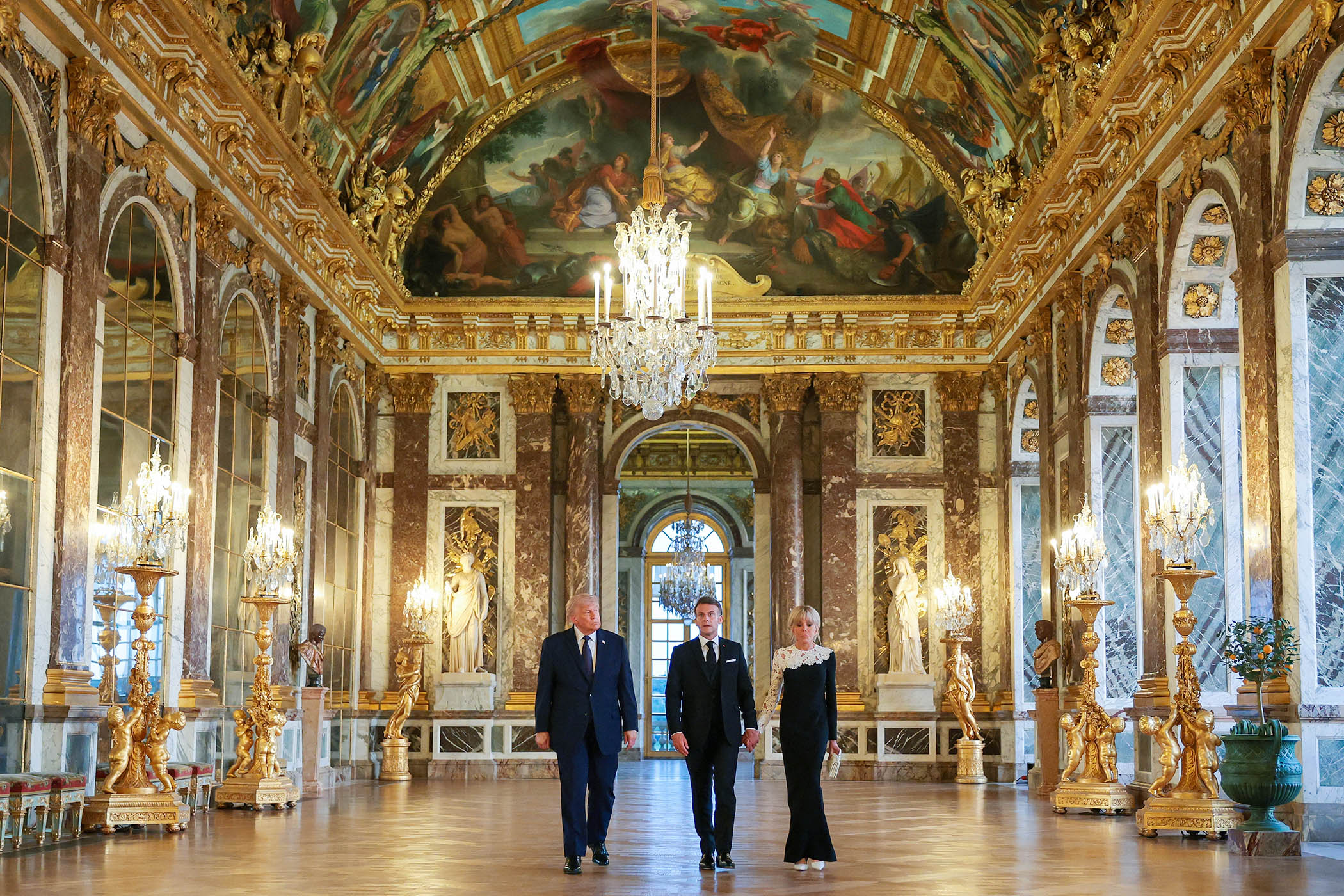
Last week Donald Trump signed a deal that isn’t a deal to end a war that he insists isn’t a war and that hasn’t ended. Commentators were struck by the symbolism of his signing the memorandum of understanding (MOU) at the Palace of Versailles, the scene of the signing in 1919 of arguably the most comprehensive peace treaty of all time.
But whether the US president was aware of that connection is far from clear. By his account he had been invited to dinner at the palace at the last moment after the G7 meeting by that “very nice man” Emmanuel Macron. The word “deal” did escape Trump’s lips. “I’m a fan of beautiful places,” he told the press, “and Versailles is not a gold leaf. Versailles is the real deal.” Almost the Mar-a-Lago of Louis XIV in fact. Versailles is – naturally – covered in gold leaf.
It’s also the place where in 1871 the victorious Prussians forced the French into a humiliating surrender agreement, which involved demobilising much of the army and opening the gates of Paris to the Prussians. No deal there, just capitulation.
But in any case, Trump had already auto-penned his signature on the “Islamabad Memorandum of Understanding” – “foreign shitholes” providing useful middlemen – the 14 points of which took some time to be released to Congress or the public.
An MOU is usually neither a deal nor a treaty: but can be an important preliminary to one. It’s a statement of intent by both parties, and this one has been interpreted as giving Iran everything that it might have wanted in terms of substantial sums of money, the “immediate and permanent” ending of hostilities, sanctions relief and the unfreezing of Iranian assets, in return for opening the Strait of Hormuz (which Iran said yesterday would be closing again over attacks on Lebanon) and agreeing not to procure or develop nuclear weapons. Something Iran had agreed in the Joint Comprehensive Plan of Action (JCPOA) signed in July 2015.
It is fair to say that none of the objectives for the war against Iran stated by administration figures and the president over the past four months have been realised. The regime is still there, bruised but defiant, the Iranian people still live under the boots of the morality police and the IRGC, Iran still has the capacity to produce ballistic missiles, its nuclear programme stands where it was, it arguably has more control over shipping through the Strait than before, and it will be paid off with a large bribe, the bill for which, Trump insists, will be entirely footed by the Gulf states. No detail has yet been settled.
It has been left to the strange moralising vacuum that is the US vice-president JD Vance (whose book on how he found Jesus has just been published in the US) to go and sell the virtues of the deal to a cynical world. In the end it amounted to, “If you have a better idea, let’s hear it.” Meanwhile it is clear that the Israelis have no intention of understanding the memorandum, whose first point requires an ending of military actions in Lebanon.
This one ought to go down in history as The Emperor’s New Deal, and perhaps Munich would have been a better venue for a signature. In 1938 there were two “deals”. In the first, France and Britain surrendered the Sudetenland to Hitler in return for guarantees that the German dictator would leave the rest of Czechoslovakia alone. That one was a proper agreement, if shameful and naïve (people still argue about this one).
The second, a day later, was much more like Trump’s Iran deal. Chamberlain stayed in Munich for a second bite and came away with the Anglo-German Declaration – a sort of memorandum of understanding. In it Britain and Germany declared their peaceful intentions and the desire of their two countries “never to go to war with one another again”.
This was the piece of paper flourished by Chamberlain at Heston Aerodrome promising “peace for our time”. The Austrian-Jewish writer Stefan Zweig, forced out of his homeland weeks earlier by the Anschluss, witnessed the reaction of ordinary Britons to Chamberlain’s claim. In London he heard “two young men making fun of the air raid shelters in the purest cockney; expressing hope that they could be converted into underground public conveniences… everyone joined in the laughter”.’
Newsletters
Choose the newsletters you want to receive
View more
For information about how The Observer protects your data, read our Privacy Policy
A month after Munich, Hitler’s foreign minister, Joachim von Ribbentrop, presented his first territorial demands to the Polish government. Four months after that, Germany invaded the rest of Czechoslovakia. Hitler had understood the memo differently.
When writing about Trump’s foreign policy, once much praised by various intellectuals and commentators as bringing the art of the deal to international affairs, it is hard for the analyst not to sound like a polemicist. This week he talked about how Russia’s invasion of Ukraine would have succeeded had it not been for the mud. Try couching a reaction to that idiocy in neutral terms.
So here’s my question as we count the cost of this war: might it not in the end sometimes be better to be Trump’s enemy than his ally?
Photograph by Anna Moneymaker / POOL / AFP via Getty Images