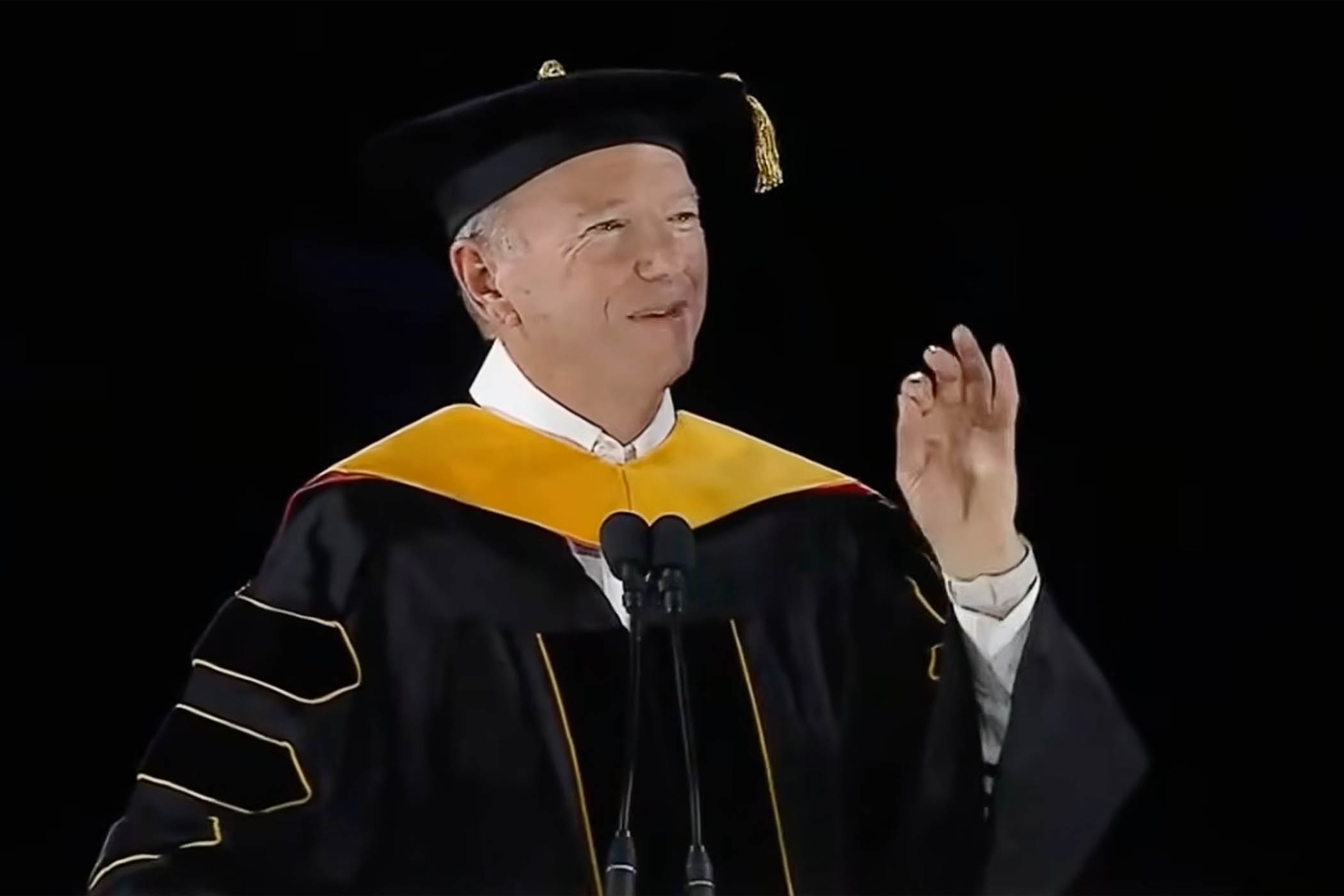


He stands at the podium, a little discomfited perhaps – but not willing to give an inch. Eric Schmidt, the former CEO of Google, was the commencement speaker at the University of Arizona this year: his boosterish remarks about the rise of artificial intelligence were not received as he had anticipated they might be.
This technology, he insisted, “will touch every relationship you have” – a prediction met with wild and raucous boos. He spoke of his own participation, back in the day, in the creation of the technological cage within which we are now imprisoned: “We thought that we were adding stones to a cathedral of knowledge that humanity had been constructing for centuries,” he said, with no little grandiloquence. “But the world we built turned out to be more complicated than we had anticipated.” ( For further thoughts on the matter Mr Schmidt might want to check out the Pope’s encyclical “On safeguarding the human person in the time of artificial intelligence”.)
Similarly, at the University of Central Florida, Gloria Caulfield, vice president of strategic alliances at Tavistock Development Company – a real estate executive, in more casual parlance – offered graduates the insight that “the rise of artificial intelligence is the next Industrial Revolution”. The chorus of opprobrium that arose clearly blindsided her. “What happened?” she asked, sounding alarmed. JD Vance had come prepared when he took to the podium on Thursday to address the lucky graduates of the US Air Force Academy in Colorado. “You can’t boo me,” he said. “I’m the vice president of the United States.” That’s those cadets told, then.
The commencement speech is a tradition that has, for the most part, remained firmly based in the United States, at least insofar as this late spring, early summer ritual marks a real cultural moment. Elite colleges – and less elite ones too, but we better not start parsing that distinction here or we’ll never stop – vie to bring showstoppers to the stage to give graduates the benefits of their wisdom. Who can forget Kermit, in froggy cap and gown, speaking last year at the University of Maryland (alma mater of his creator, Jim Henson)? Harvard snagged Tom Hanks in 2023; Dartmouth aced Roger Federer the following year.
And commencement speeches have made their mark in history. Secretary of State George C Marshall laid out his plan to rebuild Europe after the Second World War at Harvard University in 1947. President Lyndon B Johnson laid out his vision for “the Great Society” to graduates of the University of Michigan in 1964.
One reason Schmidt’s speech struck such a bum note was not wholly to do with the way he championed AI as his audience looked down the maw of a job-devouring monster. We get it, Schmidtty, you’re an expert. You’ve made a jillion dollars and you think you’ve got some wisdom to impart. But sweetheart, it’s not about you, and the best commencement speeches really understand that. To me, there is something of the best part of America in the tradition of the commencement speech: the exhortation to do better as a community, to be outright earnest about it.
In 2013, the writer George Saunders gave a speech to the graduation class at Syracuse University, where he is professor of creative writing. Saunders, whose 2017 novel Lincoln in the Bardo won the Booker prize, chose to speak about kindness – or rather, he chose to recall his own failures of kindness, and to share why they still caused him regret, however small his actions (or lack of action) might seem. It went viral, and was later published as a slender book, Congratulations, By the Way: Some Thoughts on Kindness. Its strength was to reach out to his audience, to recall his own younger self and thereby understand the challenges faced by those sitting in front of him: “Kindness, it turns out, is hard – it starts out all rainbows and puppy dogs, and expands to include… well, everything.”
Just a few days ago, the bestselling and beloved author Min Jin Lee spoke to the graduating class at Yale: she herself was a graduate of that august institution in 1990, but in her telling she really didn’t settle into her four years there. “I was not tapped by any societies or clubs. I said and wrote things which upset important people,” she said. She went to law school after she graduated, but quit the profession early on for a much more uncertain career as a novelist. Her second novel, Pachinko, became a global success and a television series; American Hagwon, her much-anticipated new book, is due in the autumn.
The gift of her speech is her empathy with her listeners: she notes that they have been called “the anxious generation” but lists – at some length – the causes of that anxiety, from the threat of mass shootings to the climate crisis and everything in between. Her advice to these young, hopeful folks? Learn to choose “the important over the urgent”. She spoke of the different ways in which the ancient Greeks understood time: chronos, the time of the clock, and kairos, the opportune time, the moment to be seized. Consider always kairos: because it tells you “what matters and when”. When she looked back at her college years, she said, what seemed painful or insignificant were in fact karoi – markers of what she could choose to become.
Our graduation days may be looming or long behind us. Either way it’s not bad to be reminded that we never stop being given choices as to how we interact with the world, and with others. Every day is commencement, if you go about it right.
Newsletters
Choose the newsletters you want to receive
View more
For information about how The Observer protects your data, read our Privacy Policy
Photograph courtesy of YouTube