

I’d flown to India for the Jaipur Literature Festival. Of course, coming for a short stay in one city of a vast continent, I knew I would only get a tiny glimpse of the place, the culture.
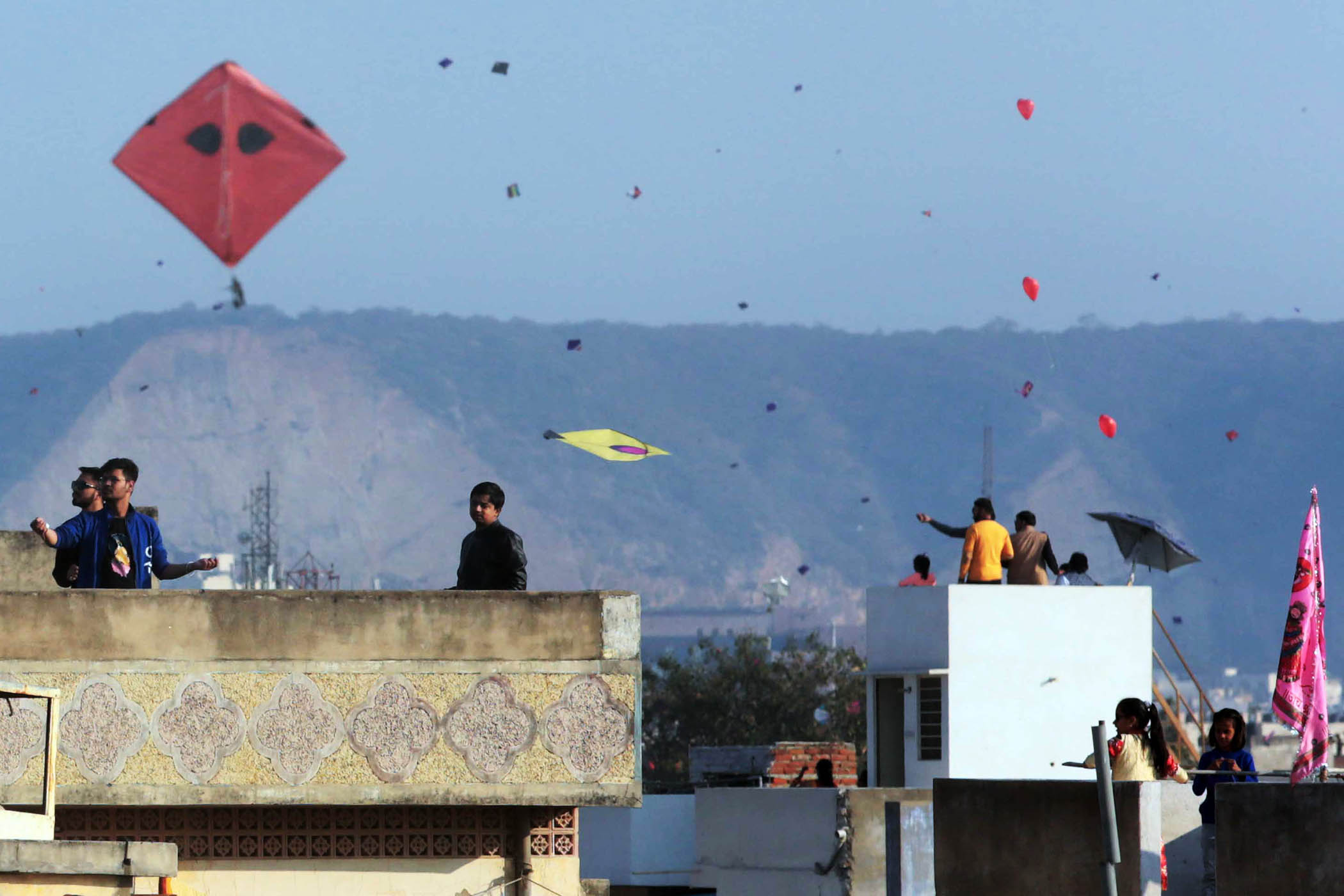
One thing that helped me to get into the swing on arrival was that, seemingly, all its able-bodied citizens had climbed up on their rooftops to welcome me by flying kites with a feverish abandon.
It was in fact Makar Sankranti, a midwinter Hindu festival, marking the harvest and new beginnings – so I was told by Parag, a waiter at my hotel who had observed my amazement. It made for a dangerous sport, he told me, because people often hurt themselves falling off houses.
Someone showed me a little trick the other day that has stayed in my mind – and also slightly blown it. In a quieter corner of the festival I was talking with a friend from London about how we were both adjusting to the five and a half hour time difference. Then, with a conjurer’s flourish, she turned her wrist, flipping her analogue watch upside down, and asked me to tell her what time it was. The watch hands, mysteriously, were no longer pointing to the Indian time of 10pm but to good old GMT, 4.30pm. Sure, this trick may be well-known, but it was new to me. By now I’ve seen it described by some as a neat illusion, but also read several quite taxing explanations of how and why it works due to the geometry of a watch face.
The author Geoff Dyer, a speaker at the festival and a Brit who knows about India – see his novel Jeff in Venice, Death in Varanasi – also seemed intrigued by this timezone hack when he saw it being performed. Maybe he was just being polite. In any case, it was disorienting not to be able to swiftly work out whether to trust in this gimmick. But then I’m in India for the first time, so there is quite a lot I am grappling with.
Being suddenly in a part of the world that I have read so much about, and watched so often portrayed on screen, from the literature of EM Forster’s British Raj, to more contemporary stories like Aravind Adiga’s 2008 novel The White Tiger, has made me wary of simply seeking to verify what I think I already know. There is a strange familiarity to the look of things that can fool you, like being misdirected by a magician.
The festival crowd is largely Indian, although there are many visitors from home, including Stephen Fry, Esther Freud, Marcus du Sautoy and Ian Hislop. But by the end of a talk by the Indian writer Kiran Desai about her recent novel, The Loneliness of Sonia and Sunny, the author had made me reconsider what I might take away from this first visit.
The British tourist might learn more by looking back the other way, Desai suggested gently to her large audience of fans; in other words, by looking at Britain from inside India. It was, she said, “a necessary journey” for anyone who really wants to understand. The watchface, she seemed to be telling me, should more often be turned upside down.
Photograph by Himanshu Vyas/Hindustan Times/Getty Images
Newsletters
Choose the newsletters you want to receive
View more
For information about how The Observer protects your data, read our Privacy Policy