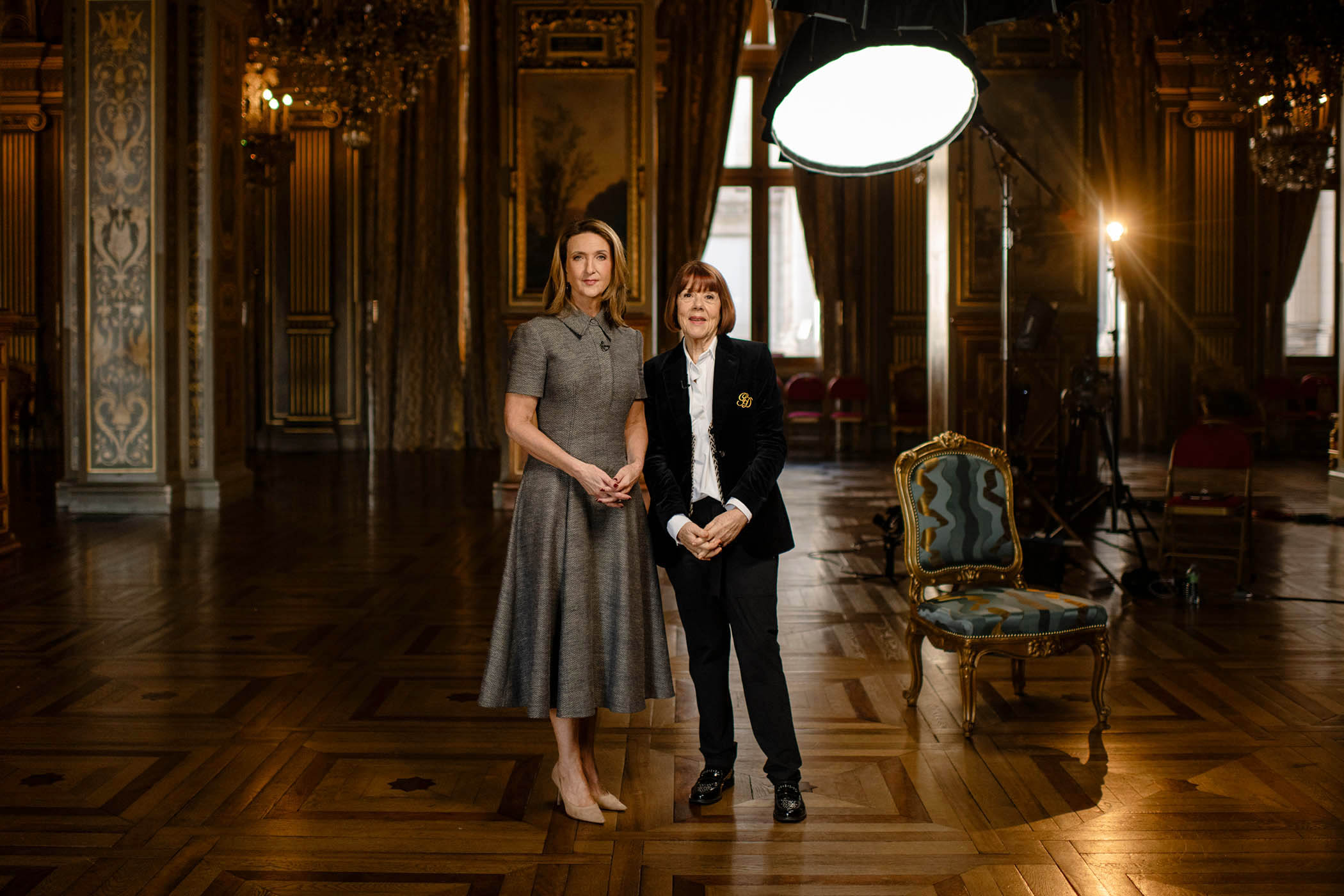

And there she was, standing in the Salon des Arcades of the Hôtel de Ville in Paris. In the gilded neo-renaissance hall with ceiling frescoes high above us, somehow this petite woman in her navy velvet jacket, white shirt and black leather loafers commanded the space. She had an aura – everyone was drawn to her. I introduced myself in French; she smiled easily and shook my hand. There was a warmth about her.
This was Gisèle Pelicot, and I was in Paris to do her first and only UK television interview.
All of us know what happened to Gisèle Pelicot, who was betrayed by her husband Dominique Pelicot in the most unimaginable way.
For almost a decade he drugged her, plunging her into a state of unconsciousness so he could rape her and bring dozens of men he met on the internet into their home to rape her too. He filmed more than 200 assaults and stored the footage on his laptop.
We know this because of the decision she made to waive her legal right to anonymity before the trial of the accused began. We followed the police investigation and witnessed her powerful plea that “shame must change sides” from victim to rapist, which resonated around the world.
I was apprehensive about meeting a woman who’d become a global icon for so many of us. I knew the vile details about the case: Dominique would poison Gisèle’s glass of wine or food with his own insomnia and anti-anxiety medication, as well as a potent muscle relaxant. I knew about the accused – 50 in total, although some remain unidentified and walking free – all convicted of rape, attempted rape or sexual assault. They were husbands, fathers, grandfathers who, after attacking this sedated woman in her own bedroom, would go about their lives. Most pleaded not guilty.
Yet I knew little about Gisèle Pelicot herself. How open would she want to be about the grotesque assaults she was subjected to? About the decimation of her family? (Her three grown-up children ripped up once-treasured family photos as they absorbed what their father had done.) About whether she believed her former husband had abused their own daughter? (Two photos were found on his laptop of Caroline asleep in bed in her underwear.) Most of all I wanted to know how this mother and grandmother had managed to survive such a brutal and devastating ordeal for nearly a decade – both physically and emotionally.
‘It was inconceivable that this man who shared my life could have committed these horrors’
‘It was inconceivable that this man who shared my life could have committed these horrors’
Gisèle Pelicot, rape survivor
This wasn’t one of those interviews where you’re able to have a “briefing conversation” on the phone first. I had little idea how talking about her experiences might affect her. Plus, and I know this sounds trivial, I was embarrassed about my lack of French. With the help of one of my sister’s best friends I learned how to say: “Madame Pelicot, it’s an honour to meet you” and “I’ve read your book four times. For me it was very distressing and also full of hope.”
I was told Ms Pelicot spoke just a little English, so the interview was going to be “live translated” for both of us by an interpreter in a separate room and communicated to each of us via our own tiny earpiece.
We met at 8.30am on a cold bright morning. Gisèle Pelicot introduced us to her new partner, Jean-Loup. He was smiley and wore spectacles, and he and I chatted in fluent Franglais about our dogs – his bulldog Zoe, my cocker spaniels Gracie and Lola.
Newsletters
Choose the newsletters you want to receive
View more
For information about how The Observer protects your data, read our Privacy Policy
And then we began. She was remarkable – speaking candidly and in a calm, composed way about how she initially reacted when she was informed by police of her husband’s crimes: “I told myself that it was inconceivable that this man who shared my life could have committed these horrors… It was a descent into hell… We were crushed by the horror.” On watching the videos Dominique Pelicot had recorded, she said: “The images in those videos are truly unbearable… I was thrown as prey to these individuals. To think that one of them was HIV positive – it was sheer luck that I didn’t contract the virus. I really am a survivor.”
And she is. Gisèle Pelicot is the strongest woman I have ever met. “Strength is in my DNA”, she said.
This is, in part, she explained, because her mother died when she was just nine – one of the cruellest blows any child could face. And in part because she has chosen to retain her faith in humanity. She will not allow herself to be consumed by anger and hatred and has decided to “walk towards the light”. It feels like many of us could learn from her example. It’s perhaps why she has been able to find love when she definitely wasn’t expecting it.
Her heart is open despite what has happened to her. I witnessed the kindness as well as the sparkle between Gisèle Pelicot and Jean-Loup. “We fell in love like teenagers,” she told me, adding: “So you see, life always holds beautiful surprises.” And she’s right – it does.
Watch Gisèle Pelicot: The Newsnight Interview on BBC iPlayer now, or today at 10pm on BBC Two
Photograph by Dmitry Kostykov/BBC