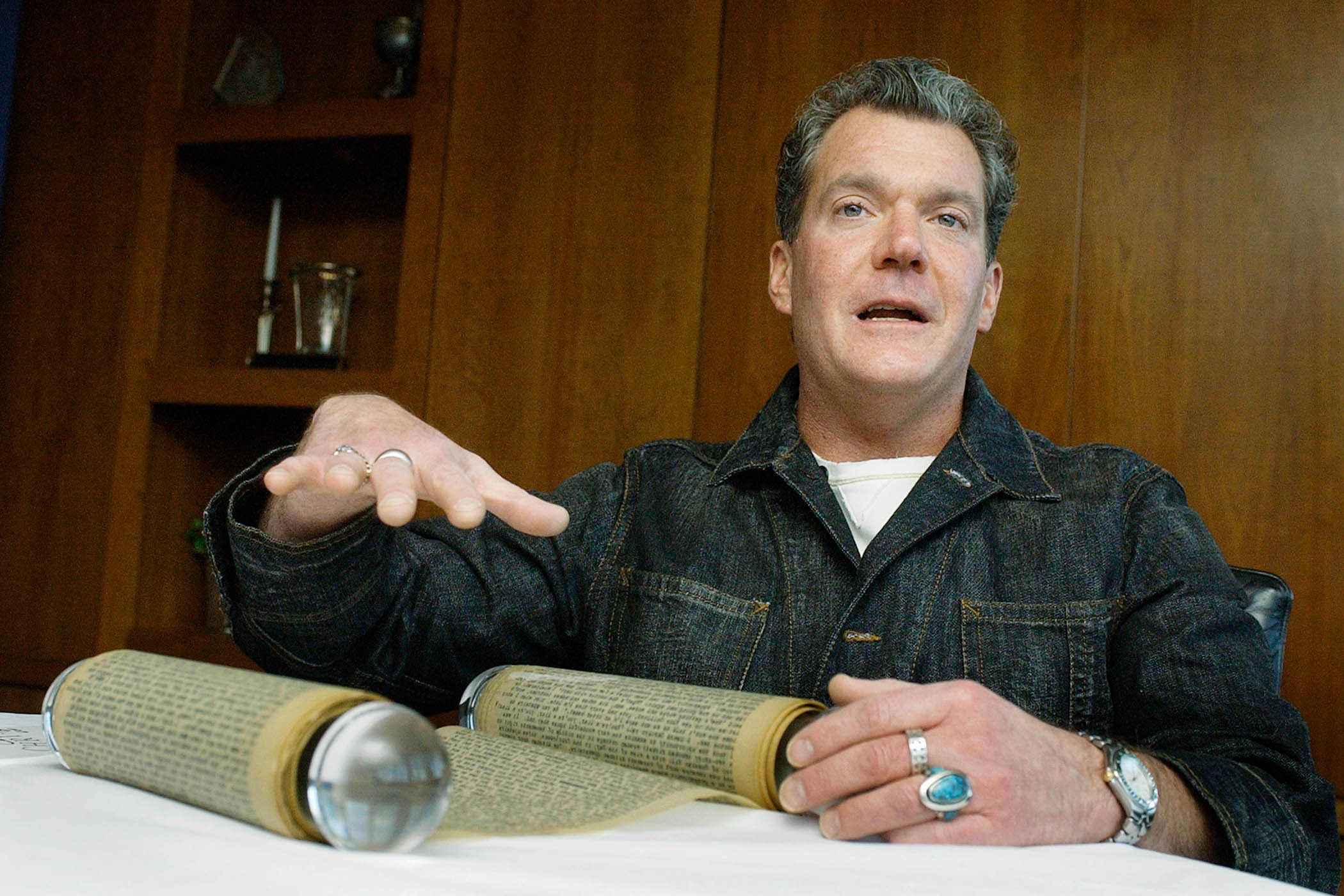

There is something about the Jim Irsay Collection, the most extraordinary group of pop culture artefacts ever accumulated, that burrows its way into the imagination. A drum head used by the Beatles in their debut appearance on the Ed Sullivan Show, the “Wilson” volleyball from Castaway, Jackie Robinson’s baseball bat, an original printing of Alcoholics Anonymous, the guitar used in the Smells Like Teen Spirit music video, a spiritual letter written by Steve Jobs, boxing gloves worn by Muhammad Ali, and, of course, the 120ft scroll on which Jack Kerouac typed the first draft of On the Road, as long as a Boeing 737. It doesn’t take a romantic to see that these things are more than things.
Jim Irsay, the man who bought these artefacts, died last June at the age of 65. Over the past few days the billionaire’s collection was sold at Christie’s New York in a series of auctions. Irsay cared greatly about the memorabilia. You can tell that not by the most valuable items, but by the least. Buying the handwritten lyrics for Hey Jude does not prove you are a true fan. But an unused ticket from a 1966 concert, worth a few hundred dollars? That does.
Now that many of the objects have gone to the highest bidders, their fate is to be apart. That is how they began their lives, imprinting themselves on the American psyche from all corners of the world. But the shared story they tell, decades later, raises questions about who they are for, where they will go next, and to whom they truly belong.
“It really started with his passion for baseball cards,” says Larry Hall, a longtime colleague of Irsay who curated his collection for seven years. “He was proud to show them off as a child. He recognised that everyone could get inspiration and joy from artefacts.”
Born in 1959, Irsay grew up through some of the most important moments in American cultural history. He would play a role in this history as the billionaire owner of the Indianapolis Colts, an NFL team which won the 2006 Super Bowl. The halftime show was one for the ages: Prince and a guitar in the pouring rain.
But Irsay’s lasting contribution was as a steward of the 20th century. In 2001, he spent $2.4m on the On the Road scroll, which Kerouac made by stitching together strips of tracing paper. It was the only time that Irsay bid for an object in person, but he would go on to spend more than $100m putting together a collection of memorabilia to rival any museum in the world.
When it comes to instruments alone, his collection included Miles Davis’s trumpet, John Coltrane’s saxophone, John Lennon’s piano, and David Gilmour’s modified guitar from Dark Side of the Moon. Any abridged list omits a different wonder: the championship belt Muhammad Ali won for The Rumble in the Jungle, Sylvester Stallone’s script for Rocky, the handwritten lyrics for The Times They Are a-Changin’. When it comes to the Beatles, Nathalie Ferneau from Christie’s New York told The Observer that “you would probably have to go to a member of the band” to find a comparable collection.
The task of acquiring the items was as freewheeling as Irsay, a larger-than-life figure who publicly battled addiction. Hall remembers the surreal mission to get hold of the saddle that sat atop Secretariat, one of the greatest race horses of all time. “I got to meet Ron Turcotte, the jockey that rode him. Five years after winning the Triple Crown he became a paraplegic. I drove up to the northernmost part of Maine, right at the Canadian border.” Turcotte arrived with the saddle in a big red pickup truck. “He used his thumbs for acceleration and for braking.”
It would be easy to look at Irsay’s 25-year mission as an exercise in kleptomania. When the On the Road scroll last went on sale in 2001, the ex-wife of Neal Cassady, who inspired one of the book’s characters, dismissed the auction as “blasphemy”. She said: “If they auction it, anybody rich could buy it and keep it out of sight.”
Somebody rich did buy the scroll, but, like the rest of the collection, it was not kept out of sight. Irsay lent his objects out to museums, and then from 2021 took them on tour as part of a free travelling roadshow across the US. “He always saw himself as a steward of these artefacts,” says Hall. “People would come to tears.”
Newsletters
Choose the newsletters you want to receive
View more
For information about how The Observer protects your data, read our Privacy Policy
Now, less than a year after Irsay’s death, the objects have embarked on their next journeys. The auctions in downtown New York attracted an audience of big-ticket bidders, Christie’s employees working on behalf of their clients and pop culture enthusiasts.
“One of the things we talk about is being a conductor,” Tash Perrin, deputy chairman at Christie’s and auctioneer for the collection, told The Observer. “There is an opportunity to pass an object on to the next custodian who might have it for the next 30 years.” A far cry from the fast-talking stereotype, Perrin has the calm demeanour of a gameshow host checking a final answer. But there is no getting around the amount of money changing hands. Before the auction, the entire collection was expected to go for $30m. It made $93m and broke 23 records. The highest sale was of Gilmour’s guitar, which went for more than $14m and became the most expensive guitar in the world.
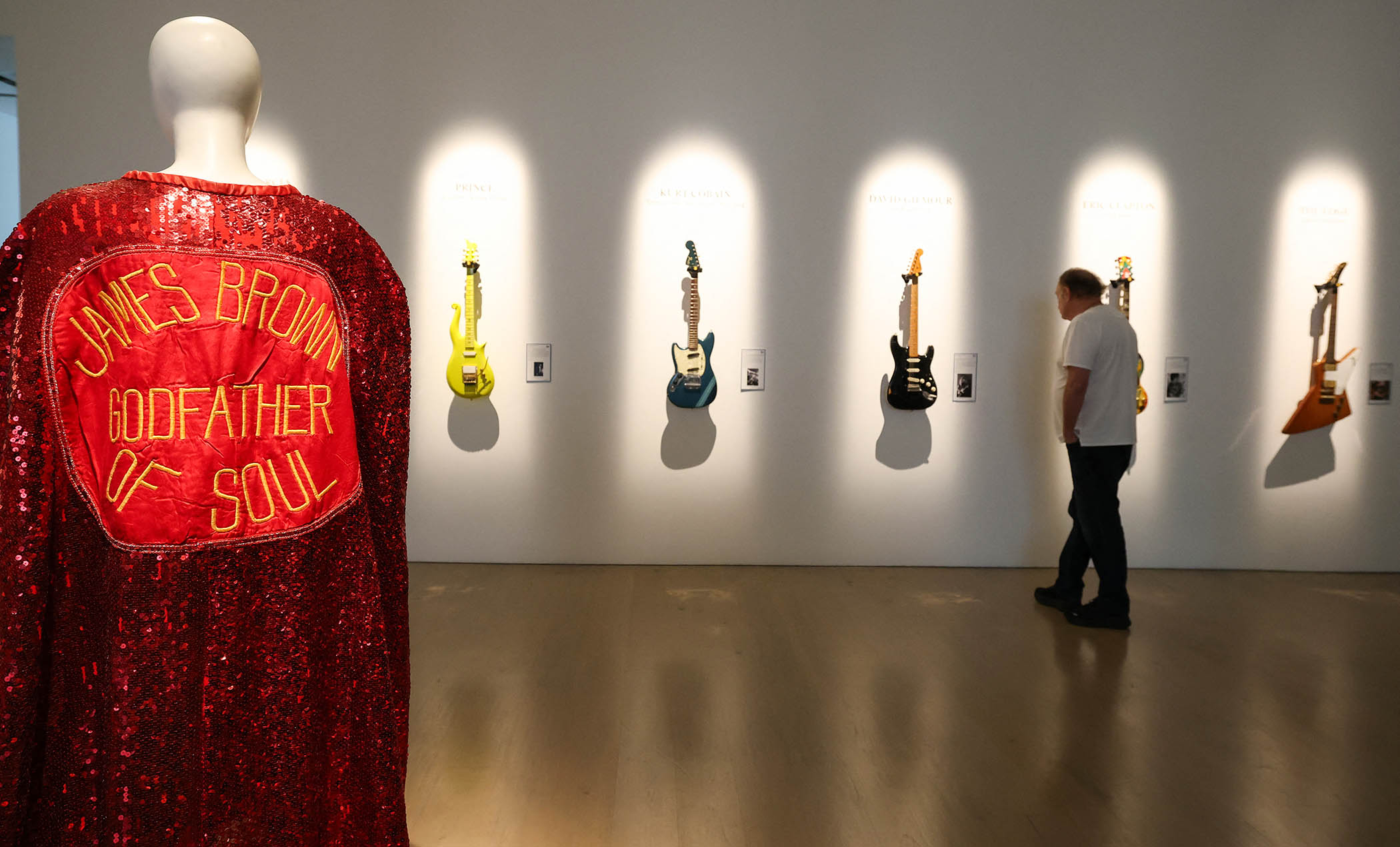
James Brown’s stage-worn sequined cape is displayed as a visitors look at (L-R) Prince’s Andy Beech custom Yellow Cloud guitar, Kurt Cobain’s 1966 Fender Mustang, David Gilmour’s "Black Strat", Eric Clapton’s "The Fool" Gibson SG and The Edge’s Gibson Explorer during a press preview of the Jim Irsay Collection at Christie’s
Watching the auction, even from a live stream, was a strange experience. It’s not just that what was being sold were tools of creation rather than the creation itself, closer to Picasso’s paintbrushes than a Picasso. No, as object after object went to unknown figures outside the room, you couldn’t help but feel that some pieces of history were surely fading from view. Perhaps the buyers will be museums or characters like Irsay, but this may be wishful thinking on the whole. Billionaires have priced many institutions out of the art market. The $450m paid for Salvator Mundi in 2017 by a Saudi Arabian prince is four times the annual income of the British Museum. Private sales make up a quarter of the revenue of Christie’s and have nearly doubled in value since 2019. Its top three sales last year were all private.
The net result is that many of the world’s most important cultural objects, whose value is determined in part by the taste and passion of ordinary people, are out of sight, only lent to institutions on a temporary basis and at the discretion of the owner. It seems reasonable to fear that plenty of the items in the Jim Irsay Collection will go the same way, bought by people with less interest than their former owner in sharing them with the world.
But Ferneau, who was in charge of the Christie’s auctions, thinks that Irsay would be sanguine about seeing his objects go their separate ways. “He had this great quote: ‘You never see a U-haul following a hearse.’”
Hall agrees. “Splitting up seems a little challenging, but knowing that they’re going to go out to new people is also joyful,” he says. “From hearing Jim speak about it, that’s what he would have wanted, to make sure that people get to share that joy.”
And there is already some cause for optimism. On Thursday night, Bobby Tseitlin spent more than $11m on Tiger, a custom-built guitar once owned by Jerry Garcia of The Grateful Dead. Tseitlin’s entity, Family Guitars, describes itself as a living collection of instruments that continue to be “heard and experienced the way they were meant to be”. A day later, the guitar was played on stage by the singer Derek Trucks at the Beacon Theatre in New York City.
As for the reportedly Benzedrine-fuelled Kerouac scroll, that was bought for $12m by the country star Zach Bryan. It is expected that it will be put on display at the museum that Bryan is building to remember the author in Lowell, Massachusetts. For the optimists, Irsay’s legacy continues and the auction of his beloved objects will be no ending. It is another stop on the road.
Photograph by Darron Cummings/AP, Valérie Macon/AFP/Getty Images