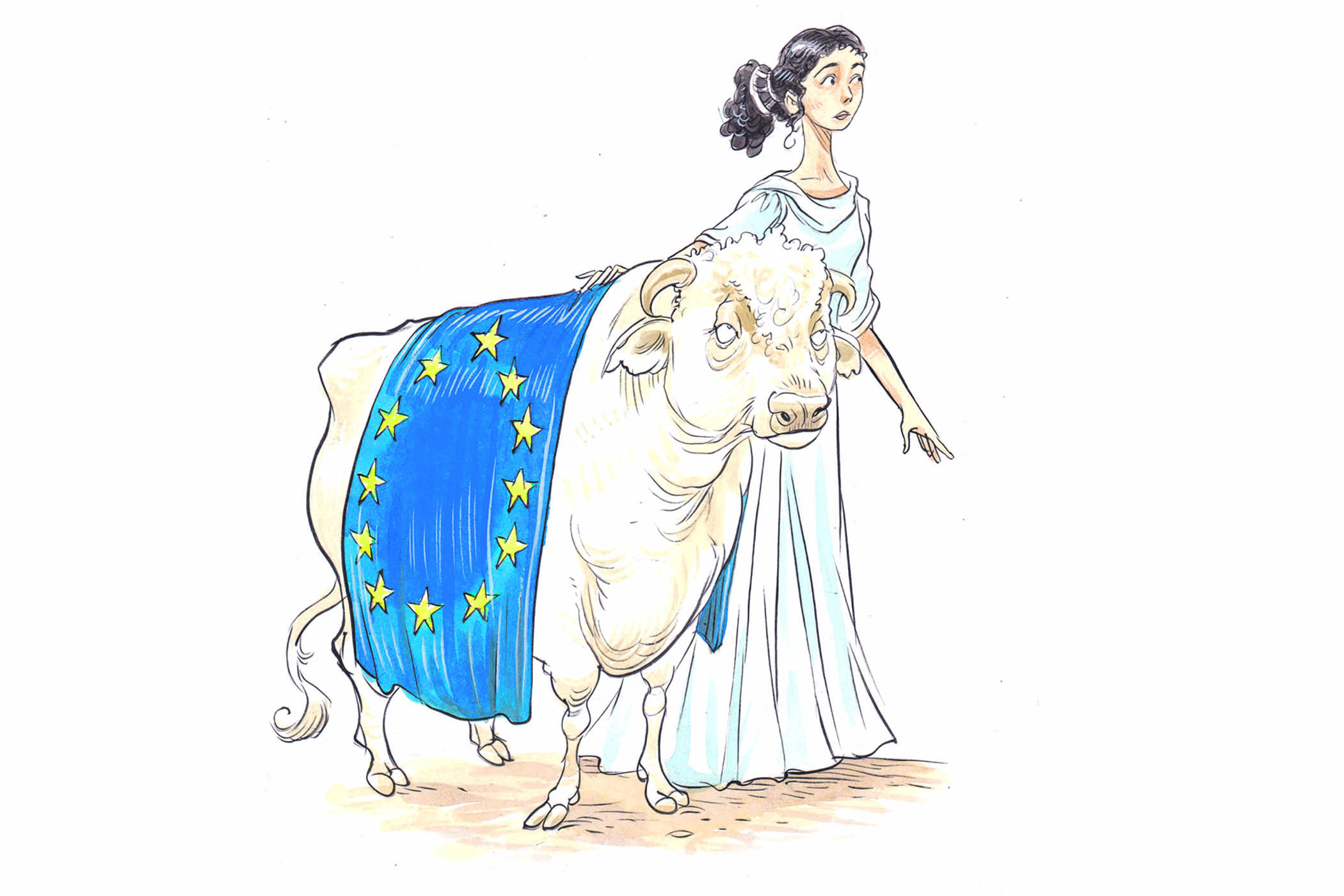
Illustration by Chris Riddell
‘Europe will be forged in crises, and will be the sum of the solutions adopted for those crises.” So said Jean Monnet, one of the architects of the great late-20th-century European project. That quote has been regularly used by his successors, often politicians of lesser stature. Now, with a hostile Vladimir Putin to the east and with an out-of-control Donald Trump to the west, rampaging across the western hemisphere and with his eyes on Greenland, the old continent struggles to respond. Call it the EU, call it Nato, call it just by its name, Europe was supposed to be greater than the sum of its parts: strength in unity.
Yet it has rarely shown unity or strength, and it is now paying the price. Its modus operandi is reactive, its decision-making cumbersome. After Trump launched his overnight snatch-and-grab last weekend on Venezuela, the EU’s foreign affairs chief, Kaja Kallas, scurried around trying to get the 27 member states to agree to a statement of concern before a White House press conference. She couldn’t get that done in time. Herding limping cats isn’t easy.
Trump made clear even during his first term his desire to seize Greenland, and yet until recently the European response was to will the problem away by ignoring it. Concerns about a Maga stitch-up of Ukraine and embrace of the Kremlin have dominated European thinking, which leads to avoiding anything that may antagonise Trump.
The performative obsequiousness has taken a variety of forms: the hand on the knee (Emmanuel Macron), the fawning royal letter (Keir Starmer) and the use of the term “daddy” to address his US host (Nato’s general secretary, Mark Rutte). It might have staved off a Trump rant in front of the White House cameras, but it does not earn respect.
In Friedrich Merz, Germany has its first chancellor since the cold war who understands the extent of Europe’s fragility – and culpability. With an increasing number of countries such as Hungary forming a pro-Putin, pro-Trump vanguard, it is hard to see how the EU can cohere in future crises. That will require the main states – Germany, France and, yes, Poland – to take the lead, assuming their governments don’t succumb to the far-right march.
As for Britain, never has the folly of Brexit been more evident than now, and never has the need been greater for it to return to the heart of Europe. Will any of that happen?
Geography concentrates the mind. The Germans and Poles are the only big players committing seriously to defence. It doesn’t help that relations between these two neighbours are poor – that Poland complains of being kept away from the top table. Polish politics is divided between a far-right populist president and, in its prime minister, Donald Tusk, a European of the old moderate mould. Meanwhile, Merz must work hard to keep his Social Democrat coalition partners on side. At least both countries – alongside the Nordics and the Baltic three – are trying. If it sticks to its planned trajectory, thanks to €1tn in borrowing, Germany will meet the new Nato target of 3.5% of GDP on defence, plus another 1.5% on critical infrastructure by 2029. By then, its defence budget will be double the size of Britain’s and greater than that of the UK and France combined. Macron and Starmer talk a good talk. Addressing the diplomatic corps at the Élysée Palace on Thursday, the French president said the US was “breaking free from the international rules that it was until recently promoting”. He has among the warmest relations of anyone to Volodymyr Zelensky, yet France’s record on military supplies to Ukraine has not been as generous as it likes to project. For all the British prime minister’s fighting talk about “the coalition of the willing”, the UK is due to meet its Nato targets by 2035, at best. The talk in Berlin is of a midway point between peace and war, with Russian hybrid attacks and provocations taking place daily. Until such time as Europe can look after itself, it remains tied to the leader of a superpower whose behaviour hovers between an unreliable partner and an enemy. The recently published US national security strategy makes clear the administration’s goal to further the interests of “strongmen”, undermine the liberal order and work to usher in far-right governments wherever it can.
The EU and Nato were essential components of the postwar architecture, constructed as bulwarks against dictatorship, to project political, economic and military strength. Now the institutions and many of their member states are led by supplicants who struggle to agree among themselves and carry little authority on a global stage defined by the raw projection of power.
No political system is guaranteed for ever, and the best way to condemn liberal democracy to oblivion is to try to stumble through. As individual nations and as a collective, Europe needs to find a new form of muscular courage, reflecting the harder-edged realities of now. The old world is not coming back. As Monnet pointed out, times of turbulence require radical thinking; they provide the most fertile ground for it too.
Newsletters
Choose the newsletters you want to receive
View more
For information about how The Observer protects your data, read our Privacy Policy
John Kampfner’s latest book, Braver New World: The Countries Daring to Do Things Others Won’t, will be published by Atlantic in April