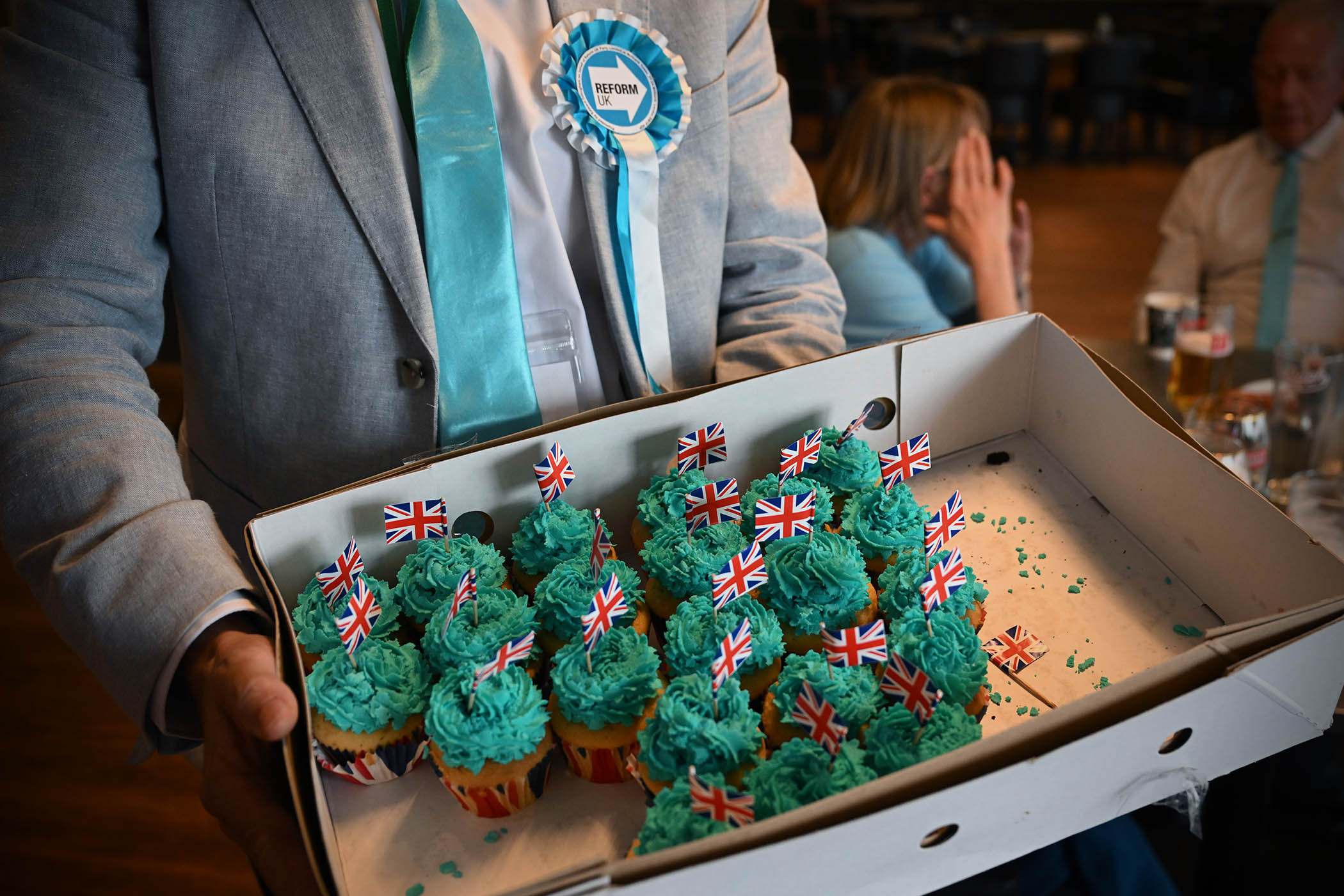
The great winners of the local elections in England last week were Reform and the Greens. Both are described as populist parties existing at the opposite poles of the political spectrum. Both are said to embody the new politics in some way. But how they go about it is very different, and different in an interesting way.
On election day, Londoners and people in Wales (and possibly elsewhere) found their local free newspapers had shelved their usual front pages for full-page ads featuring a tanned Nigel Farage and the legend “Vote Reform. Get Starmer Out”. This would have been an expensive exercise, but then Reform is an increasingly expensive party, bankrolled by a Thai-based crypto billionaire, Christopher Harborne, who has become the biggest single donor in British political history. In 2025 he gave £12m to Reform.
The money shows: Reform’s leader is flown to newsworthy destinations at Harborne’s expense, Reform events are lavish affairs and there is no sense of an insurgent party having to reach deep into largely empty pockets or relying on the goodwill of volunteers.
Not that this worries anyone other than Reform’s opponents. In 2024, when Farage seemed poised to give up frontline politics to pursue a more lucrative media business career, Harborne gave him £5m as a personal (and undeclared) gift. Farage subsequently re-entered the fray. This revelation – now being investigated by the Electoral Commission – seems not to have slowed Reform’s advance. As Reform’s chair, David Bull, told BBC News, “It hasn’t come up on the doorstep. It is a Westminster bubble story.”
Voters can be very forgiving of dubiously acquired wealth and its equally dubious application to politics, especially if the beneficiary has charisma. Long before Donald Trump, the Italian media mogul Silvio Berlusconi – arguably the first successful postwar populist – leveraged wealth and his TV channels to help his political career. More recently in Hungary, Viktor Orbán would get his millionaire friends to buy up all the poster sites in Budapest and other cities so that his was the only political message visible on the streets.
Farage also benefits from having, in effect, an expensive news channel – GB News – as a partisan booster for his party. By contrast, the Greens and their leader, Zack Polanski, have opted for the far less costly form of populism that modern technology now permits. Polanski himself is not so much a politician as an influencer – the sort of person who started on TikTok and then made it from YouTube to I’m a Celebrity in quick, smiling steps.
In fact, his charm is so contemporary that I am too old to understand it. My generation better comprehends the quiet rise of the Liberal Democrats, whose leader, Ed Davey, organises It’s a Knockout-type stunts to remind you that he’s (a) alive and (b) affable.
My generation better understands the quiet rise of the Lib Dems, whose leader, Ed Davey, organises It’s a Knockout stunts to remind you he’s (a) alive and (b) affable
My generation better understands the quiet rise of the Lib Dems, whose leader, Ed Davey, organises It’s a Knockout stunts to remind you he’s (a) alive and (b) affable
Polanski’s bling-free appeal applies to some of the Greens’ other emerging figures. The winner of the recent Gorton and Denton byelection, Hannah Spencer, was the kind of low-key, voter-friendly candidate who – as a colleague described her – is alone worth one of Harborne’s millions.
None of this tells you whether Farage or Polanski are fit to govern. Farage’s Starmer slogan had nothing to do with local government competencies, and Green voters will be disappointed to discover that Hackney council has limited influence on Middle Eastern politics.
A couple of weeks before the election – largely unnoticed in this era when political correspondents appear to be the only ones that media outlets still employ – health policy thinktank the King’s Fund released an annual report on the cost of adult and child social care, a budget item that absorbs between 70 and 85% of English local authority budgets. The report revealed that, in 2024/25, an additional 30,000 people received long-term care, meaning a real term increase of over 4% in local authority spending on social care. The result, said King’s, was that authorities were increasingly raiding their reserves to meet the recurring cost.
Newsletters
Choose the newsletters you want to receive
View more
For information about how The Observer protects your data, read our Privacy Policy
The UK has suffered five great shocks since Tony Blair left office 19 years ago: the 2008 crash, Brexit, the pandemic, the Ukraine war and Trump 2.0. Only one of these could we have avoided, but 10 years ago next month, we voted to embrace it.
Now we want someone to put a grin on a slow, grinding pull out of the slough of despond. Or at least to level out our shallow arc of decline, while finding more money for an ageing population and for a defence budget that meets the Trump-Putin-Xi era.
Is this difficult? Not according to the not atypical Reform supporter, the chief US correspondent for GB News, Ben Leo, who posted on Friday: “‘There are no easy answers to the problems we face?’ YES there are. STOP the boats. DEPORT those who are here. CUT regulation. SLASH taxes.” Mr Leo missed out compulsory flag flying in schools.
His Green equivalent is likely to offer a prospectus which involves borrowing far more than the bond markets will allow you, taxing the rich far more in a variety of ingenious (and to most economists implausible) ways, and boycotting Israel.
A reader may conclude that populism, however sold (and however bought), however charming and however slick, rarely addresses the questions that really need answering. But will also understand why we are so desperate to avoid discussing them.
Photograph by Anthony Devlin/Getty Images