

For many black and Asian Britons of my generation, the Henry Nowak bodycam footage would have appeared tragically familiar. In the 1970s and 1980s not only was racism viscerally woven into the fabric of British society but the police were complicit in enforcing it. Few victims of racist attacks would have turned to the police for support because they knew they were more likely to be arrested than the racists.
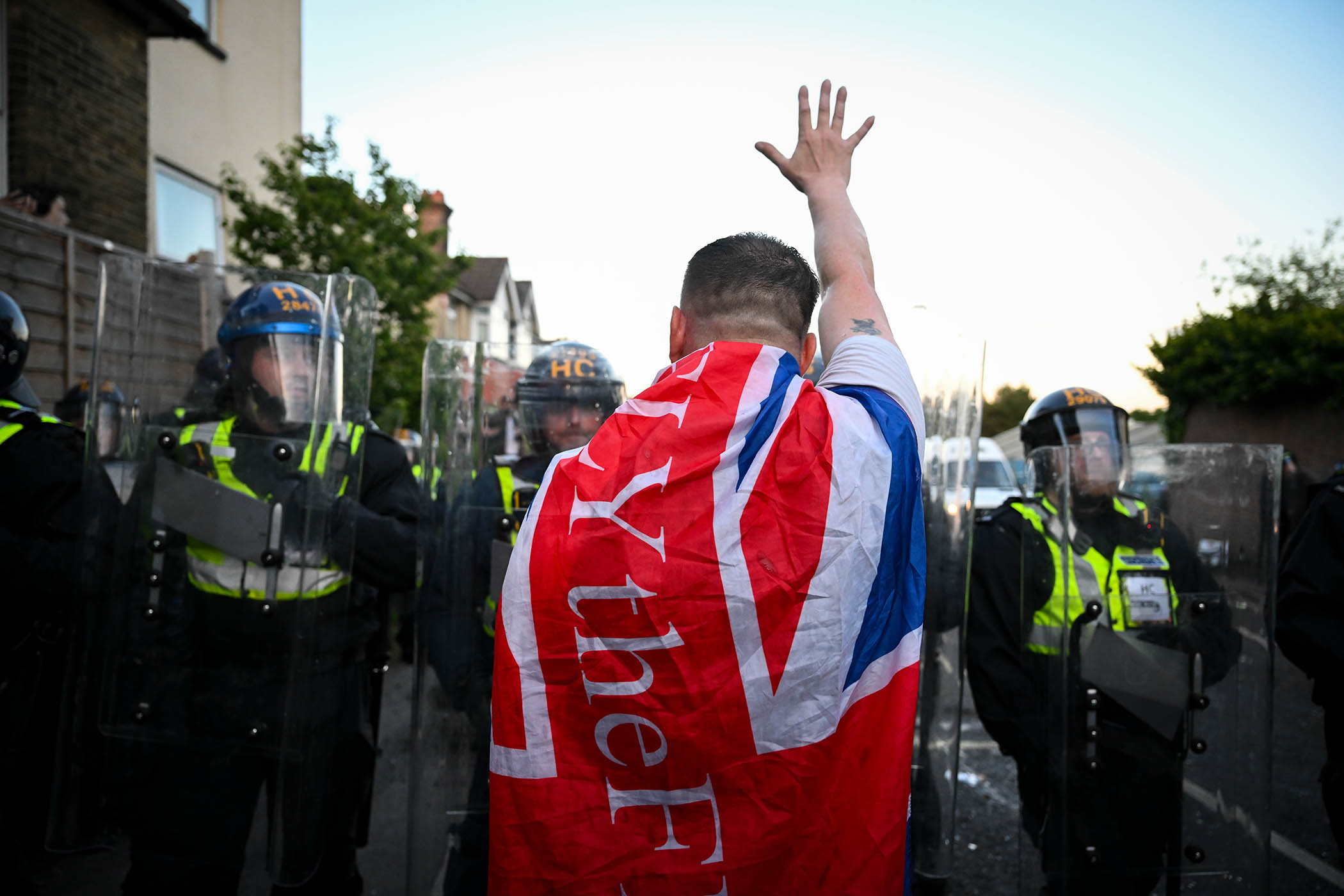
Two-tier policing existed long before rightwing commentators discovered it. Certain groups have always been singled out as particular threats to social order and subject to differential treatment. When the targets of excessive policing were almost exclusively black people, or Irish republicans or working-class militants, many on the right celebrated it as the necessary enforcement of law and order.
What has changed in recent years is that the boundaries have shifted. The authorities have become more sensitive to issues of race and identity, while the policing of sections of the working class deemed to be racist has become more assertive.
When police officers arrived at the scene of Nowak’s murder, they took killer Vickrum Digwa’s claims of having been racially attacked as the truth, rather than as an allegation to be investigated, and refused initially to heed Nowak’s distress. For many on the right, the breakdown in the basics of policing was the consequence of wokeness and of DEI (diversity, equity and inclusion) policies, and in particular the malign influence the Black Lives Matter movement gained after the murder of George Floyd in America in 2020. The assumption that an Asian man must be the victim and a white man the racist assailant was, according to one commentator, the product of an institution “reformed” to be “openly racist against white people”.
This makes little sense either factually or historically. Black people remain proportionately more likely to face police violence, to be tasered and to die following police restraint; Black children are more likely to be strip-searched.
The decay of antiracism into bureaucratic forms has degraded the struggle for equality. It has also instilled a nervousness in talking about race
The decay of antiracism into bureaucratic forms has degraded the struggle for equality. It has also instilled a nervousness in talking about race
At the same time DEI is not the start but the end point of a complex set of changes that began much earlier. In the 1980s, in response to the inner-city riots and widespread anger at racist policing, the authorities drew antiracist activists into the state system, providing funding and resources. Through this process, the goal of equality became redefined as a drive for diversity, while “racism awareness training” became entrenched, a development that, as long ago as 1985, the radical antiracist Ambalavaner Sivanandan described as “catharsis for guilt-stricken whites” and a “degradation” of the antiracist struggle.
As independent antiracist movements decayed, “antiracism” became identified with bureaucratised forms of diversity training, including within the police. It also became more Americanised. The “Police Anti-Racism Commitment”, a document that stirred much debate last week, is a good example. A flimsy piece of work, it seems to have been written mainly to showcase performative phrases like “it is not enough for us to not be racist” that echo American writers such as Ibram X Kendi.
The document also draws on British multicultural ideas. “Our commitment to racial equity,” it insists, “does not mean treating everyone ‘the same’.” It’s a phrase that reflects how, in the shift from equality to diversity, the very meaning of equality became transformed from signifying the right to be treated the same to denoting the right to be treated differently. Equality, as the influential Parekh Report on The Future of Multi-Ethnic Britain, published in 2000, put it, “must be defined in a culturally sensitive way”.
This is the backstory to contemporary debates about DEI. The bureaucratisation of antiracism helped degrade the meaning of equality and reinforced identitarian politics, on both left and right. It has also allowed racism to become rebranded in the language of white identity.
When rightwing politicians claim that “white people are now demonstrably the biggest victims of racism in Britain” or that, in the words of Nigel Farage, “the rights and privileges of white people matter less than those of ethnic minorities”, they are appealing not to the facts but to the emotional import of identitarian politics. Politicians who have been vocal in criticising “victim culture” are now at the forefront of promoting white victimhood.
Newsletters
Choose the newsletters you want to receive
View more
For information about how The Observer protects your data, read our Privacy Policy
It’s an approach that bleeds into straightforward racism, as in calls to “deport all Sikhs”, or American vice-president JD Vance’s surreal tweet claiming that Nowak was a victim of “the mass invasion of migrants” and that he “died the same way a civilization dies”. Those exploiting the tragedy to demonise immigration seem to forget that Nowak himself was of migrant descent and held dual British-Polish nationality. A decade ago, in the context of Brexit, there was often racist hostility towards Poles. Today, their whiteness has made them an acceptable foil to Black and Asian migrants.
The decay of antiracism into bureaucratic forms has warped the struggle for equality. It has also instilled a nervousness in talking about race that can, as one report put it, make people “reluctant to act” for fear of being called racist. We can see this in the grooming gangs scandal, and in the cases of the Southport killer Axel Rudakubana and Valdo Calocane, who murdered three people in Nottingham. It’s an issue that needs urgently addressing. That is very different, though, from claiming that white people are now the real victims or embracing the politics of white identity.
In his 1968 “Rivers of Blood” speech, Enoch Powell recounted a constituent’s prophesy that soon “the Black man will have the whip hand over the white man”. The contemporary version is: “They have more rights than us.”
It is a perspective as pernicious now as it was then. It is vital to confront it.
Photograph by Finnbarr Webster/Getty Images