

“This tablet commemorates the courage and endurance of the jury… which established the right of juries to give their verdict according to their convictions.” The quote comes from a plaque in the Old Bailey recalling perhaps the most famous case in British legal history of a jury defying the judge.
In 1670, the radical Quakers William Penn and William Mead were tried for preaching to a “tumultuous assembly”. The jury rejected the judge’s demand that they be convicted. A furious judge imprisoned the jurors “without meat, drink, fire, and tobacco… till we have a verdict that the court will accept”. Still the jurors refused to convict.
The judge fined them for their disobedience. When one juror, Edward Bushell, refused to pay, he was kept in jail until finally released by Chief Justice Vaughan, who ruled that jurors could not be punished for an unwelcome verdict. Bushell’s case, as it came to be known, was a foundational step in the long history of ensuring the independence of juries and their liberty to pass a verdict according to their conscience, whatever the law or the authorities may demand.
That liberty is important not only for justice but for democracy, too, providing, as the judge and legal philosopher Patrick Devlin argued in his 1956 Hamlyn lectures, “insurance” that laws “will conform to the ordinary man’s idea of what is fair and just”. Jury equity – the right of jurors to speak from their conscience – is an important bulwark against what Devlin called “harsh and oppressive” laws.
Perhaps its most famous application in recent decades came in the trial of Clive Ponting. In 1984, Ponting, a civil servant, leaked details to the MP Tam Dalyell of how parliament had been misled over the sinking of the Argentinian ship, the General Belgrano, during the Falklands war two years earlier. Prosecuted under the Official Secrets Act, Ponting argued he was acting in the “public interest”. The judge ruled that “the public interest is what the government of the day says it is” and indicated a guilty verdict. The jury disagreed and acquitted him, much to the consternation of both the judge and the government.
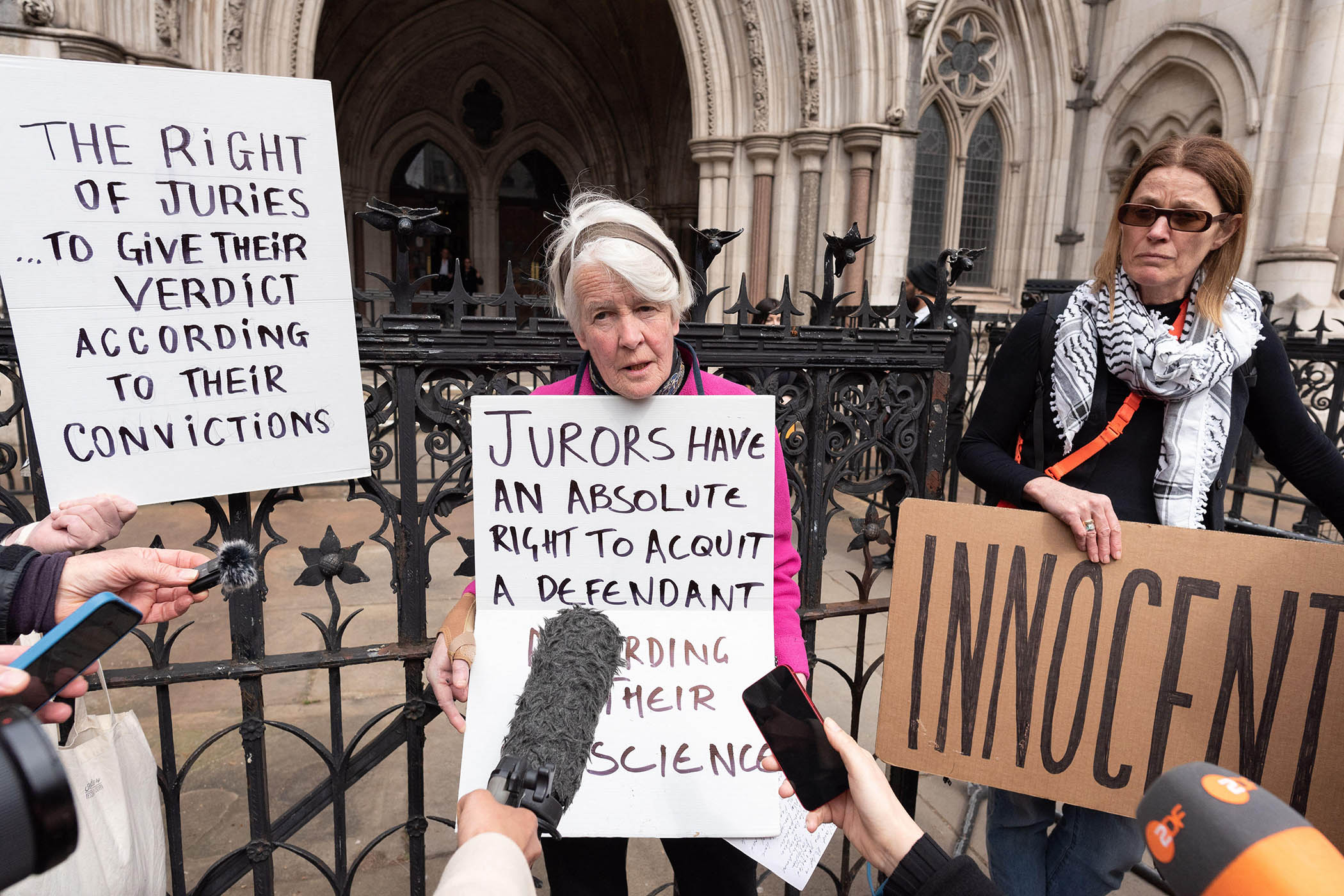
Three years ago, Trudi Warner stood outside a trial of climate protesters with a placard that read “Jurors: You have an absolute right to acquit a defendant according to your conscience”. She was charged by the attorney general with contempt of court. The high court eventually threw out the case, observing that “Warner accurately informed potential prospective jurors about one of their legal powers”.
Yet juries are often denied being informed of that power. Rajiv Menon is the barrister defending Charlotte Head, one of six Palestine Action activists tried for damaging equipment and weapons at an arms factory near Bristol belonging to the Israeli-based defence firm Elbit Systems. At their first trial, in February, the activists were acquitted of aggravated burglary and of violent disorder. A second trial this month found four of the six guilty of the lesser charge of criminal damage, and one of inflicting grievous bodily harm.
The judge, Mr Justice Johnson, warned defence barristers not to tell jurors that they could follow their conscience. Menon allegedly did so, mentioning the Bushell case. The judge referred him to the high court for contempt. Last week, the appeals court stopped the case as procedurally flawed but left open the possibility of the attorney general pursuing it.
For a lawyer to be threatened with a sanction for attempting to apprise a jury of its legal rights is, fellow barristers have observed, “unprecedented”. In recent years, in a number of trials involving climate protesters and other activists, juries have ignored judges’ directions and acquitted according to conscience. The Menon contempt case may signal an attempt by some within the judiciary to push back.
Meanwhile, reporting restrictions on the two Palestine Action trials were lifted last week, allowing journalists to reveal that the defendants may be sentenced as having committed “terrorism”. In a pre-trial ruling, Johnson suggested that their offences could have a “terrorist connection” because the defendants were trying to “influence the Israeli government”, a somewhat fanciful claim. He also ruled that this could not be reported, nor the jury informed.
Newsletters
Choose the newsletters you want to receive
View more
For information about how The Observer protects your data, read our Privacy Policy
Being sentenced as terrorists could mean the defendants facing a longer sentence and being denied early release unlike most prisoners. Upon release, they would have bank accounts, emails, home addresses, even relationships, monitored for life as if they were jihadis. Given that juries found the defendants not guilty of aggravated burglary, convicting them only of the lesser charge of criminal damage, for the judge to now give himself leeway to impose a tougher sentence is alarming.
All this takes place against the background of the government’s attempt to scale back jury trials. In the last parliamentary session, the courts and tribunals bill sought to restrict the right of many defendants to a jury trial, create a judge-only division of the crown court to try cases that today would be heard by a jury, and extend magistrates’ sentencing powers. In the king’s speech, these proposals were rolled into a new courts modernisation bill.
These proposals will, as the Institute of Government has observed, barely dent the huge backlog of cases in crown courts that is so worrying, but will reinforce the power of magistrates and judges, enfeeble the role of juries and reduce the quality of justice. As the Palestine Action and Menon contempt cases reveal, there are already attempts to sideline juries. It’s the public, not the judiciary, who should be pushing back.
Photograph by Ron Fassbender/Alamy