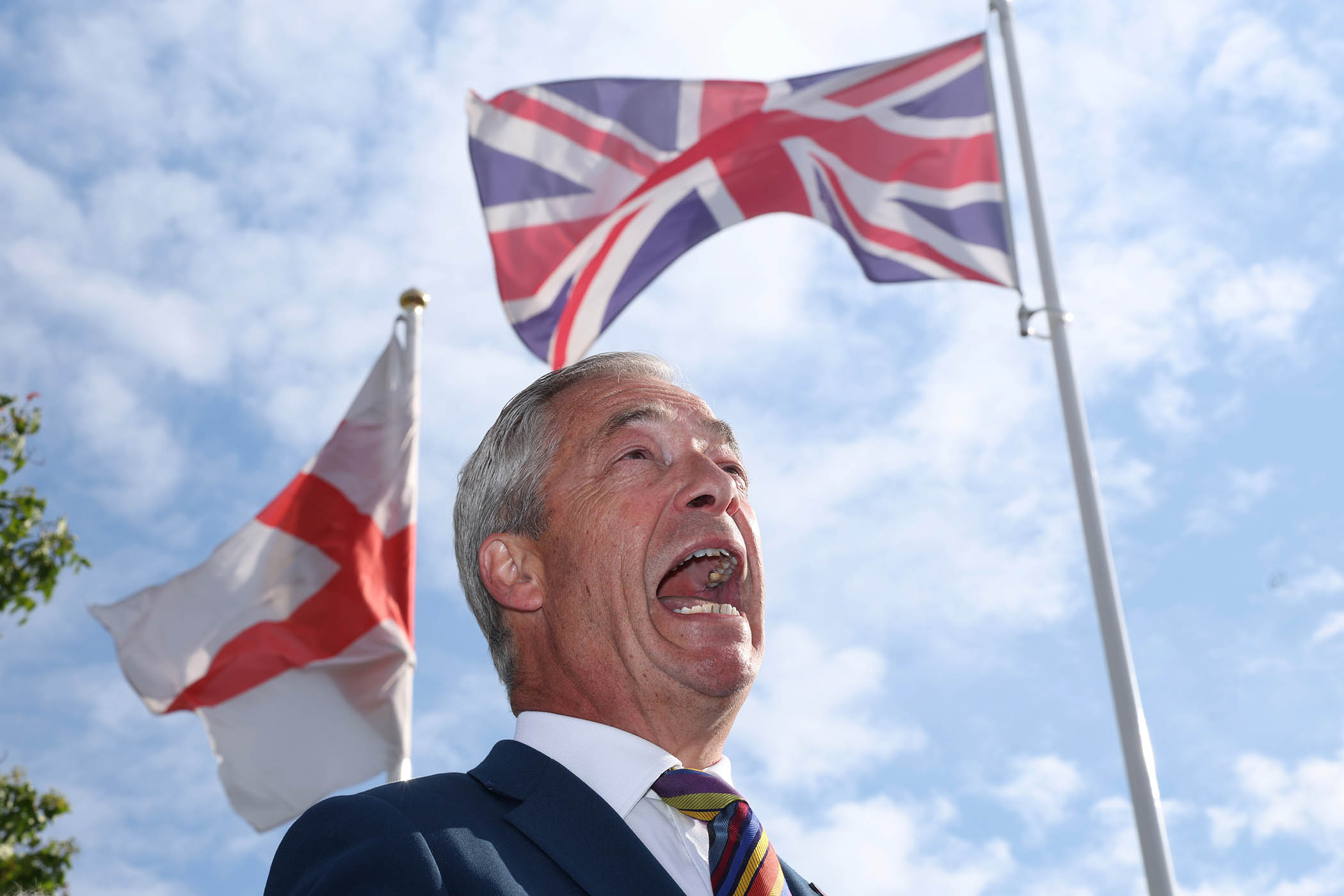

Even before the final results had been declared, Nigel Farage was hailing his party’s performance in the local elections as representing a “historic change in British politics”.
Reform UK’s surge across the country has come at the cost of both Labour and the Conservatives, with the party picking up council seats in Wigan, Bolton, Salford and Halton – once dominated by Labour – as well as Tory heartlands such as Newcastle-under-Lyme, Suffolk and Essex.
As Farage pointed out, the Conservative party leader, Kemi Badenoch, would “lose her own seat [...] based on these Essex county council results”. Reform has even won control of Havering, its first victory in a London borough. While the Greens have performed well enough to exacerbate the damage inflicted on Labour, it is Reform that appears to be best placed to benefit from the UK’s first-past-the-post system come a general election.
Over the last few weeks, Reform has been ramping up what one party figure called “the razzmatazz”. Members of the team have been crisscrossing each other around the country, as they look to speak directly to the grassroots supporters and would-be voters, with expenses ranging from petrol money and a stay in a basic B&B for the party’s lower orders, to something grander for the upper echelons.
But as Reform transforms from an upstart one-man band to one of the biggest political forces in the country – more than 60 people are now working out of its headquarters – paranoia is creeping in.
A few weeks out from the local campaign, panic set in at Millbank Tower: a fox had entered the henhouse, the team having realised it had been infiltrated by an undercover journalist. As fear spread through head office about what, if anything, had been dug up before the reporter was discovered, it also exposed a gap in the team’s due diligence.
Sources say the answer to those questions are still being figured out, but the impact is clear. Despite being awash with more cash than the party can spend, thanks to Christopher Harborne’s record-breaking £12m donation, this saga has had an effect on Reform’s ability to expand the central team, slowing the recruitment process to near paralysis, for fear that it will make the same mistake again.
“It’s actually proving harder to hire for head office than to find candidates,” said one senior party source. A Reform spokesman declined to comment.
On top of this, party sources, including MPs, are grumbling about Farage’s increasingly “snippy” responses at press conferences, in particular to female journalists.
Some wonder if the punishing schedule – weekly conferences, plus countless rallies and other events around the country – is taking its toll on the 62-year-old politician, who is known for his love of alcohol and cigarettes.
Newsletters
Choose the newsletters you want to receive
View more
For information about how The Observer protects your data, read our Privacy Policy
Others worry there is a more fundamental problem with his attitude to women. On at least one occasion, party figures have had to apologise to the female journalist on the receiving end of Farage’s barbs.
The Observer understands that Farage has been offered – and turned down – media training by supporters within the party, including some of the recent defectors, to help him navigate tougher questions without appearing rattled. But a spokesman for Reform was sceptical: “The idea that Nigel has been offered media training is laughable.”
As well as pounding the streets, Reform has adopted a more sophisticated social media approach. During the 2024 election campaign, its Facebook page ran just 40 different adverts and variations on them. Over the last month, that has shot up to 2,300, according to Who Targets Me, a non-profit project aimed at making digital political ads more transparent and accountable. The party has also sought to focus its message on its main account rather than the party leader’s: Reform’s page now outspends Farage’s by £10 to every £1.
In the month to 3 May, the party was the second biggest spender across paid-for platforms, ploughing nearly £250,000 into adverts, according to Who Targets Me. The single biggest day for spending was 30 April – the day after the Guardian revealed Harborne’s undeclared £5m personal donation to Farage.
The data does not include the day on which the party promised to build mass migrant detention centres in constituencies that voted Green, complete with slick videos of Reform’s home affairs spokesman, Zia Yusuf, strolling across Brighton beach. Nor does it tell us how much has been invested in the new website.
But, along with the campaign slogan – Vote Reform: Get Starmer Out – it paints a picture of a party that sees these local elections as central to its chances of claiming victory at a future general election. Reform wins in Essex, Suffolk and Norfolk, where the party has spent much of its ground game, are expected to lays the foundations for gains farther across the UK.
Even the outer ring of London, which has come under the campaign management of former Tory MP Andrew Rosindell, has been viewed as within reach, as evidenced by the advert takeovers of both the print and online editions of the London Standard on voting day. Sources estimated the total cost at about £50,000. An earlier full-page advert in the London freesheet Metro that urged potential candidates to stand for Reform would have cost the party up to £26,000, based on the paper’s advertising rates.
Then there are the leaflets. Rival campaigners told The Observer that Reform had been flooding target wards with literature that took a national approach, not mentioning local candidates but featuring Farage addressing the general problems facing the country.
Critics note that this allows the party to sidestep election expense limits, although this is not a new phenomenon. However, as one Liberal Democrat figure observed, things have “reached the tipping point” as a result of the increased competition fuelled by mega donors.
“Now it’s something that’s happening at a huge scale, and so what was a quirk is now a major weakness in our political finance rules,” they added. Reform’s spokesman said: “Reform UK always complies with the electoral law.”
Photograph by Dan Kitwood/Getty Images