Illustration by Andy Bunday
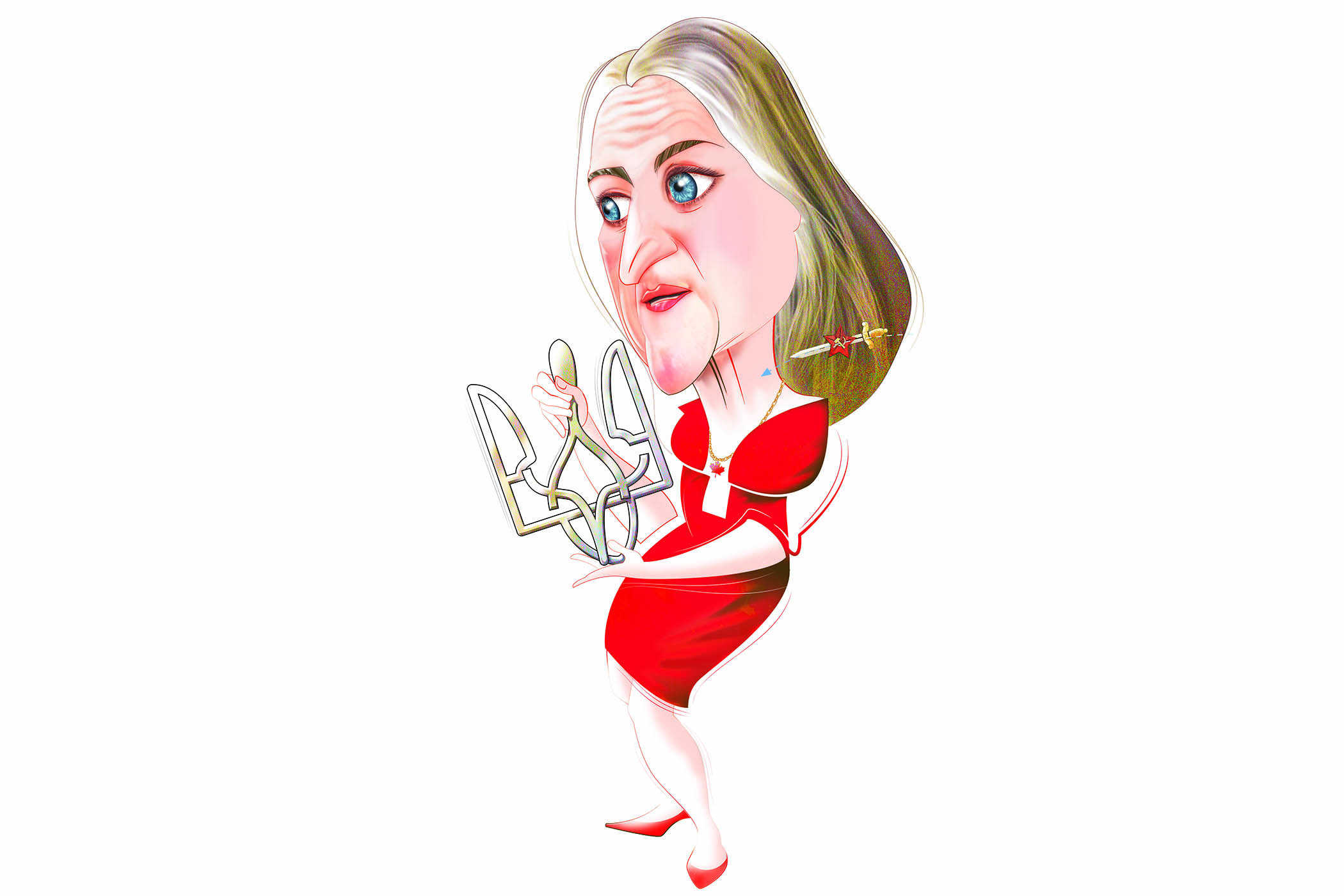
In 1998 an article appeared in Pravda Ukrainy, the mouthpiece of the Ukrainian communist party, under the headline “Red Handed”. It detailed the activities of a young Canadian exchange student in Kyiv, Chrystia Freeland, accusing her of colluding with western intelligence agencies and local agitators.
A KGB report from the time detailed an extensive programme of surveillance against Freeland, who spent her time in Ukraine campaigning for democracy and organising rallies. Her flat was bugged, her movements were tracked and an informer inserted himself into her friendship circle. To send material abroad, she made use of Canada’s diplomatic pouch through an embassy contact.
The colonel who wrote the document was forced to grudgingly admit she was “a remarkable individual” who was “erudite, sociable, persistent, and inventive in achieving her goals”.
Over time Freeland, 57, became a globe-trotting journalist for the FT and Reuters, and was then the star of Canadian prime minister Justin Trudeau’s centre-left cabinet, successively running the trade, foreign and finance portfolios and earning a reputation as the “Minister of Everything”. From 2019-24, she was also deputy prime minister.
Now she is leaving Canadian politics and becoming an unpaid economic adviser to Volodymyr Zelensky tasked with shaping Ukraine’s postwar reconstruction.
It is a position to which she appears uniquely suited. Fluent in Russian and Ukrainian, Freeland has deep personal ties to the country. Her mother was born to Ukrainian parents in a postwar refugee camp and moved to Ukraine after the fall of the Soviet Union. Her grandparents, she wrote in 2015, “saw themselves as political exiles with responsibility to keep alive the idea of an independent Ukraine, which had last existed, briefly, during and after the chaos of the 1917 Russian Revolution. That dream persisted into the next generation, and in some cases the generation after that.”
Daniel Béland, who directs the McGill Institute for the Study of Canada, said this Ukrainian heritage is “part of her personality”.
“The first time I met her, we had a chat after a formal meeting, and she started to explain to me: ‘You know the meaning of that word in Ukrainian?’ She’s very proud of her Ukrainian roots, and of course she’s a very, very strong supporter of Zelensky.”
Freeland was born in Peace River, Alberta, where she was raised on her parents’ farm. After graduating from Harvard and Oxford, where she was a Rhodes scholar, Freeland joined the FT, becoming Moscow bureau chief during the wild post-Soviet years of the 1990s. She later ran its US edition. At Reuters she was a managing editor overseeing the news agency’s digital output.
Newsletters
Choose the newsletters you want to receive
View more
For information about how The Observer protects your data, read our Privacy Policy
At the FT she met her husband Graham Bowley, who is now a reporter for the New York Times. They have three children together. She made her name as a journalist writing books on plutocrats and Russia’s messy transition to a crony capitalist economy. She also managed to hold global elites to account while being welcomed into their fold, becoming a regular face at Davos.
Then, in 2013, came an abrupt career change when she successfully stood as an MP for Trudeau’s Liberal party, winning a safe seat in Toronto. In parliament, she was a vocal champion of Ukraine after Russia seized Crimea and parts of the Donbas, visiting regularly and acting as an informal adviser. Eight years before Putin’s full-scale invasion, she cast the confrontation as a “historic fight over the future of democracy in Ukraine”. This support earned her a Russia visa ban.
Her bargaining approach was successful, though it earned the ire of Trump
Her bargaining approach was successful, though it earned the ire of Trump
She was, she said, “genuinely sad to be barred from Russia. I think of myself as a Russophile. I speak the language and studied the nation’s literature and history in college. I loved living in Moscow in the mid-1990s.”
After Trudeau’s victory in 2015, Freeland quickly became the star of his cabinet. As foreign minister from 2017-19, her number one priority was handling Donald Trump’s temperamental administration and preserving the North American Free Trade Agreement. Her hard bargaining approach was successful, though it led to friction with US trade envoy Robert Lighthizer. It also earned the ire of Trump.
“We’re very unhappy with the negotiations and the negotiation style of Canada,” he said at the time. “We don’t like their representative very much.”
This won her admirers at home. “She’s really the most effective foreign minister Canada has had in a generation,” Ben Roswell, a former Canadian diplomat. “She was able to stand up to a president of the United States in a way most of our prime ministers would not have had the courage to do.”
By 2020, when she became finance minister, Freeland was seen as Trudeau’s heir apparent. “The Liberal party of Canada is a big tent – there are people on the centre and centre right, but there was an ideological coherence there,” said Béland. “Freeland and Trudeau were very closely aligned.”
The pair broke dramatically in December 2024, as Trudeau’s deeply unpopular government teetered on the edge of collapse and rumours circulated that Freeland was about to be replaced. She announced her resignation at a press conference, accusing Trudeau of “costly political gimmicks” and of failing to prepare for the second Trump administration’s threat of huge tariffs against Canada.
“It was seismic,” said Peggy Nash, a former Canadian MP now at Toronto Metropolitan University. “She was a very, very close number two to the prime minister. The media was lined up thinking it was going to be an interesting update, because there was some financial bad news, and instead she just turned the whole politics of the country upside down.”
Freeland’s dramatic departure made Trudeau’s position untenable, and he announced his resignation a month later. It also spelled the end of her own political career. In the subsequent Liberal party leadership race, Freeland was trounced by Mark Carney. She was briefly Carney’s transport and internal trade minister – a clear demotion – and was special representative for Ukraine’s reconstruction. This week Freeland announced she was leaving Canadian politics.
With a Ukrainian peace deal apparently in sight, Freeland’s deep knowledge of Ukraine and deep contact book will be valuable resources for Zelensky as he sketches out his country’s postwar future. So will her experience of handling Trump. The president has taken a keen interest in receiving a share of Ukraine’s mineral wealth as a reward for his efforts to broker a deal with Russia.
The task before her will require the inventiveness remarked on by the KGB colonel in 1998. Ukraine’s economy has been devastated by nearly four years of war, and much of its infrastructure lies in ruins. European allies are concerned about a recently uncovered corruption scheme at Ukraine’s nuclear energy agency involving some of Zelensky’s closest allies, which could deter foreign investors whose dollars Ukraine needs for reconstruction.
Freeland will work from Oxford – where she will also take over the Rhodes Trust, the body that administers the Rhodes scholarship – starting in the summer.
“She’s incredibly bright, she loves complexity and she’s very good at building relationships. I think she will be in her element trying to navigate this,” said Nash. “How it’ll all turn out, who knows. The US is very unpredictable. But I think she clearly will relish the opportunity to play a role.”
Chrystia Freeland
Born Peace River, Canada
Alma mater Harvard and Oxford
Work Journalist turned politician
Family Married, three children