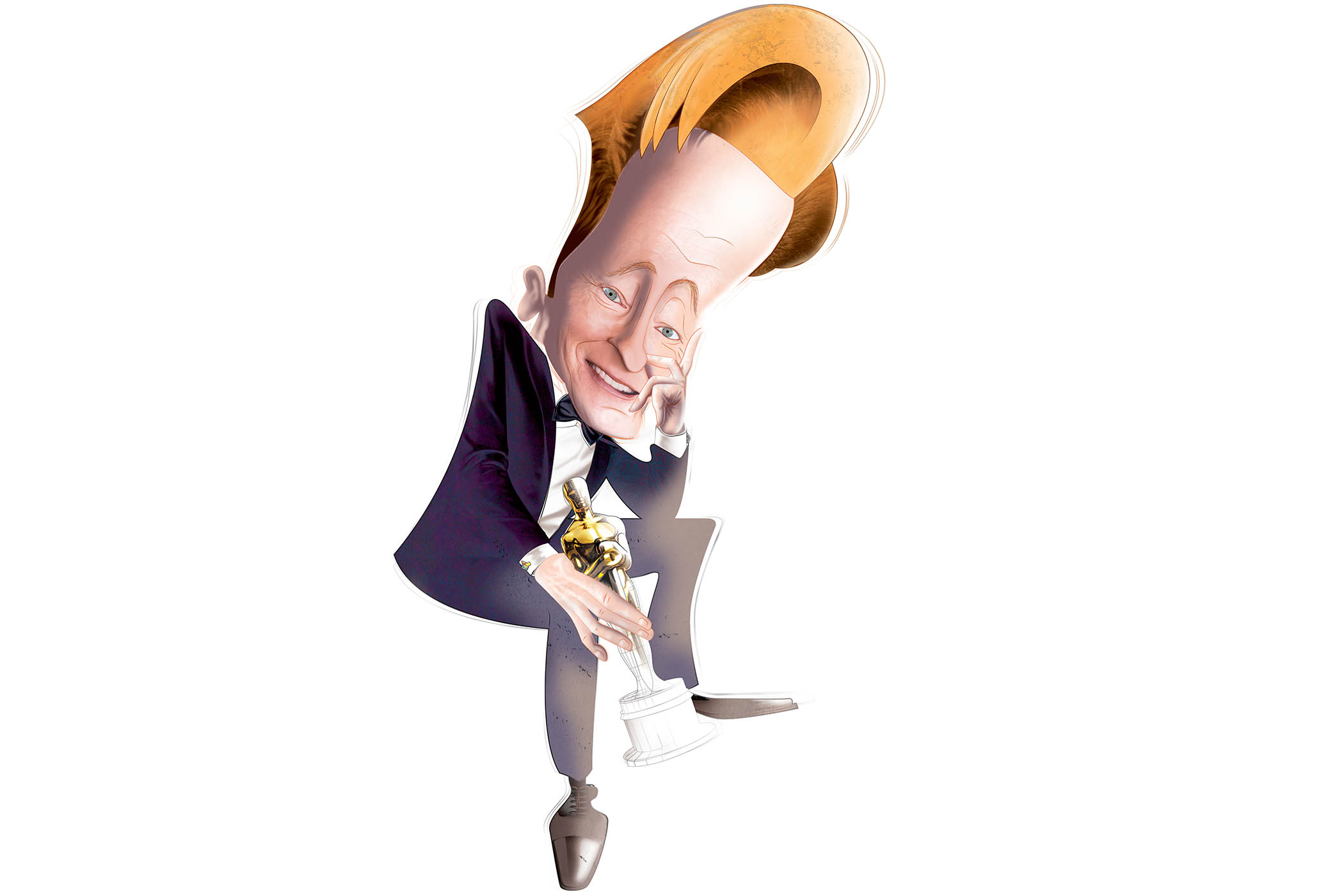

When Conan O’Brien, the returning MC at next week’s Academy Awards, nervously started out as a talkshow host, the reviews were so bad that one critic suggested he should return to his previous identity, Conan O’Blivion. Instead he stuck to the job, amid continued speculation that was he about to lose it, and slowly built a reputation for madcap professionalism.
In the US, late-night talkshows have long enjoyed a prominence in the culture far greater than their audience size. In the Donald Trump era, they’ve also become an improbable frontline of resistance, with Jimmy Kimmel Live! suspended following Maga-critical comments, and Stephen Colbert’s The Late Show cancelled in what many see as an appeasement to Trump.
O’Brien has offered his support to both men but has never been particularly political himself. After three decades in the celebrity chat trenches, fronting Late Night, the Tonight Show and then finally Conan, the 1.93m (6ft 4in) redhead, who turns 63 next month, is in danger of becoming an elder statesman in the business. For most of O’Brien’s 28 years behind the prop desk, he was operating five nights a week. What confers a kind of hallowed status on talkshow hosts is not reach but familiarity, the reassurance that at a given hour each night they will be there to prompt, guffaw and play their promotional part in the great American celebrity industrial complex.
It was an unlikely calling. The antithesis of Conan the Barbarian, he was a history and literature graduate from Harvard. Not for him the well-trodden standup comedian’s path to the host’s swivel chair. Nor, he has said, did he harbour an abiding passion to ask guests about their latest movie. As he once put it, dreaming of “interviewing B-level celebrities” is “a sad ambition”.
Sad, perhaps, but also upliftingly lucrative. Four years ago O’Brien sold Team Coco, his podcast and digital media business, to the American satellite radio broadcaster SiriusXM for $150m. The centrepiece of the deal was the weekly podcast Conan O’Brien Needs a Friend, which has featured Barack Obama, Paul McCartney and Tom Hanks. The premise-conceit of the show is that O’Brien never made friends with the celebrities in the tightly prescribed format of the talk show, but a more informal approach to conversation might provide the springboard for genuine and lasting relationships. In reality, over the years O’Brien has developed a social network that shares a large Venn diagram overlap with various Hollywood stalwartssuch as Jason Bateman and Will Arnett.
His annual Christmas party in Brentwood, Los Angeles, is a highly coveted gathering of industry players. In December it came to public attention when two of the guests – the film director Rob Reiner and his wife Michele Singer Reiner – were killed within hours of leaving the party. The couple’s troubled son Nick, who was also present, has been charged with murder.
Last month O’Brien spoke for the first time about the tragedy to the New Yorker. “I knew Rob and Michele,” he said, “and then increasingly got closer and closer to them … and my wife and I were seeing them a lot, and they were so – they were just such lovely people.” He acknowledged that he’d been “in shock for quite a while afterward”.
His father jokingly suggested his son suffered some kind of chemical imbalance for which comedy was the compensation
His father jokingly suggested his son suffered some kind of chemical imbalance for which comedy was the compensation
It was a rare deviation from his signature high-energy, sardonic front. This is a man who even turned his parents’ deaths into a running gag, involving Bateman and Arnett, for his podcast.
O’Brien grew up in an upper-middle-class Irish-American family in the plush Boston suburbs. One of six children of a Harvard professor of medicine and an attorney at a blue-chip law firm, he says his father jokingly suggested that the son suffered from some kind of chemical imbalance for which comedy was the compensation.
At Harvard he became president of the Harvard Lampoon, the undergraduate satirical magazine known for its practical jokes and raucous parties – and for providing a pipeline to the American comedy mainstream. Other alumni include Andy Borowitz, Greg Daniels, Jim Downey, Al Jean, and BJ Novak. During the same period the president of the Lampoon’s fierce rival, the Harvard Crimson, was Jeff Zucker, who some years later would go on to be O’Brien’s boss at NBC. Zucker took the student rivalry seriously enough to respond to one Lampoon prank by getting a number of its staff arrested.
Newsletters
Choose the newsletters you want to receive
View more
For information about how The Observer protects your data, read our Privacy Policy
After graduation, O’Brien moved to LA, where he wrote sketches and did improv classes, before landing a job as a writer on Saturday Night Live. He quit three years later, pleading burnout after a failed sitcom and a broken engagement. He soon moved on to The Simpsons as a writer and producer, but what he really wanted to do was perform.
His girlfriend at the time, Lisa Kudrow – still a couple of years away from becoming Phoebe in Friends – encouraged him to make professional use of his larger-than-life personality.
That opportunity came along when, almost out of nowhere, he replaced David Letterman on Late Night. An early fan was the writer and comedian Elliott Kalan.
“I was around 11 or 12 and I videoed the show each night so I could watch it the next day,” he recalls. “He was breaking the form of the talkshow. It felt like he had this kind of pure comedy, this radical energy that was very exciting.”
Neither critics nor most viewers were quite so convinced. It took O’Brien a long time to gain enough momentum to escape the constant threat of cancellation. But when he did get going, he was seen as the coming guy, and was promised the illustrious Tonight Show, where Johnny Carson once presided, and which was then presented by Jay Leno.
Yet just seven months after assuming the role in June 2009, he was gone and Jay Leno was back. The drama that unfolded during that brief period, with falling viewer figures and behind-the-scenes intrigue, set the two presenters against each other and divided Hollywood. The American media reported the tensions and machinations in forensic detail, subjecting the rival camps to the kind of feverish scrutiny under which the divisions between Blairites and Brownites had been placed in the UK.
The man who reappointed Leno to the Tonight Show was Zucker, O’Brien’s old adversary at Harvard. Fellow talkshow host Jimmy Kimmel argued that O’Brien had received a “raw deal”. If it was raw, it was also extravagantly well rewarded, with what was reported to be a $45m pay-off ($12m of which was earmarked for O’Brien’s staff).
Where Letterman gave the impression that hosting a talkshow was inherently ridiculous, Conan loved the ridiculousness, and his sincerity shone through
Where Letterman gave the impression that hosting a talkshow was inherently ridiculous, Conan loved the ridiculousness, and his sincerity shone through
Elliott Kalan
To many observers, the whole episode sounded the death knell of a dying genre. “According to the critics,” says Kalan, “the talkshow has been on its death bed for the past 40 years. But the most successful late-night hosts are like jazz musicians. They take an existing form and then play with it and come up with something new. Where Letterman gave the impression that hosting a talkshow was inherently ridiculous, Conan loved the ridiculousness, and his sincerity shone through.”
That sincerity saw him through another 11 years on cable TV before he went to podcast land. Like a lot of relentlessly active people, O’Brien has a solid home life, having been married for 24 years to former advertising copywriter, Elizabeth Powel, with whom he has two adult children.
Last year was something of an annus mirabilis. First he hosted the Oscars and received glowing notices, no doubt partly inspired by the relief that, after some difficult years at the ceremony (you won’t have forgotten Will Smith slapping Chris Rock), nothing disastrous occurred.
Then three weeks later he picked up the Mark Twain prize for American Humor at the Kennedy Center, where Will Farrell told him he was a “genius” and actor-comedian Tracy Morgan declared him an “absolute giant in the world of comedy”. In the well-established American tradition of recognising the recognised, O’Brien was a few months later inducted into the Television Academy Hall of Fame.
Kalan doesn’t believe the attention will have gone to O’Brien’s head. He worked with him on a podcast about Robert Caro, the esteemed American biographer whom O’Brien – a serious history buff – much admires. “He was such a great collaborator,” Kalan says, praising his preparation and noting that he didn’t show any sign of starry superiority. You get the feeling that he just really likes the work.
Like the talkshow, the Academy Awards ceremony has been accused of having seen better days. But none of that will stop O’Brien, a keen student of the entertainment business, from doing what he’s always done: revelling in the fabulous, pulsing absurdity of it all.
Conan O’Brien
Born Brookline, Massachusetts
Alma mater Harvard
Work Comedian, talkshow host
Family Married with two children
Illustration by Andy Bunday