

An afternoon in Stornoway, end of May, weather forecast “100% rain”. The author Douglas Stuart’s phone is radiating superstar American glamour. “A gift?” Oprah Winfrey exclaims in an Instagram video Stuart has called up onscreen.
“This is something from my friends at Harris Tweed Hebrides,” Stuart says. “They have made you a one-of-a-kind tweed fabric. They looked at the colour of your dogs and matched the colour to your pups.”
Onscreen Winfrey looks delighted.
“No one else in the world owns this,” Stuart goes on. “We wanted to give you something for talking about Scotland and about tweed… So you can make a kilt.”
“I could make a jumpsuit!” Winfrey says. “I could make a coat! I could do anything.” And the video ends.
Stornoway is the main town on Lewis and Harris. It’s the largest island in the Outer Hebrides and the setting of Stewart’s new novel, John of John, which was Oprah’s Book Club’s pick for May, a huge and important achievement in the literary world.
I’m with the 50-year-old, New York-based Glaswegian on the final stop of the novel’s first book tour, which by the time we meet has already been running for five weeks. Such is the global success of Stuart’s stoutly Scottish but magically, boldly, persuasively universal books that his literary tours are of rock-star proportions. He’s already done PR in the US, where he recorded the gifting video with Oprah; there have been Q&As, talks, public appearances and television performances. This book – after his Booker-winning debut, Shuggie Bain, and his 2022 follow-up, Young Mungo – is going to take him around the world through to autumn: more Q&As, more talkshows, more gifts.

But for Stuart, visiting Lewis and Harris is a kind of homecoming. Set in 1996, John of John is the story of Cal, an art colleague graduate who (like Stuart) studied textiles, is secretly (as Stuart once was) gay, and who returns to these ruggedly beautiful islands off Scotland’s west coast to reimmerse himself culturally and environmentally – as Stuart is doing now, if only temporarily. The Hebrides is a place of crofting, of sheep-farming, of home weavers and Gaelic speakers, of strict Presbyterianism and other rock-deep traditions that are both life-affirming and life-restricting. Tweed, too, has been a major part of the centuries-old fabric of these isolated communities’ existence. Which is where the idea for the gift came from.
“When she called and said, ‘It’s Oprah. You’re my Book Club pick,’ I just thought: ‘I have to do something for the islands’,” Stuart says.
Luckily, Stuart knows people in high places. He spent 16 weeks researching John of John on the islands, the first eight in 2019, when he was still an unknown, unpublished author. He got to know the geography and geology, flora and fauna, religious traditions and weaving lore, crofters and churchmen and key figures in the communities. He even got to know some Gaelic. He knows a thing or two about fashion, too. Before becoming a novelist, Stuart – having relocated to New York from the UK in 2000 – designed clothes for Calvin Klein, Banana Republic and The Gap. When the Oprah call came, he got in touch with Margaret Ann Macleod, the CEO of Harris Tweed Hebrides, whose Shawbost Mill, with about 60 workers, is one of the island’s largest private-sector employers. Stuart commissioned Macleod to make a one-off cloth, but because of a non-disclosure agreement he was unable to tell her who it was for. The commission was given a code-name – Project Brenda – and assigned to a local weaver, Calum Iain Macleod, a 36-year-old craftsman who is also a mussel farmer. “I was told it was a very important customer,” Macleod says when Stuart and I meet him in his weaving shed on the shores of Loch Carloway. “They said it was an American. Well, it could have been anyone. Taylor Swift? Obama? I had no idea.”
Newsletters
Choose the newsletters you want to receive
View more
For information about how The Observer protects your data, read our Privacy Policy
After thanking Macleod for his toil, his craft and his discretion, Stuart tells me that he’s checked his own social media for the stats on the Oprah video. “On the insights on my Instagram page, it’s over two million views in a day. Which, for a small island manufacturer, is enormous. It’s not going to translate to two million orders. But people are now aware.”
Even if Stuart hadn’t written John of John, tweed would be having a fashion moment. But that wasn’t the case when he graduated with a BA Honours in textiles in 1998. Stuart was educated at the Scottish College of Textiles in Galashiels, now part of Heriot-Watt University, in the Borders. “By the time I came out, the textile industry had gone the same way as everything else,” he says. He is referring to the post-Thatcher decline in Scottish manufacturing. “It had been happening for years,” he says, “and the industry was all centred down in the Borders. So even as students we were involved in the news about mass unemployment and the layoffs and the mills closing and production going to Asia. All these businesses,” he says, “just gone.”
This must have alarmed Stuart’s teachers, who had suggested he think of textiles as a career. When I first interviewed him, in the summer of 2020, just before the publication of Shuggie Bain, he told me he’d missed a lot of school because of homophobic bullying and because of “what my mother was going through”: the alcoholism that would eventually kill her, a single-parent, when Stuart was 16.
Stuart’s teachers, aware of these struggles, and that he was unlikely to pass his exams, nudged him towards textiles “as a creative outlet, because I could express myself. But also: if you couldn’t make it creatively, you could always get a job making cloth in Scotland.” People suggested he move to Innerleithen, the mill town, or get a job at Pringle. “It was a very practical thing my teachers did for me,” he says. “They pointed me that way.”
Margaret Ann Macleod, too, remembers life being tricky on the islands. “It was a difficult time,” she tells Stuart and me at Shawbost. “The industry, the whole world, was going through a transition. We moved away from traditional textiles to modern fleeces, modern textiles. So when Douglas writes about the hardship of people on the islands” – John of John is set in the mid-1990s, when all this change was at its most pronounced – “that was true. He’s managed to capture the challenge of crofting and weaving, of life then in the rural communities around our island.”
When Stuart finished his textiles degree, he moved to London, where he studied for a masters in menswear at the Royal College of Art. Ahead of his final year, he won a travel bursary, in a competition run by the Guardian, to research the history of the Shakers in New England.
“Part of that religion is design,” Stuart says. “‘Hands to work, hearts to God’ is what they call it. It’s about how the best way to serve God is to be useful. As a Glaswegian socialist, I was into that!” (Stuart got so into it that at one point a tutor in London remarked that he “might be under the influence of a cult”.) Ultimately, the trip influenced his graduate collection. While his peers designed in the usual “riot of colours – so over-the-top, a little preposterous,” Stuart’s collection was “all black and grey. Just these long columns. Really monastic. And all of these fashion companies came by – Gucci, Prada – and they picked up all of my classmates, and they all got jobs in Milan at 24. And I was like, ‘Fuck, I’m not gonna get a job.’”
Then, luckily, the team from Calvin Klein visited the college. “The sombre seriousness of my work – which carries through to my writing, I suppose – well, they saw that as minimalism. They offered me a job, and that was it. Before I’d even graduated I knew I was going to be in New York.” Which is why, interviewed onstage that night at Stornoway arts centre An Lanntair, this bestselling, Oprah-endorsed author still describes himself as a “weaver to trade”.
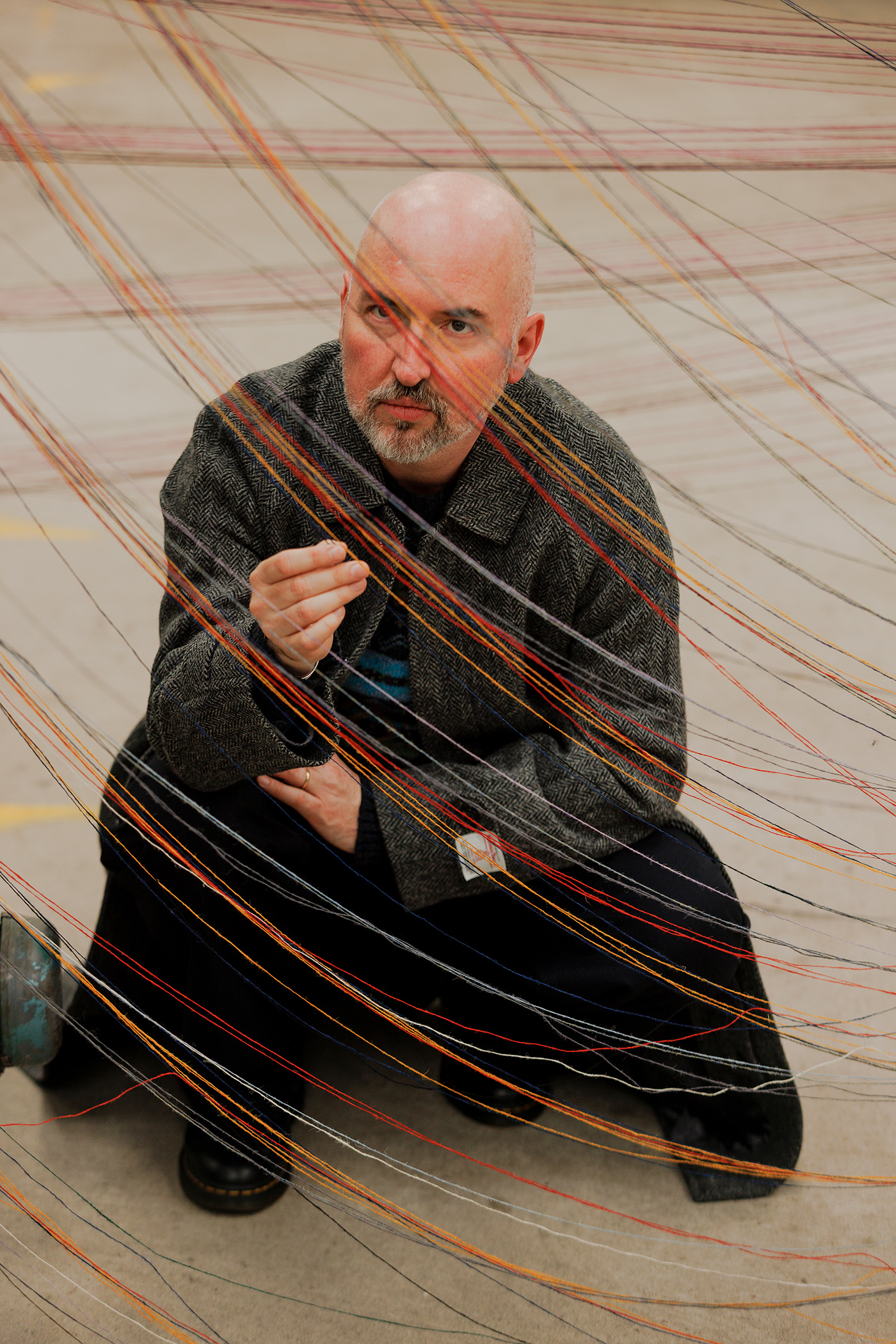
We sit down the following morning at his hotel, over a restorative fried breakfast. “That’s what I trained in,” he says. “That was my apprenticeship, I suppose, rather than writing. But the real truth of it is my specialism became knitwear. It was a time in fashion when they needed people who knew how to make all kinds of cloth. That was how I built my career in fashion. I was known as the guy who understood textiles. Other kids had gone to ‘fashion’ college – they understood ‘fashion’.” He goes on, guzzling coffee now. “I was the print-and-pattern guy. The guy who was slightly ahead of the collection, designing fabrics and cloth to inspire everyone else. So that when we got to the season and had to design garments, there were already exciting fabrics to work with.”
That specialism enabled him to spend his time in the belly of the mainstream American fashion industry funnelling money back to Scotland. “I’ve sent tens of millions of dollars back,” he says. “I was a really big supporter of Todd & Duncan’s Scottish cashmere, in Kinross. When I was at Banana Republic, we wrote a cheque for, I think, six million quid. Which is a lot, for a little mill.” His bosses wanted to “buy the Chinese stuff at half the price and twice the softness. And I was like, ‘No, no, no.’ Harris Tweed: anytime I could get it into a collection, I would do it. I felt like I owed Scotland, if I’m honest. Scotland gave me the education.”
Stuart is still paying it back. John of John, in its narrative of a son butting heads with a father with his own secrets, is his testimony to the resilience of the human spirit, of the islands, of the tweed. It’s a full-circle for the author, who once told me that “coming from a visual background, there’s a language I can bring to writing that a lot of other writers can’t”. John of John is rich with the kaleidoscopic colours of the islands, and the chromatic specifics contained in the finally calibrated warp and weft of Cal’s weaving – and that of Calum Iain Macleod, the man who wove for Oprah.
“Colour is a language in the novel,” Stuart tells me as we finish our tattie scones. “The men can’t talk about the truth of their feelings, or about what’s really going on. But they have such specificity around colour, and that’s the one place they can meet.”
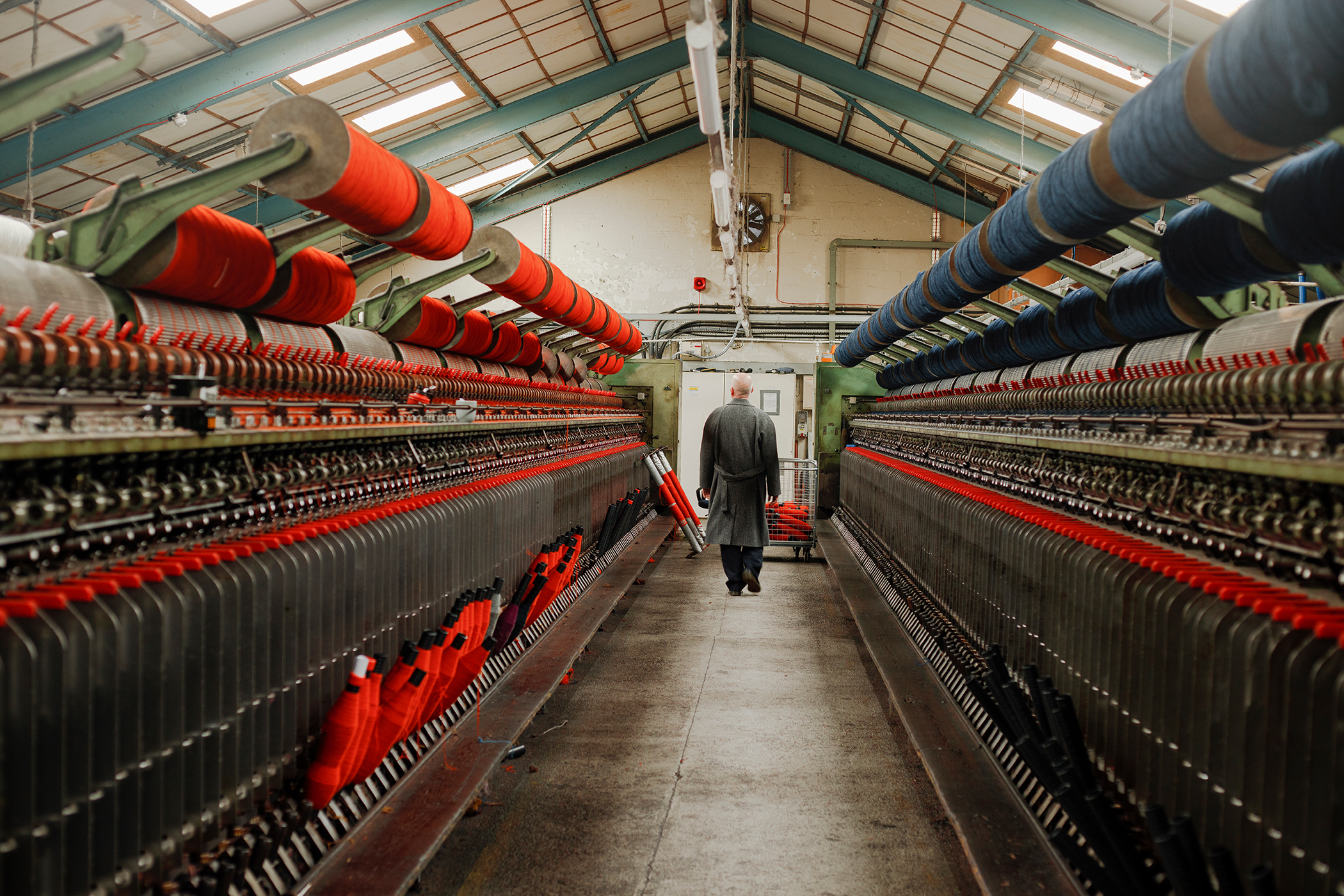
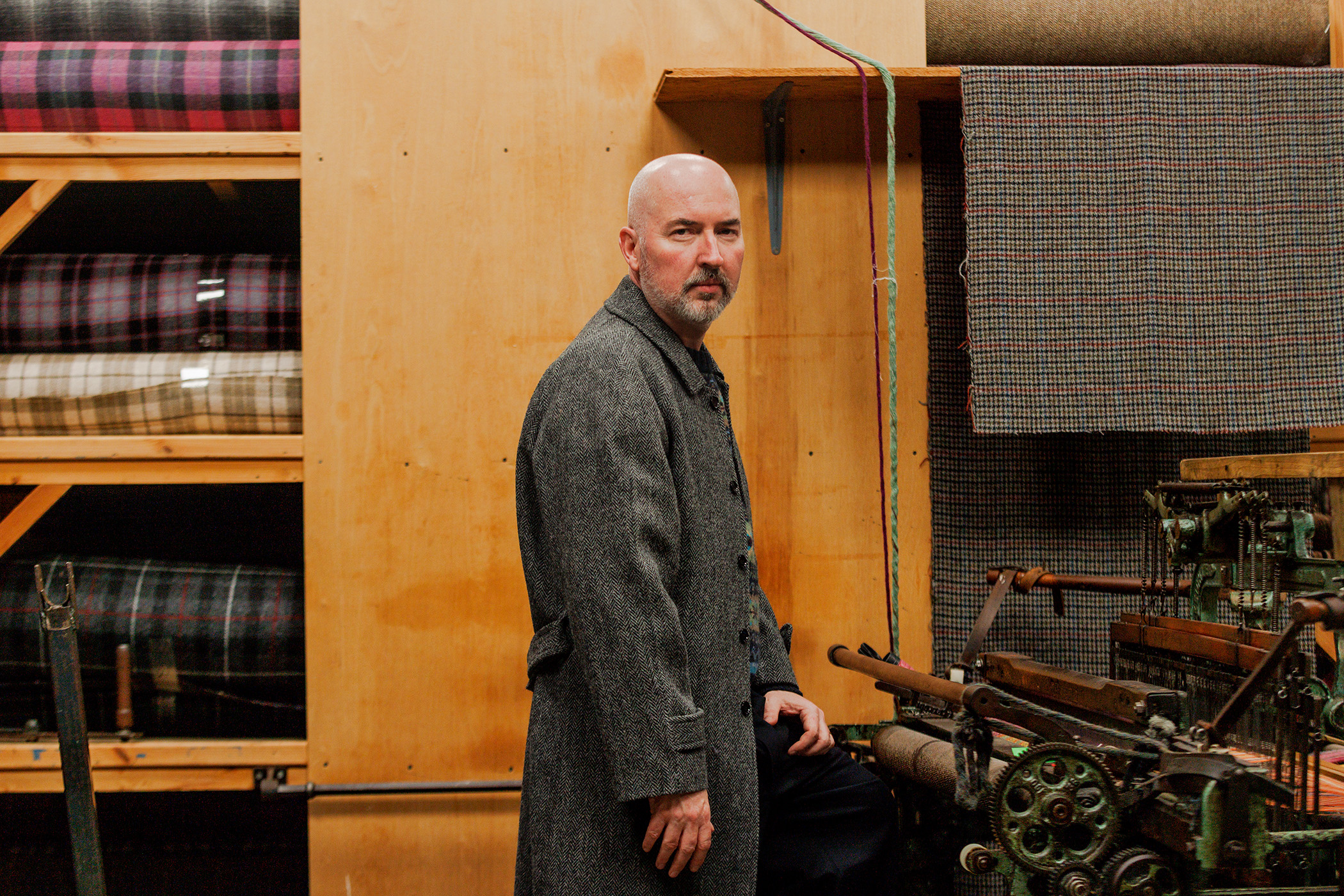
Douglas Stuart in the Harris Tweed mill in Stornoway
For all Stuart’s acquired knowledge, he admits that even he was unaware of the prismatic possibilities contained in fabrics, such as the one being fashioned right now into something fancy for one of the most powerful women in American culture.
“Before I came to the islands, I thought, ‘Oh, the green in that tartan – maybe it’s just some green from the world.’” But, of course, it’s a historical thing. The colours they use come from the land beneath their feet. If they choose a green, it’s the green of the lichen, or the yellow of the moss on stones, or the pink of the hellebores.” The weavers of Lewis and Harris, of John of John, are “working with their own colours,” Stuart says. “And they belong only, specifically, here.”
John of John by Douglas Stuart is published by Picador (£20). Buy a copy from observershop.co.uk for £17. Delivery charges may apply