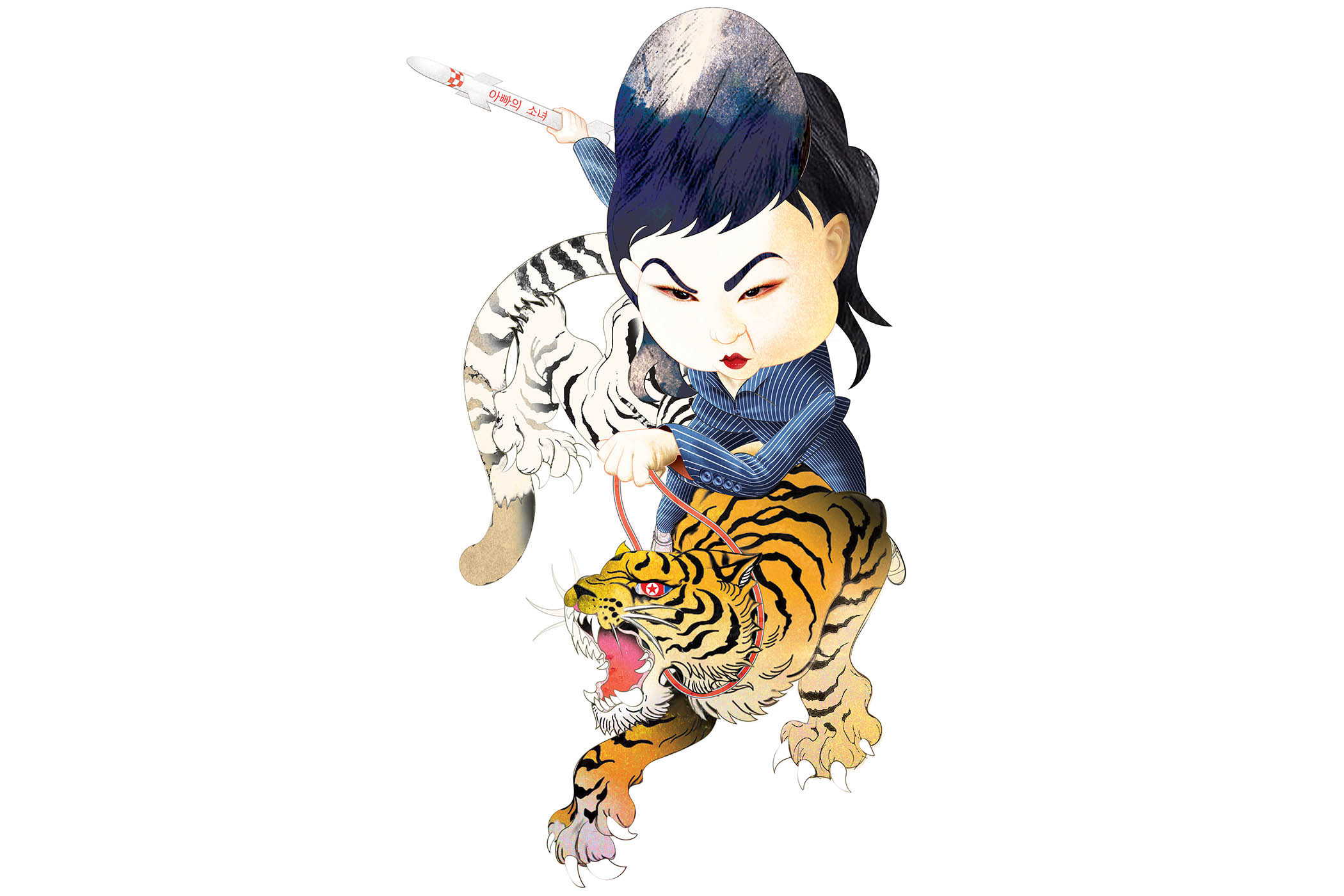

Over the past few months, North Korean state media has been creating a new star. Kim Ju-ae, as she is believed to be named and who is thought to be aged between 12 and 14, has been filmed driving a tank at a military training base, firing pistols at a munitions factory and standing in a matching leather jacket alongside her father at the Workers’ Party Congress closing parade.
That father is Kim Jong-un, the man who has been leading North Korea for the past 15 years, the third Kim in a dynasty that stretches back to 1948. South Korea’s spy agency now believes it is “fair to view” the North Korean leader’s daughter as his successor.
But some North Korean escapees warn that reading meaning into her wardrobe and military profile fundamentally misreads how North Korean rule actually works. Rather than watching a coronation in slow motion, it is all part of an operation to bolster support for Kim Jong-un himself. Kim Ju-ae’s carefully curated appearances in state media are, they say, propaganda efforts to portray Kim Jong-un as a father figure.
Eunhee Park, an author who escaped North Korea in 2012, does not believe Kim Ju-ae is being presented as the next leader at all. Instead, she sees the father-daughter appearances as an attempt by Kim Jong-un to soften his image for a younger generation of North Koreans who no longer respond to pure intimidation. “By portraying himself as a caring father, he is trying to emotionally reach a generation to reinforce control.”
Hyun-Seung Lee, a North Korean defector and DPRK specialist, echoes this idea, but also notes that Kim Jong-un simply seems to enjoy having her around. “She's his beloved daughter — cute and charming — and he likely wants to show her off while demonstrating himself as a hardworking father and affectionate leader,” he says.
Kim Ju-ae’s public presence may also reflect something more personal, according to Lee. Kim Jong-un spent most of his youth outside Pyongyang, and his mother, Ko Yong-hui, was kept hidden from public view, he explained. Showing his own daughter openly could be a deliberate contrast to the concealed childhood he endured.
Lastly, the defector noted that there may be family politics at play, too. Ri Sol-ju, Kim Jong-un’s wife, has long been overshadowed by the leader’s sister, Kim Yo-jong, who has accumulated significant political influence and is widely seen as the second most powerful figure in North Korea. With no comparable power base of her own, Ri’s best card may be her children — and keeping Kim Ju-ae visible at her father’s side helps cement her own standing within the inner circle.
Ri was a singer in the Unhasu Orchestra before her marriage, an elite North Korean state music group known for blending western classical music with Korean repertoire into catchy propaganda songs. She was introduced to the public in July 2012 but has never been given any formal titles, unlike the leader’s sister.
Beyond that, little is known about Kim Ju-ae. Most aspects of her life remain shrouded in secrecy. She has made no public addresses and her name has never been officially disclosed by Pyongyang. The only evidence comes from a 2013 visit to the DPRK by the American basketball player Dennis Rodman, who said he held “baby Ju-ae”.
What is visible is how carefully her image has been managed. At her debut in November 2022, she was a shy child in a white padded jacket, clutching her father's hand beside an intercontinental ballistic missile. Within years, the shy girl had been replaced by an adolescent in Dior jackets and Gucci sunglasses, confidently appearing next to the leader. This is despite the North Korean government strictly discouraging young people from wearing ostentatious clothing, deeming “bourgeois” culture a tool that western nations use to “spread decadent ideology and alien lifestyles among people to corrupt them”, according to DPRK state media.
Newsletters
Choose the newsletters you want to receive
View more
For information about how The Observer protects your data, read our Privacy Policy
Even less is known about the rest of Kim Jong-un’s family. Some analysts have speculated that an undisclosed son could still emerge. Either way, there are no signs of a succession in the short term. While there has been speculation about Kim Jong-un's health, he is still in his early 40s and appears fit.
When the time for succession does come, the defectors say, the criteria will have nothing to do with public appearances. History tells us that succession in Pyongyang has never been determined by primogeniture or prominence, but by one thing: the capacity to maintain power through fear.
Lee comes from an influential family in North Korea, where he worked as a businessman. He and his family were among those threatened by purges in the early years of Kim Jong-un’s rule, leading him to escape to the United States.
Park agrees. “Succession under a dictatorship is not symbolic or progressive. It is strategic, violent and unforgiving,” she says. The requirement to be chosen as North Korea’s leader is the ability “to protect the regime and maintain control. There is no room for weakness or failure.”
How Kim Jong-un came to power follows this logic. Kim Jong-il, Kim Jong-un’s late father and former leader of the DPRK, had three sons. The eldest, Kim Jong-nam, had once been the natural successor but fell from favour after years spent largely outside the country, seemingly embracing a liberal lifestyle out of step with North Korean officials. He was once caught entering Japan on a fake passport to visit Tokyo Disneyland, an embarrassment that further diminished his standing with his father.
The second son, Kim Jong-chul, was reportedly also seen as too mild by his father to take over power and was known more for travelling abroad to see Eric Clapton concerts than for any political ambition.
Then there was Kim Jong-un, the youngest. “When we were in North Korea, what we heard about young Kim Jong-un was that he hated to lose, especially in games or competitions, and acted impulsively,” says Lee. “Looking at his three sons, Kim Jong-il probably judged Kim Jong-un as having the most ruthless streak — the quality he believed necessary to preserve the Kim dynasty."
Kim Jong-un proved that assessment right. After taking power in December 2011, he soon executed his powerful uncle Jang Song-thaek, likely for building an independent power base and favouring Kim Jong-nam as an alternative leader.
He purged Jang’s extended network and launched a broader campaign of removals across the senior military and party ranks. In 2017, his estranged half-brother Kim Jong-nam was assassinated in Kuala Lumpur with a nerve agent in what is widely believed to have been an operation ordered by Kim Jong-un to eliminate his potential rival.
“That ruthlessness seems to have amplified over time, as he eliminated anyone who could restrain him,” Lee says.
The question, then, is whether any of this applies to Kim Ju-ae? Lee is cautious: “Whether Kim Ju-ae has inherited that same ferocity is unclear, and it’s too early to judge based on current appearances,” says Lee. “That said, the North Korean leadership role itself has a way of cultivating ruthlessness post facto. Becoming brutal becomes a survival necessity to protect one’s power.”
Just last week, the DPRK leader oversaw a test of cruise missiles from the deck of a new warship. Days earlier, North Korea tested a graphite bomb, designed to knock out enemy electric grids, and a short-range ballistic missile fitted with a cluster munition warhead.
The tests are part of ongoing efforts to modernise North Korea’s military, but they also serve another purpose. North Korean weaponry is now a major export product, and Pyongyang has every incentive to keep innovating. Last year, reports emerged that Russia was using North Korean artillery equipped with cluster munitions against Ukraine.
All of Kim Jong-un’s actions should be seen as part of efforts to sustain his family rule and keep the DPRK as the dictatorship it currently is. For now, Kim Jong-un has placed his bets for regime survival on absolute control over the population, nuclear weapons and, increasingly, on military cooperation with Russia. When it comes to who will take over in the event of his death, he will want someone who can continue on all three fronts. And to make sure of that, he has every reason to keep his options open.
Illustration by Andy Bunday