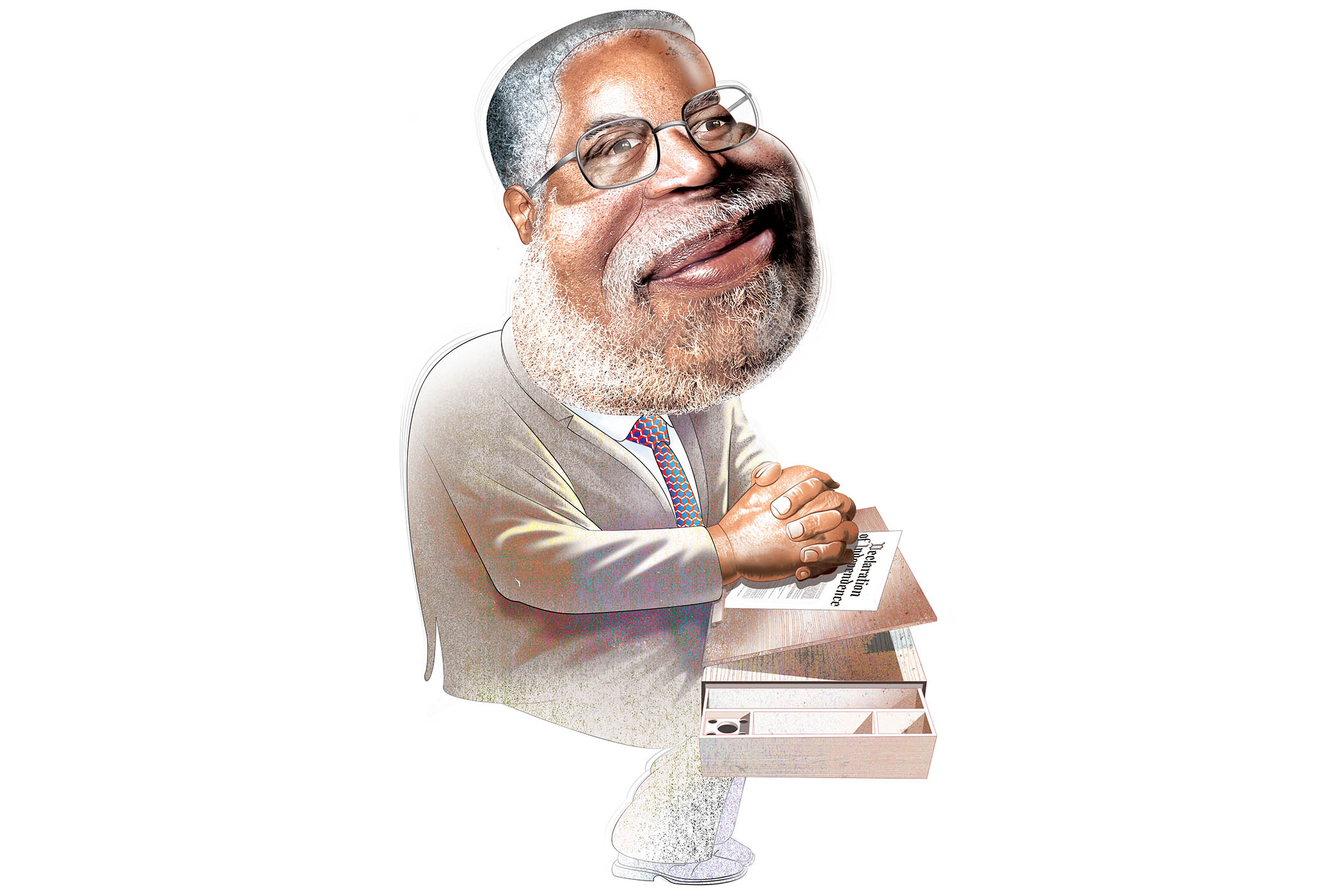


In his 1869 travel book The Innocents Abroad, Mark Twain described the Smithsonian Institution in Washington DC as a “useless, innocent, mildewed old fossil”. He didn’t count on Lonnie Bunch being in charge.
Bunch, 73, is the 14th secretary of the Smithsonian, as well as the first African-American and the first historian to lead the 180-year-old institution. He was appointed in 2019 after working as a curator and associate director at the National Museum of American History. He began his museum career at the Air and Space Museum, and was a founding director of the National Museum of African American History and Culture. His first stint at the Smithsonian came when he was doing his master’s degree in the 1970s. Despite the occasional detour, he is pretty much a lifer.
Bunch currently oversees 21 museums, 21 libraries, the national zoo and several research centres. He made his mark by recovering slave shipwrecks, returning Benin bronzes to Nigeria, negotiating the return of a pair of giant pandas loaned to China and developing new museums dedicated to, respectively, women’s history and American Latinos. Bunch has said he wants visitors to the Smithsonian to understand not just the past but the “possibilities of the future”. No one can doubt his passion for the institution — where he also met his wife of more than 40 years.
But Donald Trump has other ideas for the Smithsonian. In his mission to restore “truth and sanity” to American history, the president sees the museum as a golden goose. The White House has promised to “remove improper ideology” from the institution, and Trump could try to install board members loyal to his agenda. The 250th anniversary of independence further raises the stakes. Housing everything from the Apollo 11 command module to the original star-spangled banner, Dorothy’s ruby slippers and the casket of Emmett Till, the Smithsonian is uniquely equipped to tell the story of the nation. But, unusually, almost two-thirds of the museum’s annual budget comes from federal funding, so it is also uniquely vulnerable. Bunch is the last bulwark.
The son of two teachers, Lonnie G Bunch III grew up in Belleville, New Jersey, the only Black student at his elementary school. One day, while Bunch was playing in a neighbour’s backyard, the mother brought out glasses of Kool-Aid for everyone except him. “You drink out of the hose,” the mother said. History became a way for Bunch to “heal and to understand” such early experiences of racism. “He’s a very good storyteller,” Kim Sajet, former director of the Smithsonian’s National Portrait Gallery, said, “and a very personable and empathetic person”.
In 2005, Bunch took charge of the proposed National Museum of African and American History. At the time it had no staff, no collections and no site. Over the next decade or so, he secured nearly $600m in funding and commissioned a Ghanian-British architect to build the bronze ziggurat that now dominates the National Mall. Signed off under George W Bush and opened by Barack Obama in 2016, the museum welcomes more than a million visitors a year. “There was no political divide at that opening,” Sajet said. “It was very much a celebration of America.”
Perhaps this is because the country was less fractured than it is today, but it is also thanks to Bunch’s people skills. “He is a man on a mission to tell the story of the Black presence and position in the US,” Deborah Rutter, former president of the Kennedy Center, said. “He has done that brilliantly throughout his career.” Bunch has needed diplomacy in spades as the secretary of the Smithsonian. Sajet called it a “24-7 job”, answering to an array of stakeholders, including the public. “People do read your labels and they’ll write to you and tell you if there’s something wrong,” she said. “The greatest strength of the Smithsonian is that people believe it’s their museum.”
The problem is that Trump believes it is his museum. Last March, he signed his “truth and sanity” executive order, accusing the Smithsonian of operating “under the influence of a divisive, race-centered ideology”. Two months later, without the authority to do so, he tried to fire Sajet as director of the National Portrait Gallery. Sajet resigned. “It can be really hard to be director of a Smithsonian,” she said. “It’s really lonely… If something came out in the news, Bunch was the first to reach out and say: ‘Just thinking about you.’ To have the support of someone who has been in the crucible is great.” Rutter said that Bunch also contacted her when Trump ousted her from the Kennedy Center.
Last August, Trump wrote on Truth Social that the Smithsonian was “OUT OF CONTROL”. Among his complaints were its apparent focus on “how bad slavery was”. A few months later, the White House threatened to withdraw funding unless the Smithsonian handed over exhibition materials and plans for future shows. Bunch complied but assured staff that “all content, programming, and curatorial decisions are made by the Smithsonian”. His equanimity may not spare him his own job. All nominees to the Smithsonian’s Board of Regents, which has the power to remove the secretary, must be approved by Congress and signed off by the president. Four of the 17 regents hit their two-term limit this year. Another two regents await approval for a second term.
Tristram Hunt, director of London’s V&A museum, said he admires the way Bunch has handled what has become a perilous situation. “He is a consummate politician,” Hunt said. “He hasn’t taken the bait on any number of attempts at culture war and provocation.” But Bunch won’t be around forever. His family wants him to retire – he has two daughters and grandchildren – and he appears to recognise the punishing nature of his job. He recently told a group of historians that the institution was going through “probably the most difficult time since the civil war”.
Newsletters
Choose the newsletters you want to receive
View more
For information about how The Observer protects your data, read our Privacy Policy
But he has given the Smithsonian a fighting shot. Against strong political headwinds, he raised $2.5bn for the institution in six years. This achievement is testament, Saget said, to the “respect he engenders across the country from all types of people”. Rutter agreed: “I admire Bunch for his strength and belief in standing up for what it means to represent the history of the US. It has been really remarkable to behold.”
Earlier this month, Bunch wrote that the 250th anniversary of independence was the perfect time to “help the nation grapple with its complicated history”. It is fitting then that his favourite item in the Smithsonian is the freedom papers of a Black slave called Joseph Trammell. A symbol of pain, but also of blinding hope.
Illustration by Andy Bunday