
In 1988, when Sharon Nesmith joined the British Army as a cadet, most roles were not open to women. For her passing out parade at Sandhurst, she stood at the back holding a stick while her male colleagues clasped rifles. Later in her career, at regimental dinners, women were expected to leave early so that men could carry on the conversation alone.
Earlier this month, the army announced that it had a woman in each of its 18 ranks – from recruit to four-star general – for the first time, a sign of how much things have changed. The most senior is Nesmith, who has been vice-chief of the defence staff since 2024.
Her career has been one of firsts. Nesmith is the first woman to command a brigade, the first to lead a division-level formation, the first to be appointed general and the first to sit on the army’s executive board. But for many years, she downplayed these achievements, determined to be judged on her merits as an officer, not the brass ceilings she had broken as a woman.
“I have spent a career trying to avoid that female tag,” she told the Telegraph in 2015, shortly after her brigade command was announced. “I never wanted it to be about being a female in a male environment.” She found the media interest around her promotion slightly awkward.
More recently, however, Nesmith has grown more comfortable being seen as a trailblazer. When asked last year to name the greatest day of her career, she replied: “For a long time, I hesitated to celebrate what I was doing [as] a role model… because it was never about my gender – I was just doing what I wanted to do, what I saw as important. So I don’t know about the best day, because it wouldn’t be a single day. But I think that would be the mark of a shift where we can proudly celebrate that we are a very diverse workforce.”
She didn’t want to show ‘even a hairline crack’ to those who doubted women were up to the soldiering
She didn’t want to show ‘even a hairline crack’ to those who doubted women were up to the soldiering
Nesmith was born in Northumberland. Her upbringing, as she describes it, was “relatively straightforward”: loving parents, a happy time at school and holidays in the Lake District or Scotland. Much of her youth was spent outside, hiking in the countryside, whatever the weather.
This fostered an enduring love of the outdoors, with hobbies encompassing skiing, cycling, marathons and fell running from her family home in the Lakes. But her status as a woman in a male-dominated institution also drove her to work hard physically, not wanting to show “even a hairline crack” to those who doubted whether women were up to the soldiering.
Nesmith’s father was a navy reserve officer and her older brother served for 16 years in the Royal Scots. His decision to sign up influenced her own. She received a probationary officer cadetship in 1988 while studying biological sciences at the University of Edinburgh. She graduated from Sandhurst as part of the first cohort of female officers whose careers were not restricted to the Women’s Royal Army Corps, an administrative unit disbanded in 1992.
“It never occurred to me that I couldn’t or shouldn’t [join the army] because of my gender,” she said. “At the time, I didn’t see what now feel like very uncomfortable constraints. I only saw the things that I could go and do.”
Newsletters
Choose the newsletters you want to receive
View more
For information about how The Observer protects your data, read our Privacy Policy
After Sandhurst, Nesmith was commissioned into the Royal Corps of Signals, the part of the army responsible for setting up headquarters and communications systems in war zones around the world. She went on to serve in Germany and the Balkans, where she was told she could not deploy with her troops because she was a woman. Later she served in Iraq. As a home comfort on tours, she would take a bathmat to have something soft to step on when she left her sleeping bag.
Nick Carter, who was head of the British Army from 2014 to 2018, first encountered Nesmith when she was a major under his command as a brigadier. “She was an extremely effective staff officer and quite clearly intelligent and destined for higher ranks,” he said. “She was always extremely charming as well, easy to work with and a great team player.”
Carter recalled that Nesmith was “instrumental” to efforts to persuade the Cameron government to lift the ban on women in combat roles, a policy that finally ended in 2016. “She was a strong advocate of what we were trying to do, and when you do something that is slightly controversial, you need that sort of support from credible people – and of course, she was.”
When Nesmith was a colonel, she and her husband, Walker, a tree surgeon and veteran, decided to adopt two boys. They were aged five and six and had been through a difficult start in life.
At the time, she fretted that the decision would affect her career by forcing her to miss an important command course. “I had convinced myself that it was over, that I wouldn’t get another opportunity to compete and be selected,” she recalled in a recent interview. Her commanding officer gave her some sage advice. “He said, ‘Just stop, just stop overthinking it, try to solve everything one day at a time’,” Nesmith told another interviewer.
“So one of my life mantras is ‘one day at a time’. And he was right because I was overthinking it. I was imagining all the things that couldn’t possibly work out rather than doing one day at a time and navigating my way through.”
Nesmith went on to command 1st (United Kingdom) Signal Brigade, leading 1,500 troops. Afterwards, she held posts overseeing army recruiting, personnel and training. Before she came vice-chief of the defence staff, the second most senior position within the armed forces, she was deputy head of the army. She became a dame in 2024 and played a key role in shaping the strategic defence review, which was published last year and sets out a vision for the British military as a more lethal, technologically adept and integrated force over the next decade.
Angela Owen, founder of Women in Defence UK, said Nesmith has set an example for other women in the armed forces to follow, pointing out that she is not just the first woman to reach the rank of general but also the first mother.
“She’s a genuine people person,” Owen said. “She’s also very smart and works incredibly hard. It cannot have been easy to get to the top of the British army, where the stats are 89% male. She has done it on sheer hard work, talent, ability and merit.”
General Dame Sharon Nesmith
Born 1970
Alma mater University of Edinburgh
Work Vice-chief ofthe defence staff and master of signals
Family Walker Nesmith, two children
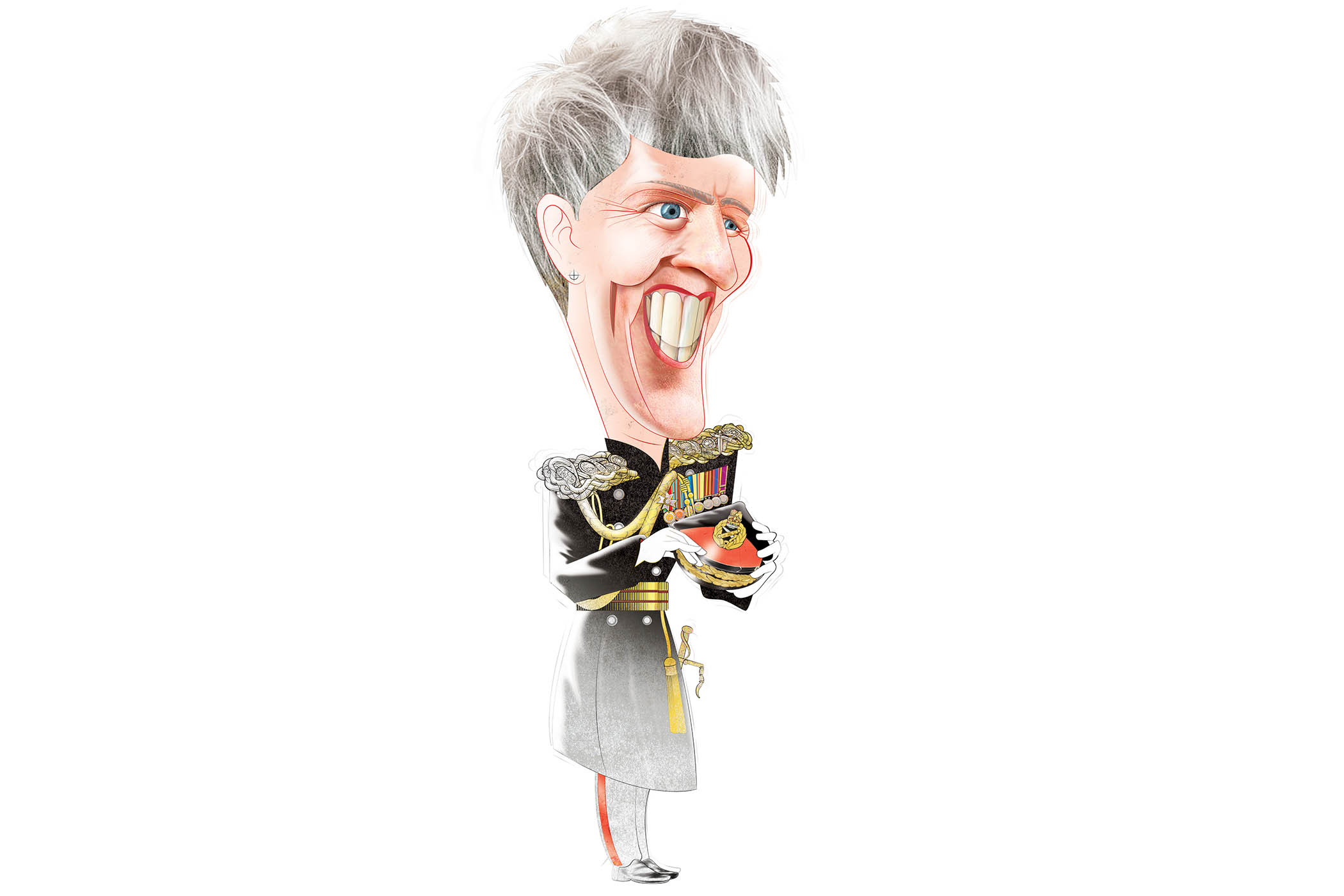
Illustration by Andy Bunday