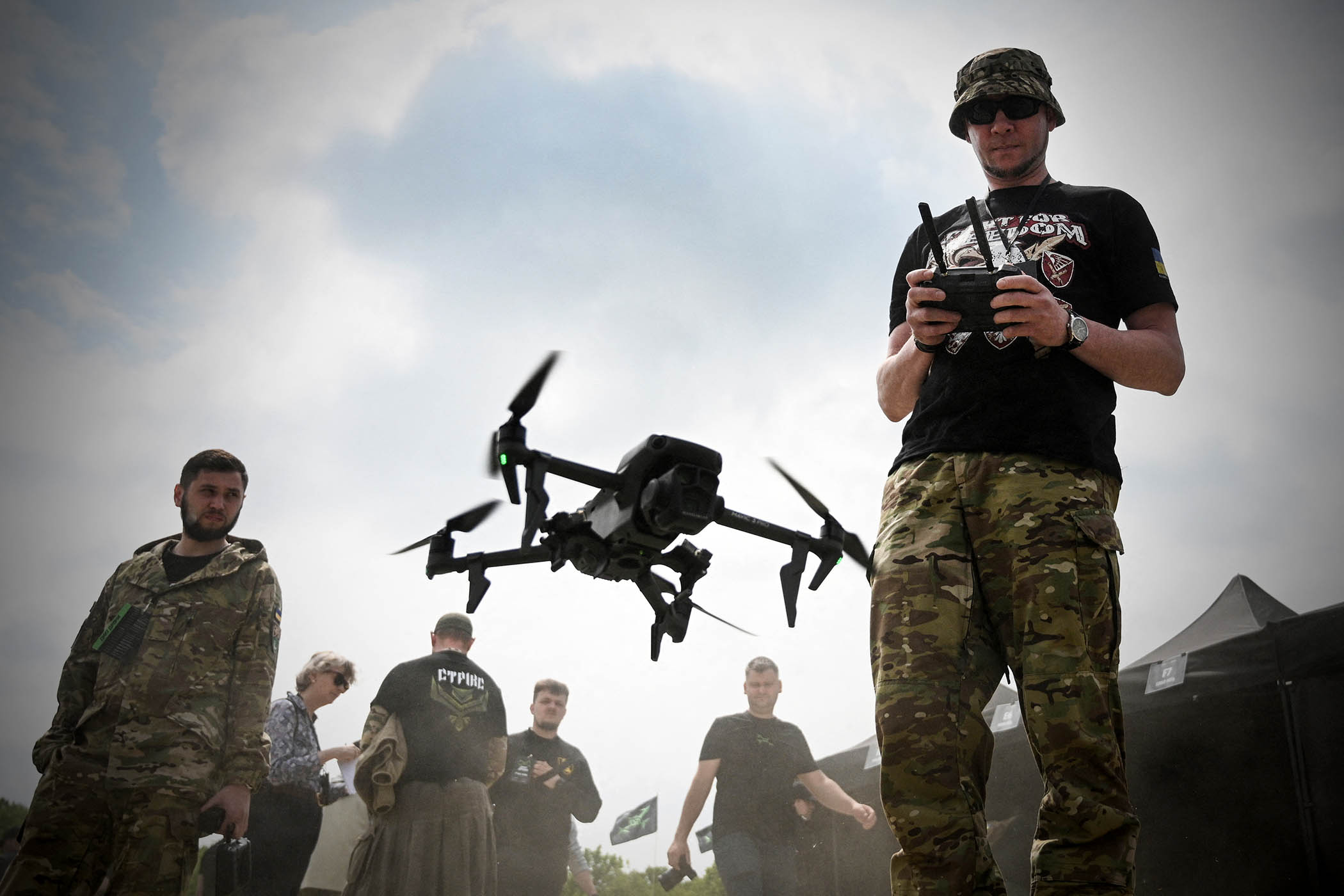



Two truisms: armies are always preparing for the last war; and military necessity is the mother of invention. Britain learned about the latter with radar in the late 1930s. The Ukrainians did the same in February 2022, when Vladimir Putin’s forces invaded their country, and they have turned out to be very fast learners. In particular, they spotted the potential of drones; specifically consumer models adapted for military use. Their imaginative use of the technology has allowed them to inflict casualty rates as high as five to one on Russian forces in recent months, while giving up little or no territory. More than 96% of those casualties are estimated to have been caused by drones.
This means that the age of the infantryman is coming to an end. Ukraine has shown that drones can incapacitate battleships and disable tanks, but their most devastating lesson for Russian soldiers is that being seen in the open is like signing your own death warrant. Surviving or avoiding a drone attack has become an almost impossible task on the battlefield. If you doubt that (and have a strong stomach), then a video montage of Ukrainian drones hunting down Russian troops – even in the interiors of buildings into which they have fled – should give you an idea of what the technology can do, and why the enemy’s mortality rate is so high.
Coincidentally, drone capability on the battlefield seems to have rendered even the most skilled humans redundant. The Wall Street Journal had an interesting piece about a Ukrainian sniper who had famously hit a Russian officer at a range of more than two miles. But now the marksman has a new job: supporting the drone pilots who remotely control the airborne devices. “Small drones that are cheap and can be rigged with explosives,” says the journal, “have changed the face of warfare in Ukraine, pushing some traditional military roles down the billing. Spotters who call in artillery strikes are no longer needed. Tank crews have lost their swagger as their vehicles are top targets for aerial craft.”
Some parts of the conventional military-industrial complex don’t seem to have got this message; possibly because their share prices depend on their not receiving it. For example, Armin Papperger, the chief executive of German weapons manufacturer Rheinmetall, recently ridiculed the Ukrainian drone production industry, which manufactured more than 4 million drones last year, and the technology generally. Ukraine’s systems aren’t as sophisticated as the products of main western defence companies, he burbled. “This is not the technology of Lockheed Martin, General Dynamics, or Rheinmetall.” That this was a feature rather than a bug clearly hadn’t crossed his mind, even when a drone maker observed that “the drones we manufacture in one day will be more than enough to destroy all the tanks Rheinmetall manufactures in a year”.
Newsletters
Choose the newsletters you want to receive
View more
For information about how The Observer protects your data, read our Privacy Policy
What’s the big deal with drones? Simple: they’re cheap, especially when compared with other kinds of ordnance. A single one costs maybe $500 (£370), compared with at least $4,000 for a single 155mm artillery shell that is the Nato standard calibre for heavy howitzers. And drones can easily be produced in such huge numbers that they can overwhelm many conventional systems, especially when they work in swarms, which will be the inevitable next step in their development.
Ukraine’s success with drones immediately prompts a comparison with an earlier warfare-shaping technology: the machine gun in the first world war. This wasn’t just an efficient technology for killing soldiers; it also overturned the prevailing military doctrine of the day: that coordinated infantry assault, properly led, could capture territory. But once a small number of entrenched gun crews could turn a swathe of ground into a killing field, that doctrine collapsed into a mud-encrusted and bloody quagmire.
Is the drone about to do something similar to the military doctrine of mechanised warfare that has dominated the postwar era? This was based on the idea that armoured vehicles, plus troops on the ground and control of the skies, was the key to success. Mobility plus protection, in other words, equalled battlefield dominance. It was clearly the proposition that underpinned Russia’s initial assault on Ukraine. But then it transpired that a $500 quadcopter carrying a grenade and flown by a conscript 12 miles (20km) away could turn a $4m tank into a flaming deathtrap, and suddenly we’re moving into uncharted territory for which Britain – and Nato – seems unprepared. Maybe the Russians, who have had to learn to deal with this development, could give them some tips.
What I’ve been reading
Stolen vote
Will Our Hyper-Gilded Age Usher in Genuine Populism? is a lovely essay by Paul Krugman on voters becoming more savvy about the tech bro robber barons.
Last among equals
A sharp Substack post by Brian Merchant is AI as the New Avatar of American Capitalism, relating how young people in the US view the technology as an extension of an already inequitable system.
Foreseen consequences
Bright Simons’s interesting essay The Social Edge of Intelligence looks at the ways in which AI will eventually undermine itself.
Photograph by Yuriy Dyachyshyn/AFP/Getty Images