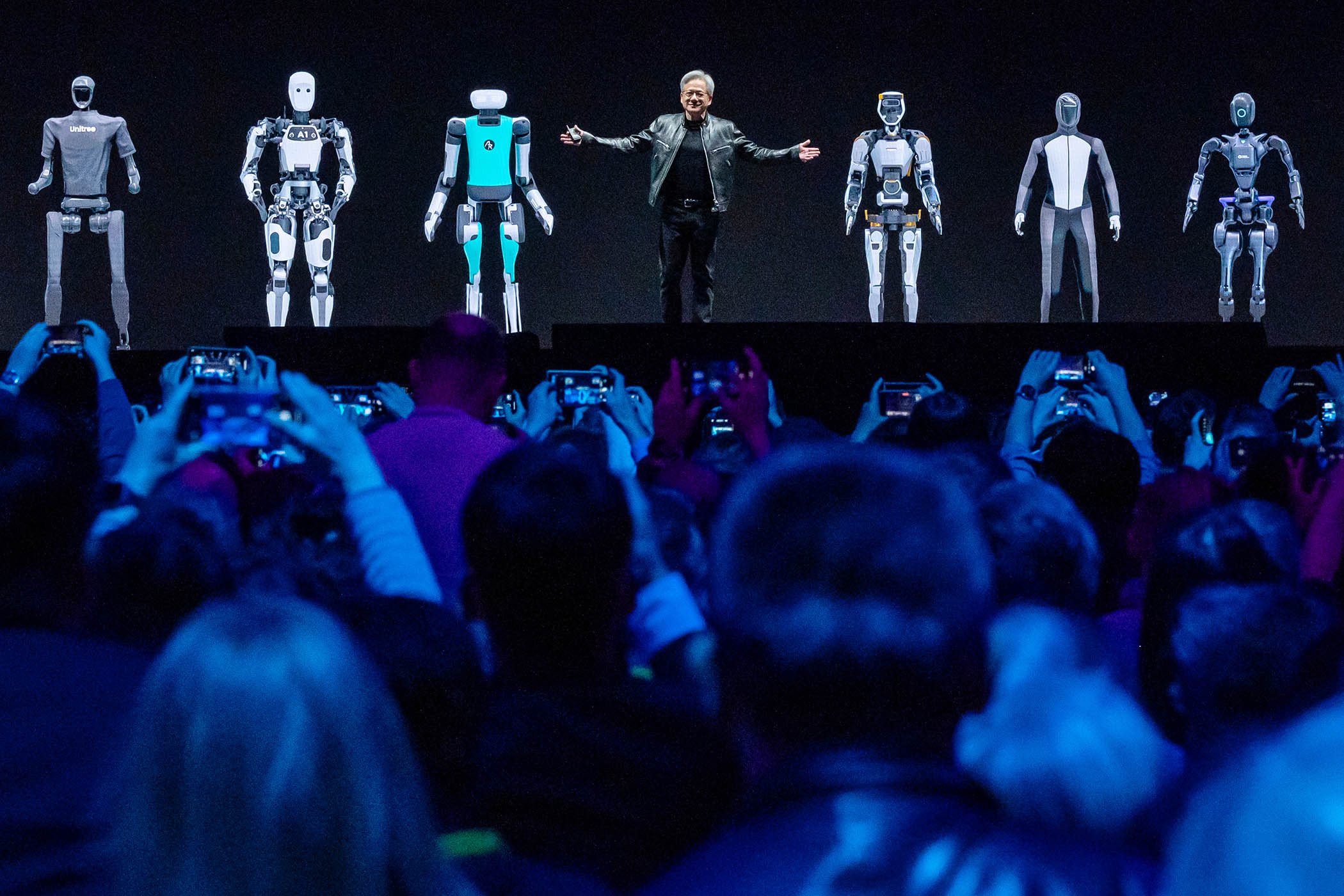



The Chinese AI startup DeepSeek shocked the world in January 2025 when it released R1, a large language model that promised to dethrone rivals from industry leaders OpenAI, Anthropic and Google. The event saw chipmaking giant Nvidia’s shares drop by 17% in a single day, and a spike in Google searches for the term “AI bubble”.
Nvidia’s woes didn’t last. By October, it had become the first company in history to reach a $5tn valuation. But the fear that we might be in a bubble, that AI technologies are too expensive, too dependent on future breakthroughs to justify today’s feverish spending – has stuck.
“Are we in a phase where investors as a whole are overexcited about AI? My opinion is yes,” OpenAI CEO Sam Altman told reporters in August. “Is AI the most important thing to happen in a very long time? My opinion is also yes.”
There are several factors that are driving fears of a bubble. The first is a surge in spending from mega corporations, which are investing heavily in chips and data centres to power AI. Oracle, Meta, Microsoft, Alphabet and Amazon were on course to increase capital investment by about 70% in 2025 to $436bn, and analysts expect a further jump of almost a third to $604bn in 2026.
The concern is that these investments will lead to poor returns. Despite $1.4tn in spending commitments this year, OpenAI is reportedly on track for a $5bn operational loss in 2025. Meanwhile, Meta expects to spend upwards of $70bn on AI, even though its main source of revenue is still in social media advertising.
Businesses need to figure out how to make AI pay, or risk a bust that “would simply mirror other, spectacular investment busts ranging from railroads in the 19th century to telecoms fibre and broadband in the late 20th”, says Russ Mould, an analyst at the investment platform AJ Bell. “This could have big implications for the providers of chipsets, data centres, cooling systems, construction equipment, electricity and others, if so, and even impact headline US GDP growth, given the big numbers involved.”
The other fear is simply that public AI companies are overvalued. The so-called Magnificent 7 tech stocks currently represent around 35% of the total US stock market value. According to Mould, similarly imbalanced markets, from the go-to tech stocks of the late 1960s to, yes, the dotcom stocks of the late 1990s, “all ultimately saw rebalancing that dealt investors’ painful blows as extended valuations and share prices proved unsustainable in the most speculative areas of the market”.
At the heart of it all is Nvidia, which has benefited enormously from the boom. Many of the chipmaker’s biggest customers have bet billions of dollars on the promises of AI without proof it can generate returns. It has extended credit or taken stakes in several others, drawing comparisons with the “vendor financing” models that played a role in the dotcom crash.
And yet, so far, the markets still believe AI could become the most transformative general-purpose technology since electricity.
Part of the reason the fears persist is that, for now, the gains are hard to see. Much of AI adoption is informal: employees using chatbots to draft emails or write code, or summarise documents. Employers may not even know their staff are leaning on these tools, but surveys suggest that as many as half of knowledge workers are. That kind of productivity won’t show up neatly in quarterly earnings.
Newsletters
Choose the newsletters you want to receive
View more
For information about how The Observer protects your data, read our Privacy Policy
In 2026, the shadow economy of AI will be forced to step into the light. Here The Observer’s business team examines how this will play out across key sectors.
Industry
Will the long-predicted artificial intelligence job apocalypse finally become a reality this year? Geoffrey Hinton, one of the godfathers of AI, thinks so. The ability of AI to successfully carry out many tasks has increased much faster than he expected, so that potentially millions of jobs can be replaced with AI bots.
There were signs of this shift in 2025, especially for jobs involving standardised and repetitive tasks, notably entry-level positions in technology and professional services companies, such as management consultancies and law firms.
Yet even if the number of headline-making, AI-related job cuts continues to grow in 2026, the overall trends in the relationship between the technology and work are likely to remain more nuanced. A task being done faster, better and more efficiently by AI is not the same as a job going away: AI has transformed early cancer detection in radiology, yet despite doomy predictions of the profession’s demise, there are now more radiologists than ever. And it is always easier to spot which jobs are threatened by a technological shift like that taking place in AI than to imagine the new jobs that will be created by that same technology – of which we are likely to hear many more examples in 2026.
We will also hear a lot more dire predictions this year about the job destruction soon to be caused by the rapid adoption of AI-powered machines, such as self-driving vehicles and humanoid robots – though again, at least outside China, that threat will not become significant until 2027 at the earliest. Matthew Bishop
Climate
There’s no question that AI is power hungry. Getting answers from AI tools requires 10 times as much energy as search engines. Power demand from data centres in the US is projected to double in the next two years. Tech companies set themselves “moonshot” goals of being carbon-neutral or even negative by the end of this decade, but the quest for more energy has rolled the moon much further away.
Partly due to AI, Microsoft said last year its carbon emissions were up 23% on 2020 levels, while Google’s emissions rose 51% from 2019 to 2024. The vast energy needs of training and operating AI have driven tech businesses to find their own supplies of power, and in some cases turn back to fossil fuels: OpenAI’s Stargate project is building natural gas turbines in Texas, and much more gas consumption is likely to follow this year, especially where there are delays linking data centres to local grids.
But companies insist they have not given up on climate goals, though they acknowledge their pace of decarbonisation has slowed. An alternative to burning gas is shifting to locations where cheap renewable energy is on tap: Microsoft and OpenAI both announced deals last year to rent AI computing power in the Norwegian port of Narvik, where there is abundant hydropower, less need for cooling because of chilly temperatures and little local demand as few people live nearby.
As they seek to balance sustainability targets with staying at the front of the AI race, expect tech companies to scout the globe for more suitable locations. The Nordics are an obvious choice, but more adventurous options include Greenland and even sunken data centres on the ocean floor. Jeevan Vasagar, climate editor
Defence
Last year’s Strategic Defence Review called for the MoD to become an “AI-native” organisation. The SDR envisions a targeting web of sensors, so that a full digital map of what is going on is always available, with autonomous ships, aircraft and ground vehicles able to use this map to attack or defend, and with decisions being made at lightning-fast speed. However, the UK remains opposed to “terminator-style” weapons that can kill without a human making the active decision.
Plenty of companies are moving in. Traditional defence contractors like BAE Systems use AI in products such as the Tempest future fighter jet, and Babcock exploits the technology in managing the Skynet (yes, really) communications satellite network.
Newer entrants like the US firm Palantir have signed partnerships with the UK to use AI to support decision making for the UK armed forces, while IBM and Google Cloud are working with the MoD to use AI for logistics support in predictive maintenance and to provide secure cloud storage for MoD AI-related data. Helsing has opened an autonomous underwater vehicle factory in Plymouth.
Yet, while the number of potential applications is vast, the difficulty will be whether the MoD can afford the price of the new technologies. Traditional platforms like ships, tanks and aircraft are already woefully underfunded. Making space for Skynet will be a challenge.Bernard Gray, contributing editor
Media and entertainment
On 11 December, Disney announced a $1bn deal with OpenAI, granting its Sora video platform access to Disney, Marvel, Pixar and Star Wars characters. Disney chief executive Bob Iger claimed the deal “will thoughtfully and responsibly extend the reach of our storytelling through generative AI”.
More licensing deals between creative intellectual property owners and generative AI giants are likely to follow this year. Legacy businesses bending under structural pressures and tech giants buying up Hollywood studios mean AI’s cost-cutting promise will weave its way into as many corners of the culture industry as will tolerate it.
While virtual actors such as Tilly Norwood are already on social media feeds, no major studio has an AI movie in production for 2026, although OpenAI’s animated Critterz debuts in Cannes in February. It will test whether audiences will pay for AI-assisted animation and whether the economics can translate into a viable studio model, or whether this is a one-off stunt.
A key barrier to AI adoption in the creative industries will be the thousands of human workers – from actors to designers and animators – who will resist the technology for fear of widespread job losses.
In December, the actors’ union Equity asked members to vote on whether to authorise strike action over the use of digital scanning to create AI replicas of performers; the result of this poll is due later in January. Stephen Armstrong
Healthcare
Last month, the NHS announced it is equipping every stroke centre in England with AI imaging software designed to help clinicians spot dangerous clots within minutes.
The national rollout follows trials suggesting the technology can speed up decision-making in acute stroke care, where delays can mean permanent disability or death. It is part of a wider burst of NHS experimentation with diagnostic AI this year, including a major programme using AI to help detect breast cancer earlier in screening, and a triage tool aimed at flagging suspicious skin lesions for faster review. If they work, these systems could save lives.
But rolling them out at scale will be a challenge for the labyrinthine NHS, a service still dealing with fragmented and uneven IT capability across its many trusts. In 2025, 19 were yet to adopt an electronic patient record (EPR), and where EPRs do exist, frontline staff often struggle to use them.
Perhaps, some say, AI could be a solution for that, too. An AI forecasting tool has been made available to trusts to predict A&E demand peaks, so hospitals can plan staffing and beds more efficiently. Meanwhile, NHS England has already published guidance for “ambient scribing” tools that turn consultations into structured notes and letters, pitching them as a way to reduce documentation burden. Other tools are being developed to draft discharge documents, a process that could free up beds.
As the NHS tests AI through formal channels, some clinicians are already using it. A survey found nearly a third of GPs use AI in daily practice, with 11% of them leaning on tools such as ChatGPT over IT provided by their practice. Questions about patient confidentiality and data privacy will no doubt become urgent as these trends continue. Patricia Clarke, technology reporter
Photograph by David Paul Morris/Bloomberg via Getty