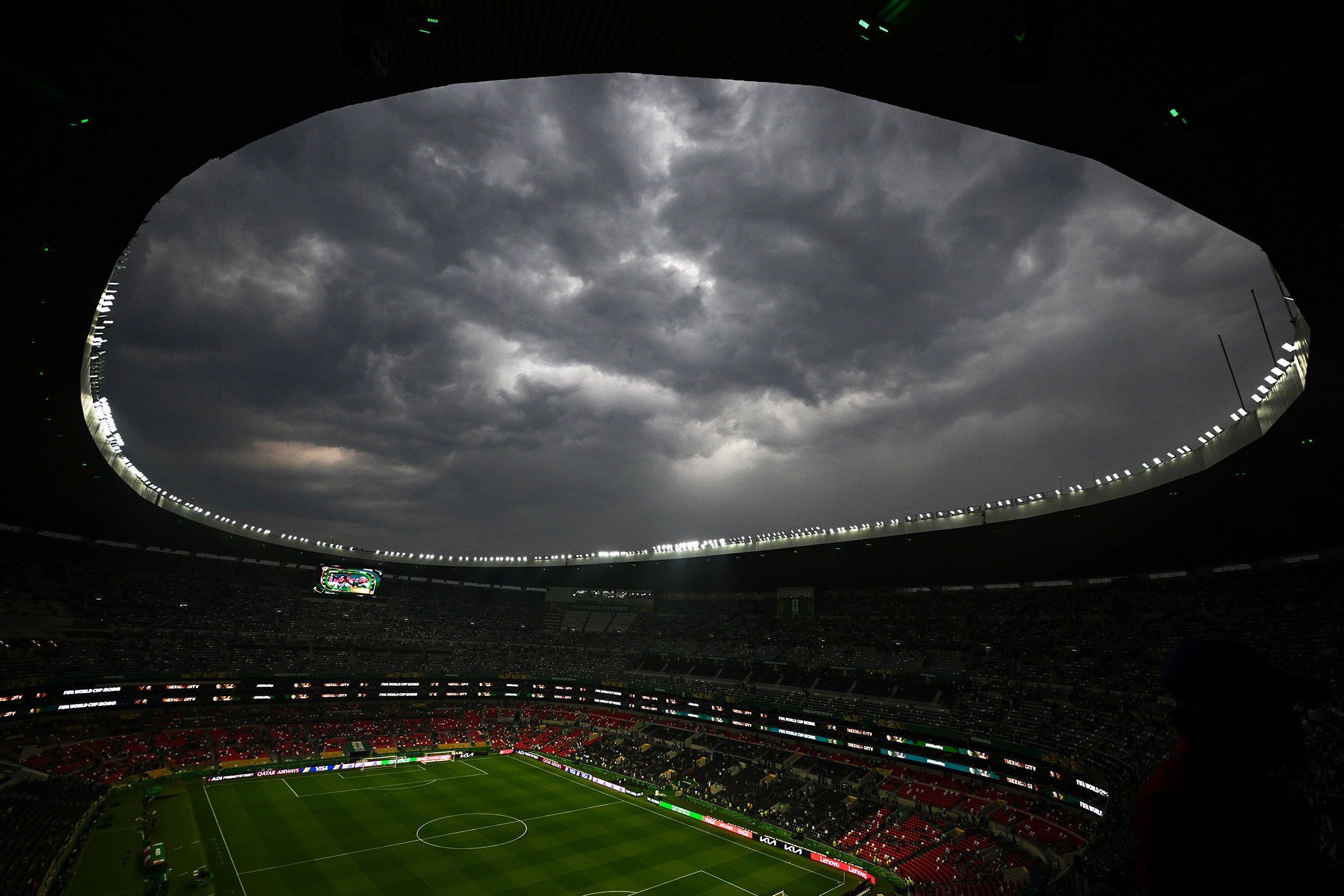



Yes, the Estadio Azteca is a footballing palace and pilgrimage site, a cradle of modern football. Yes, I’m excited and you’re excited. Yes, this is Maradona in Mexico, Carlos Alberto and the birth of joga bonito, Pure World Cup, Pure Football. Except, to ask the question everyone seems desperate to avoid: is it?
In your first week at 2,200m, about where the Azteca sits in the Valley of Mexico, the air is approximately 23% thinner. This means fatigue often increases by 15-20%. You struggle to sleep. The fundamentals of your decision-making and cognition shift. The total distance your body can cover can drop by 10%, as can your capacity to repeatedly sprint. This will be Mexico’s fourth match this World Cup at the Azteca, having been based at the Centro de Alto Rendimiento – a 20-minute drive from the stadium – for over a month. Studies suggest the vast majority of altitude-related symptoms subside completely after 19 days, three weeks of acclimation halving impact on performance. The second-best option is to arrive as close to the match as possible, ideally on the same day, but as per Fifa regulations, England arrived on Friday evening having played DR Congo on Wednesday. On top of this, the reduced air density means the ball moves faster and spins at a noticeably different rate compared with sea level. These are tangible handicaps.
Host-nation advantage is an accepted and unavoidable element of major tournaments. Qatar’s was getting to play in the World Cup in the first place. Russia reached the quarter-finals in 2018, South Africa beat France in 2010, South Korea made the semi-finals in 2002 despite not winning a knockout match before or since. Someone has to host and organise the thing. Home advantage is a provable phenomenon at every level of football. This is fine.
But if the whole tournament was in Mexico, as in 1970 and 1986, this issue would be lessened. Four of the country’s five biggest stadiums are above 1,500m, including Guadalajara’s Estadio Akron, where Mexico beat South Korea in the group stage. It is worth looking at how Bolivia deal with this, given La Paz sits at 3,650m. In the most recent World Cup qualifying, having lost two of their first three home games in La Paz, they opted to move matches to El Alto, the country’s second-largest city, about 4,150m above sea level. They won three and drew two of their remaining five matches, only conceding twice. Meanwhile they lost seven of their eight away matches, only scoring three goals across them. Manager Oscar Villegas was clear that the stadium change was weaponising the altitude, picking most of his squad from clubs based in El Alto and La Paz.
Of course El Alto is much higher than Mexico City, and qualifying is not the tournament proper. Argentina and Ecuador still beat Bolivia in La Paz, just as Mexico have lost to Costa Rica and Honduras at the Azteca before. None of this is to say altitude makes matches unwinnable, or even stops England being justified favourites. It bears saying that the weather presents a different challenge – for all upbringing might influence this, heat and humidity affect most people similarly and are easier to prepare for.
Maybe this is just getting the excuses in early, a brazen act of self-preservation, the English press doing English press things. But should one nation really have an in-built advantage outside the World Cup’s accepted margin for error to this extent? Is it not ultimately anti-competitive for a team to begin a match from such a position of strength so unrelated to footballing ability or physical fitness?
Beneath all this is a fundamental question: are Mexico actually good? Strip away the stadium and the crowd, what are you left with? Yes, there’s the four wins, eight goals scored and zero conceded through this World Cup, all in either Mexico City or Guadalajara. They are unbeaten across 12 matches this year, although this includes friendly wins over Panama, Bolivia and Iceland, the highlights being draws with Portugal (in Mexico City) and Belgium (in Chicago). They have won three of the past four Gold Cups and are 10th in the Fifa world rankings, above Germany and Croatia, and just below the Netherlands. They have scored as many goals as England and conceded the same xG throughout this World Cup.
But six of their starting XI against Ecuador play in Liga MX, including 17-year-old Gilberto Mora. Opta’s most recent league power rankings places Liga MX between the 2 Bundesliga and Spanish second tier. This is Raúl Jiménez’s first World Cup as Mexico’s starting striker, a beautiful story of resilience and redemption that doesn’t change the fact he is 35 and has just re-signed for recently relegated Wolves. Pre-tournament, neither fans nor the Mexican media were optimistic, the prevailing belief being that this is not a particularly talented generation. Former goalkeeper Felix Fernandez told World Soccer: “Mexico simply do not have a realistic chance of being among the top eight teams in the world.”
And yet Julián Quiňones is the sort of brutally direct winger England clearly loathe facing, three goals in four games so far, two of those remarkably similar, gliding in from the left wing and finishing with contempt. Born in Colombia, he was last season’s Saudi Pro League top scorer, which involved beating Ivan Toney, Cristiano Ronaldo and Karim Benzema, but also scoring hat-tricks against Al-Okhdood and Chris Smalling’s Al-Fayha. Mexico not conceding through four games – even if two of those were against meek South African and Czechia teams – is a rare achievement, although locals seem baffled that goalkeeper Raúl Rangel has not yet done anything notably stupid.
But tonight’s match will be decided by control, by Elliot Anderson, Declan Rice and Jude Bellingham’s ability to overpower Erik Lira (5ft 8in), Luis Romo (6ft) and potentially the prodigious but slight Mora (5ft 6in). Most of England’s players are fitter and faster and stronger and taller, perhaps even with the altitude. But even if they do find a way past both Mexico and the Azteca, it doesn’t mean they should have been forced to face the challenge in the first place.
Newsletters
Choose the newsletters you want to receive
View more
For information about how The Observer protects your data, read our Privacy Policy
Photograph by Hannah Peters/Fifa via Getty Images