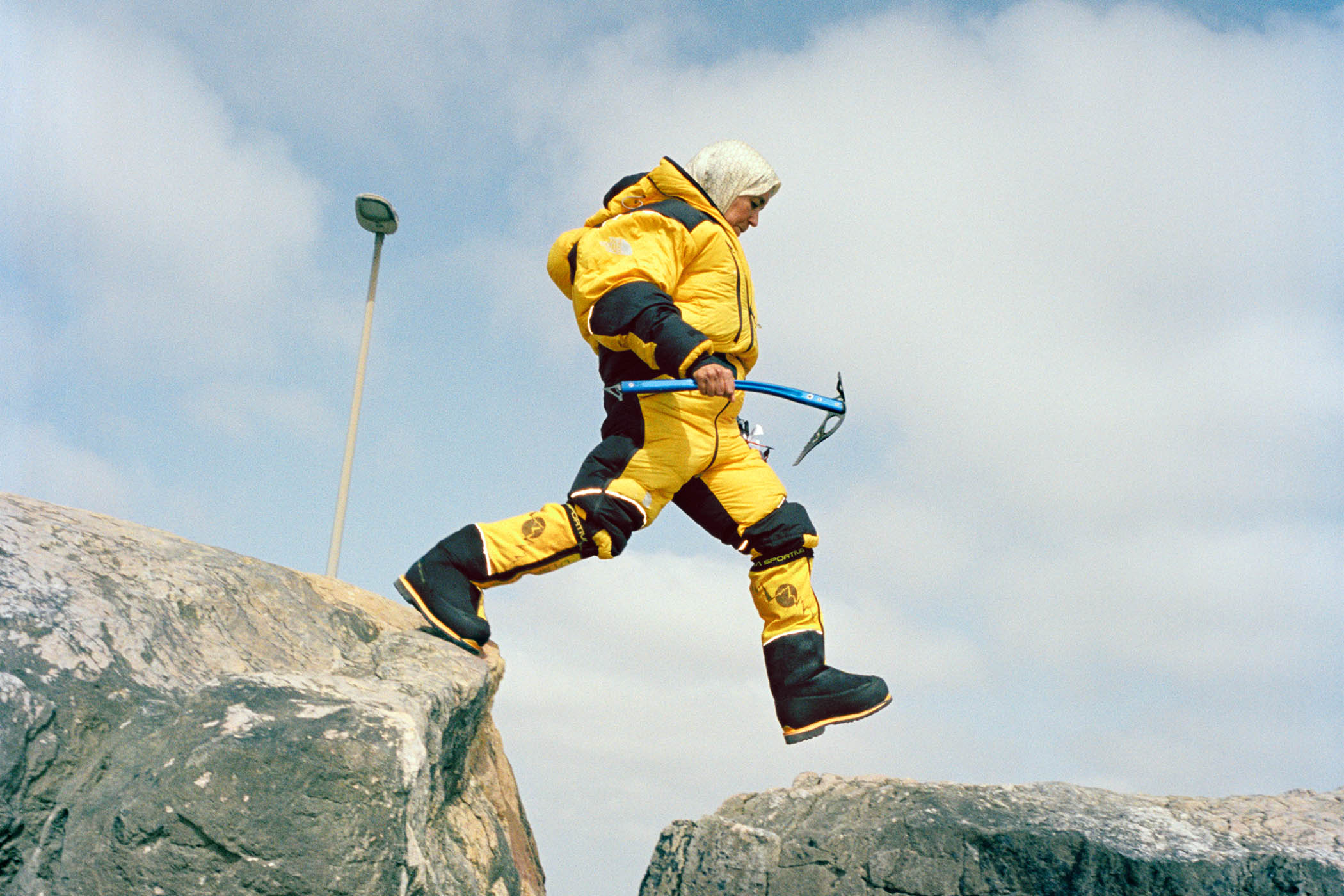

The polar peak of Mount Vinson– the highest in Antarctica, 4,892m above sea level – and the mild Mediterranean climate of Rabat have little in common. The former, adventurer Bouchra Baibanou explains, can be extraordinarily harsh. She climbed Vinson seven years ago, and is due to return to the Antarctic shortly after we meet at her home in October. “When there’s no wind, it’s OK – it’s around -5C, -10C. But when the wind starts, it’s sometimes -30C or -40C. It’s very, very cold”. She shivers at the thought. The Moroccan capital can be tropical by comparison, which seems apt, given that so much of Baibanou’s life is defined by contrasts.
The sun is bouncing off the smart white-and-tan apartment buildings in Baibanou’s tree-lined neighbourhood, not far from the Moroccan coastline. Now 56, she only took up mountaineering in earnest in her early 40s, going on to become the first North African woman to climb the world’s seven highest summits (Vinson among them), including her ascent of Everest, which she did in 2017. She is also a wife, a mother to a grown-up daughter, and she’s a hijab-wearing Muslim who keeps her Qur’an close. We meet on a Friday, and she interrupts our conversation once, briefly, to pray. A story on a Moroccan news website from 2014 described her as a “voix douce, mais un caractère bien trempé” (a soft voice, but a strong personality).
We chat over a mint tea in her living room, in an apartment filled with beaded curtains, embellished cushions, inlaid tables and a large embroidery hoop with a handmade portrait of Baibanou in her mountaineering gear. She’s generous from the off. Am I hungry? Would I like to visit some local sites? When we first met I offered a handshake and instead received a hug.
“When I am climbing mountains, it’s as if I’m free from everything,” she says. “I can fly. I can be in the sky like the birds. It’s one of the things I defend most in my life.” There is an intrepid, treacherous side to Baibanou’s expeditions. Take her visit to Manaslu in the Himalayas in 2022, dubbed the “killer mountain” due to its mix of steep slopes, high altitude and unpredictable weather, where she experienced “a big avalanche… at that moment, I told myself, maybe I will not survive. I started praying and I started waiting, maybe it will take me. But, Alhamdulillah [praise be to God], I was safe.” Many people died on the mountain that year, among them the American climber Hilaree Nelson, who fell from a 1,500m slope. “There, I told myself: never again. It’s too dangerous. But when you come back and relax…” Baibanou smiles. “You think about restarting training.”
Baibanou has written a book about her adventures, Mon Chemin vers les Sept Sommets du Monde (My Path to the Seven Summits of the World), currently available in French, but which she is hoping to publish in English. Her climbs have earned her multiple awards from the king of Morocco, Mohammed VI. Humbly, she describes herself as “a little famous” in the country – “not very”, as her daughter, Hiba, wafts into the room with a plate of biscuits.
Until five years ago, Baibanou was balancing mountaineering with a full-time job in the Moroccan government. She is a telecommunications engineer by trade. “I had to find a solution,” she says, “because I had only one month of holiday.” Expeditions were maxing out her annual leave allowance, so she registered as an athlete with the government. “When you represent your country, they give you extra vacation.” She has had to be equally entrepreneurial when it comes to finding sponsorship for her trips, which can cost six figures. She identified potential cash backers and realised, “If you find one person who also loves mountains, they will take care of it.” After she climbed Everest, she gave up the government gig.

On Manaslu, the killer mountain, ‘There, I told myself: never again. It’s too dangerous. But when you come back and relax…’
Baibanou discovered a passion for hiking as a child at summer camp. As an adult, she climbed Toubkal (4,167m), in the Atlas mountains, and volunteered with a group that guided tourists.
For a while she continued to develop her hiking skills, “just as a hobby”. In 2011, she and her husband, Lahoucine, had been saving to go to Mecca, for the Hajj pilgrimage, but failed to secure a slot in the annual lottery. Baibanou was devastated, but suggested using the money to travel to Tanzania instead, enticed by the prospect of climbing Kilimanjaro. “Not going to Mecca at that time opened this door for me,” she says. “Allah directed me to do that. And after, when I finished, I went to Mecca anyway.”
She didn’t expect to reach the summit. “I was afraid. I told myself, I’m not used to this altitude. But I was curious to know what my body would do, how it would react, and it’s there when I pushed myself beyond my limits. That helped me to build my confidence.” When she returned from Kilimanjaro, she began to think, “Why not dream big?”
Baibanou trains intensively: yoga, bodybuilding, cardio and swimming. Even with the most rigorous preparation, however, she is still vulnerable to the elements. Climbing Mount Everest, she “had snow blindness. I took off my goggles and the UV and snow just blinded me… I was very afraid.” The effects lasted several days. “I couldn’t read anything. Everything was just white.” Her vision eventually returned, but she suffered severe frostbite, too. “My fingers were all black. I went from the mountain directly to the hospital.” Fortunately, no fingers were sacrificed.
There is also a mental load that comes with attempting such perilous feats. She has lost friends to the mountains, and doesn’t take risks lightly, saying that “80% of accidents happen during descent, because people think it’s over. In the mountains, we say, your success doesn’t happen until you come down.” Unlike many sports, where an athlete’s greatest prize is gold, “Here your medal is your life. When I am there, I switch off from everything else.”
Faith also keeps her going in times of crisis and, in turn, she is all too happy to quash preconceptions. “Many, many people think that Muslim women can’t do things, or that they’re not free,” she says. “But when they see me do what I do, they know that they are free. They can free themselves from stereotypes and judgment.” She wants to be a role model for young girls, and has founded an organisation in Morocco that promotes her sport, especially to them, teaching them about hiking and teamwork. Alongside the likes of boxers Khadija Mardi and Imane Khelif, she is reshaping what female North African sportswomen can achieve. “They can do whatever they want – they can dream.” Baibanou is relentlessly positive, but not saccharine: the soft voice and strong character.
There’s a chapter in her book titled La Joie de l’Echec (The Joy of Failure), which describes a botched attempt to climb Argentina’s Aconcagua in 2012. Her latest setback was on K2 this summer. It was nothing short of a disaster, with rising, climate change-induced temperatures fuelling catastrophic avalanches and rockfalls. “If a rock hits you, you die,” Baibanou says bluntly. The mountain is “very, very dangerous right now.”
It was among the most frightening climbs she has attempted, and one she didn’t finish – the conditions were too perilous. Failure is an occupational hazard. It’s something she has made peace with. “It’s not easy, you have to have lots of resilience,” she says. “I was frustrated.” Still, she made it home in one piece. “The most important thing is that I am alive. I didn’t succeed, but it’s OK.” Then she adds, typically upbeat and steely: “Maybe I’ll try again next year.”
Bouchra Baibanou’s seven peaks
1.
Kilimanjaro Tanzania, 5,895m, 2011
2.
Elbrus Russia, 5,642m, 2012
3.
Aconcagua Argentina, 6,965m, 2014
4.
Denali Alaska, 6,194m, 2014
5.
Carstensz New Guinea, 4,884m, 2015
6.
Everest Himalayas, 8,848m, 2017
7.
Vinson Antarctic, 4,892m, 2018
Photographs by Andrea Spotorno
Newsletters
Choose the newsletters you want to receive
View more
For information about how The Observer protects your data, read our Privacy Policy