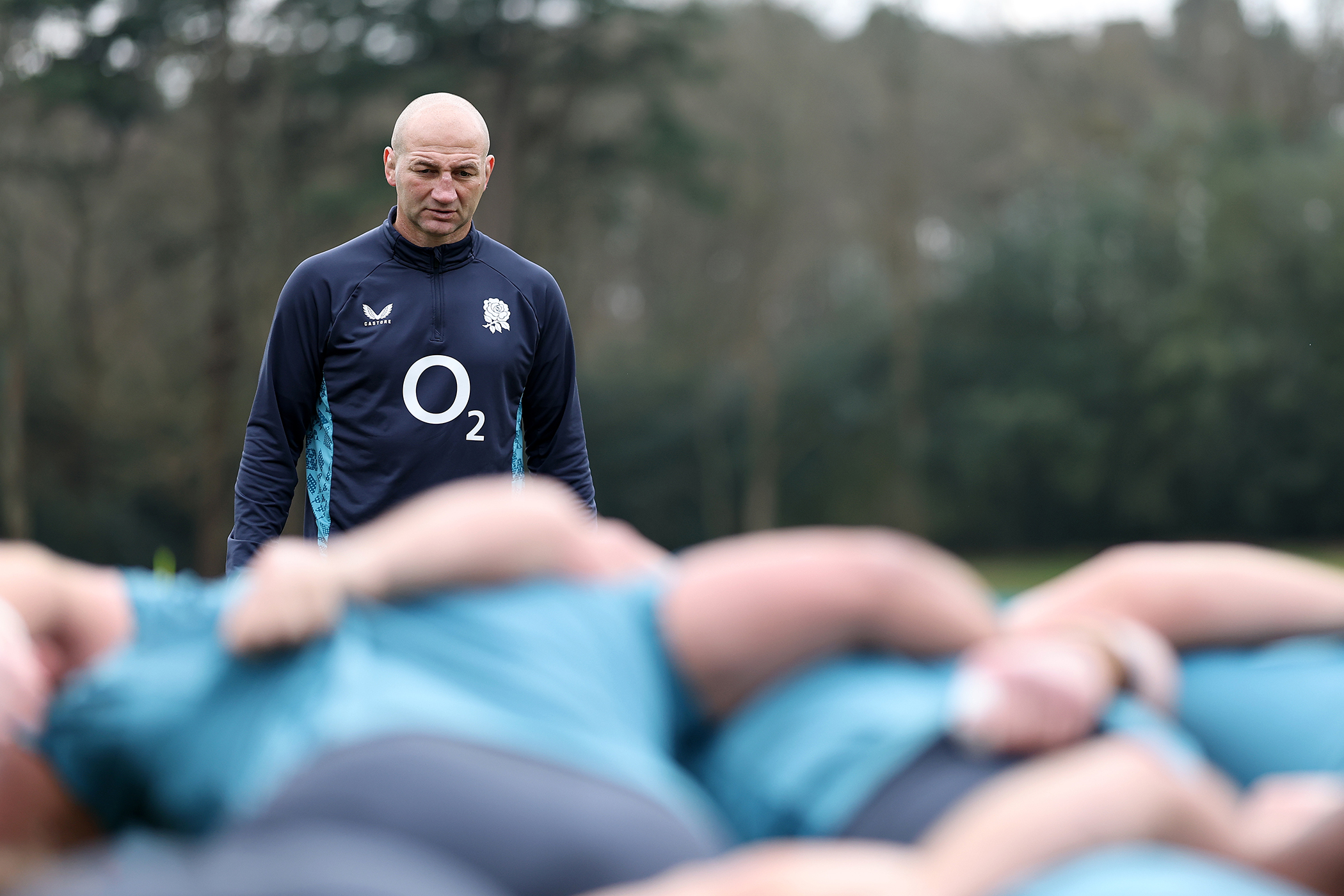

Funny, isn’t it, how quickly a team can lose that sense of consistency. Steve Borthwick has been largely viewed throughout his England tenure as a steady operator, hyper-focused on detail, someone who is not prone to rash decisions. Few big celebrations after a win, few flamethrowers after a defeat.
Look a little closer, however, and the signs were there going into the game against Ireland that the axe was ready if required. Borthwick spoke about how he had backed certain players, without naming them, to produce a performance against Ireland after what happened at Murrayfield. Being 22-0 down inside half an hour was presumably not the response he hoped for.
If you lay out that demand publicly and then the players fail to back it up, then what other choice do you have but to make changes? Alex Mitchell and Ollie Lawrence are enforced absences through injury. George Ford, Fraser Dingwall, Henry Arundell and Freddie Steward, on the other hand, have all been binned. Steward’s demotion was the most public, brought off the pitch minutes after he had managed to get back on it following the end of his sin-bin against Ireland. Borthwick later said that England required Marcus Smith on the field to chase down a growing deficit. Steward’s absence entirely from the squad this week suggests there was more to it.
Listening to Borthwick this week, this is a selection that rewards those players who have performed well in training. There has been a continued emphasis on the whole squad excelling in those sessions throughout his tenure. Ford was a prime example. Before he won back the No 10 shirt in Argentina last summer, Borthwick would rave about Ford’s attitude in training. Tuesday’s media session was like listening to an old album for the first time in a while, hearing Borthwick describe Ford as “an exceptional player. When he's not been in the team, he is the role model of exactly how a player should be, how they play and how they train.”
There is an admirable ruthlessness to the decision to cut Ford, revered for his vision out in the thick of the action, the kind of conductor that other conductors look at and want to emulate. That said, if Borthwick watched Ford misfire with a second penalty to touch against Ireland and in that moment thought “Well, time for a change there”, then you could hardly blame him. Some execution errors are more egregious than others. Fin Smith, a bit like Ford in last year’s Six Nations, must have been wondering when he would get a start again, given England’s preference for a six-two bench split and Marcus Smith’s ability to cover fly-half and full-back. Now he’s back, tasked with sparking a stodgy backline, especially in the opposition 22, into life.
Borthwick deserves praise for this showing of ruthlessness. But there a high chance this leap into the unknown completely backfires.
Borthwick deserves praise for this showing of ruthlessness. But there a high chance this leap into the unknown completely backfires.
What Borthwick and England have opted to do – on the back of defeats by Scotland and Ireland that were so disastrous that the memory of their previous 12-Test winning run is now merely ashes – is essentially swap in the backline who have been training very well against the starters over the past three weeks. Ben Spencer and Fin Smith as the half-backs, Seb Atkinson at inside centre partnering Tommy Freeman – the only back retained from Ireland – with a back-three of Cadan Murley, Tom Roebuck and Elliot Daly. The shadow backline thrust into the spotlight.
“[Even] if you haven’t played in a game with each other, you have trained three, four, five, six, seven, eight times together and you understand what each other is doing and you understand what we want to do as a backline,” said Daly. Perhaps reading that will give England supporters reassurance, but you still need to see it in action to believe it.
Finding the right word to describe Borthwick’s carve-up has been tricky over the last few days. Bold doesn’t quite work. Rash? We’ll find out. Punchy, maybe.
It certainly feels “un-Borthwick-like” to rip up a backline this way. Teams might have done this in the past against Italy, except now Wales are the new Italy, the opponent you can allow yourself to tinker personnel and tactics against knowing you can still win. Italy, this Italy, in Rome? Absolutely not. Scotland (twice) and Wales have lost there in the last three years, and Australia (in Udine). Rassie Erasmus was not kidding around back in January when he said the Azzurri would cause some trouble in this Six Nations.
England like Atkinson for multiple reasons: a direct carrying threat – “I think he brings, obviously, physicality,” as Daly put it – which they have lacked with a smaller back row, plus Atkinson’s exceptional fitness which allows him to cover more ground in defence. He can offload too, which would be nice to see, given England have only produced 17 in three games so far, one element of why their attack has become so easy to stop. Too flat, too meagre, too predictable.
Newsletters
Choose the newsletters you want to receive
View more
For information about how The Observer protects your data, read our Privacy Policy
Their failure to clear rucks effectively against Ireland was striking, blasted off the ball too often by more aggressive opponents. Adding more heft into the pack may have solved that, but England are wary, too, of the breakdown threat of Italy’s Manuel Zuliani and Michele Lamaro, opting for back-row pace over size. Italy will kick long, back their defence, hunt turnovers and errors, which England have made plenty of in their last two outings. Their elite centre pairing is back, the gain-line basher Tommaso Menoncello paired with architect Juan Ignacio Brex. The prospect of Italy’s in-form scrum going after Bevan Rodd, the replacement loosehead who has looked suspect, is concerning. England know what is coming. Can this refreshed side handle it?
At Pennyhill Park this week, Maro Itoje, the England captain, was spotted deep in conversation with Thomas Tuchel, the England men’s football manager. The day beforehand, Matt Weston, the double gold-winning Olympian in the skeleton, was also in camp. There is a joke to be made there, about Weston teaching this England side how to go downhill fast, that I will let you finish.
What a swing in events, from pre-tournament title contenders to the very real prospect of a first ever defeat by Italy. Borthwick, viewed as a steady, data-driven pragmatist, deserves praise for this showing of ruthlessness. There is also a high chance this leap into the unknown completely backfires.
Photography by Dan Mullan – RFU/Getty Images