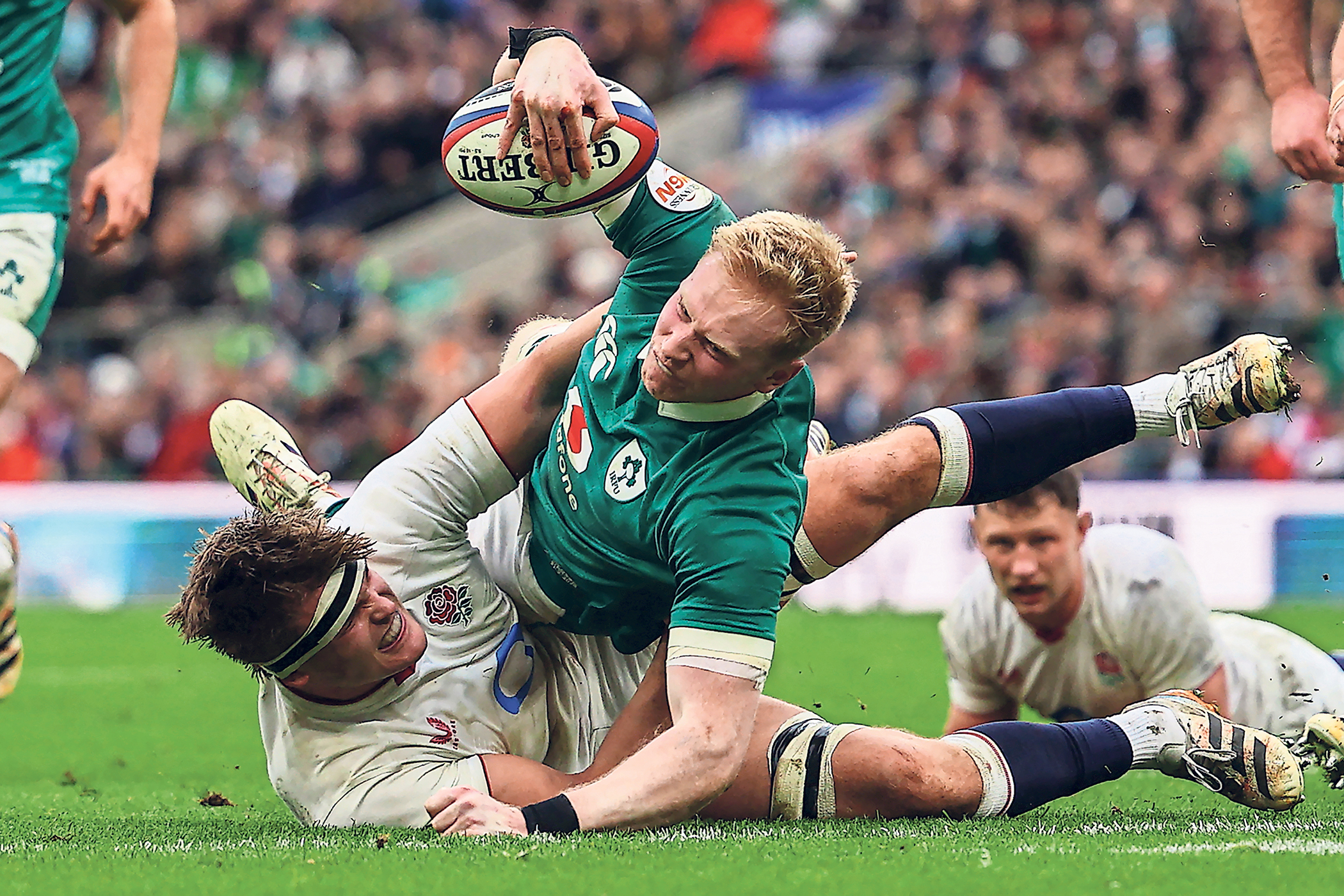



How much juice can Andy Farrell still squeeze out of this Ireland group? The problem with your detractors suggesting over and over that your side are too old, too past it, is that you need definitive proof to quash those accusations. Well, this win at Allianz Stadium, a record victory at Twickenham for Ireland, should certainly help.
It is remarkable how quickly England have gone from looking like a promising side to an outfit with a dominant scrum and little else. After 29 minutes England trailed 22-0 and the scoreboard could not have been fairer to them, they were so abject.
In that first half hour, George Ford, once viewed as so reliable that he was referred to as essentially a player-coach out on the field, missed one kick to touch short and kicked another dead. England also reached five metres out from the Irish line and then forced passes that went to ground not once, but twice. Their accuracy in the opposition 22 was a problem even against Wales, except Wales were so poor that it did not matter. Here, it did. They had 12 entries into the 22 compared with Ireland’s nine.
After that win over Wales, Ben Earl said: “We know we’ve got the toughest run of four, five weeks we’ve had in a long time,” and boy, does it feel like it.
Those attacking flaws are not a new problem – England have been trying to construct a fluid attack since their epiphany during their York camp midway though the 2024 Six Nations – yet there had been signs, breadcrumbs really, that they were figuring it out. Here they lacked power, even with the return of Ollie Lawrence brought in at outside centre to straighten the attack, but the problem was bigger than Lawrence, who was understandably rusty. Faltering composure in the red zone is an English tale as old as time. Too often they lack conviction in attack, and that is a coaching failure as much as it is on the players.
What is increasingly harder to understand, however, is the demise of England’s lineout. That is head coach Steve Borthwick’s bread and butter, his speciality. Two weeks in a row England have stuttered there – miscued throws, ill-timed jumpers, no sign of a clear connection between hooker, lineout caller and receiver. Luke Cowan-Dickie getting the hook after 29 minutes after missing tackles and the man he was throwing to wasn’t a shock, but England’s issues at the lineout were systemic. No one fears their maul any more, because it does not bully teams like it used to. Not in the areas of the pitch where it matters, anyway. Joe McCarthy was the proverbial hot knife slicing through butter for the first maul to force a turnover, setting the tone.
‘The 12-Test winning run feels like a long time ago. England have a lot of flaws’
‘The 12-Test winning run feels like a long time ago. England have a lot of flaws’
To give you an idea of just how abysmal a performance this was by England, referee Andrea Piardi injuring himself chasing after an Irish break and having to be replaced after about half an hour ended up being a footnote.
Credit has to go to Ireland for several areas, not least the mastery with which Jamison Gibson-Park played, the scrum-half surely one of the easier player-of-the-match decisions of the past few years. Razor-sharp to every attacking opportunity that fell Ireland’s way, he certainly answered that age question.
Robert Baloucoune’s pace but also his defensive awareness stood out; a player who has had to wait to be trusted with a starting role on the wing surely locking it down for the foreseeable future. His break to create Tommy O’Brien’s try was exquisite. Stuart McCloskey has been in cracking form and delivered again, crashing his way repeatedly through England’s midfield. He made England look small, thumping Lawrence back in one tackle. Ireland, in fact, made England look small. That is a problem. Defensively in the wider channels, they can be picked on. The reason England lean so heavily on a box-kicking strategy is partly because they cannot bash their way through sides, because as Borthwick so often points out: “We don’t have a huge pack, we have speed and athleticism in our back row.”
Here they were relying off scraps in the air and when they did move the ball past the first set of hands, they were thumped backwards or were forcing offloads that were not there, turning over possession. They lost the ball in 22 turnovers this week, on top of the 20 at Murrayfield last weekend.
Newsletters
Choose the newsletters you want to receive
View more
For information about how The Observer protects your data, read our Privacy Policy
Ben Earl makes a tremendous number of carries but rarely do they travel far. Asking Fraser Dingwall to carry up into traffic does not suit his skill-set. Relying solely on a dominant scrum is not a winning approach when you cannot do anything with the ball after you move up the field.
That is, if you can find touch in the first place. The ironic cheers when Ford did start finding touch after penalties will have hurt. The confusing approach with Freddie Steward – bringing him back on after his yellow card, then immediately hooking him for Marcus Smith – summed up the muddle England are in, defensively in particular.
Borthwick said before the tournament “on 14 March in Paris, we want to be in a position in that game, entering that game, we want to be in a position where we can achieve what we’re all aiming to achieve”. England after two losses will not be in that position. Instead, they are now a side riddled with doubts.
George Furbank, even with no game time, must start in Rome at full-back if England do not go with Smith. Alex Coles, too, either at six or with Maro Itoje there, to add some bulk. Moving on from Dingwall has to be a consideration at inside centre in favour of the more direct Seb Atkinson. Henry Arundell may not get another go on the wing, with Tom Roebuck – poor himself against Scotland – rested here, while it is hard to see Alex Mitchell starting at scrum-half.
The 12-Test winning run feels like a long time ago but, in a roundabout way, better to expose your flaws now, in excruciating fashion, than at a Rugby World Cup. England, it turns out, have a lot of them.
Photography by Adrian Dennis/AFP/Getty Images