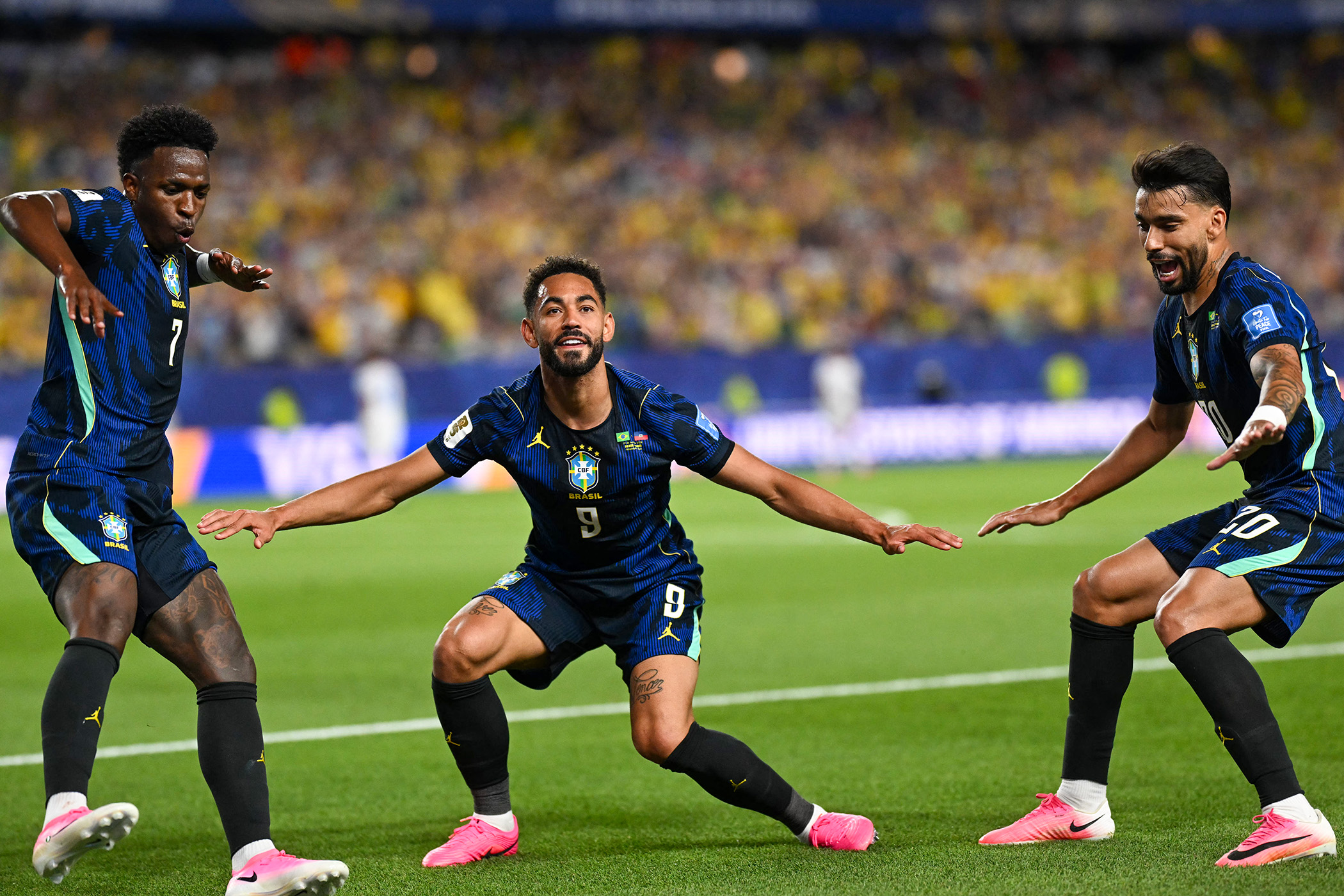

The first beats of the story that ends with Matheus Cunha leading Brazil’s attack at a World Cup are familiar. Without being glib, they follow what is by now an established pattern; the precise details are always different, personal, but the broad outline of the long journey from there to here tends to be the same.
There is the moment, as a teenager, when he moves thousands of miles from home to pursue his dream, in his case swapping the coastal city of João Pessoa for landlocked Coritiba, deep in the south. He arrives whippet-thin, so skinny that the “kits were even too big for him,” as one of his former coaches put it. He sleeps in the club’s dormitories, in the bowels of the stadium.
And then, of course, his talent makes itself known. Not only that, in fact: his industry, his determination, his relentless desire to improve. “He always stood out for his strong personality,” César Bueno, his first coach at Coritiba, told the Brazilian outlet Globo Esporte. “A winner.” He does not seek credit, but his pride at helping Cunha on the way is evident.
Where Cunha’s story diverts from accepted narrative convention is what happens next. Curitiba is not one of Brazil’s great powers. To have produced a striker who went on to sign for Manchester United, to play for his country in pursuit of o hexa – a sixth World Cup – should be a rare badge of honour. To some extent, it is. But it is also a source of regret.
Cunha spent four years at Coritiba’s academy, being turned from an attacking midfielder into a forward, building up his strength and his speed, slowly filling the shirt. Then, at the age of 18, he was sold for a nominal fee to the Swiss club Sion. The club needed the money to sign a defensive midfielder. Cunha did not make a single senior appearance for Coritiba.
As might be expected, Cunha’s presence in Carlo Ancelotti’s squad has caused a degree of soul-searching at the club that sold him – in the words of one local columnist – for “30 pieces of silver.” He is, Julio Filho wrote, the “symbol of an age of error. It is a true reflection of the lack of ambition and vision that have plagued” the team.
Coritiba are not alone in that. There are worse ways of gauging the relative economic strength between European and South American football than how many domestic-based players are called up to represent Brazil at the World Cup. In 1994, the year they won their fourth trophy, half of the country’s squad – 11 players – were playing in Brazil’s Série A. In 2002, when they claimed their fifth, there were 12.
In the years that followed, though, that figure dropped precipitously, dropping as low as two in 2006 and rising no higher than four, in 2014 and 2018. That maps fairly accurately onto the period when Europe accelerated away from South America as the game’s financial engine, the money and the glamour on offer in the Champions League enticing away almost all of Brazil’s best players.
It is heartening, then, that Ancelotti has been able to name seven this time around, albeit that does include Neymar, now 34 and struggling with an injury, who basically seems to have been included as a mascot. Brazil’s major clubs have, in recent years, taken advantage of legal changes to become more professional, more commercially minded, more able to resist the siren call of the old world.
There is still a sense, buried deep somewhere, of what might have been
There is still a sense, buried deep somewhere, of what might have been
But that does not quite paint the whole picture, because Brazil’s squad also contains a substantial number of players who played only fleetingly – and in some cases, like that of Cunha, not at all – in Brazilian domestic football.
Newsletters
Choose the newsletters you want to receive
View more
For information about how The Observer protects your data, read our Privacy Policy
Gabriel Magalhães, the Arsenal defender, featured for Avaí, a modest team based in the surf resort of Florianopolis, for a single season. Raphinha, who played in the same youth sides as the defender, did not even manage that; he left for the Portuguese side Vitória Guimarães while he was still a teenager.
“Not even the fans knew Raphinha,” said Rodrigo Faraco, a commentator in Florianopolis who covered both Gabriel and the winger when they were emerging at Avaí. “He was sold as he made the transition between being in the youth academy and going professional.”
Fabinho, the former Liverpool midfielder, was named on Fluminense’s bench once before he was plucked by another Portuguese club, Rio Ave. He stayed there for a month before moving on loan to Real Madrid’s youth team. He has also never played a senior game in his homeland. Marquinhos did slightly better: the defender featured eight times in the country’s top flight before joining Roma.
There are many more who played just a handful of times, often for smaller, provincial teams – Itúano (Gabriel Martinelli) and Naútico (Douglas Santos) and Ribeirao (Éderson) – that might rarely intrude on the national consciousness but regularly attract the eagle-eyed attentions of the cadres of European scouts employed to scour Brazil for even a hint of promise.
Often, their first port of call in Europe is not an obvious upgrade; for years, Brazilian clubs’ relative penury meant they had to sell to whichever European team could afford to pay.
Ancelotti only drafted Igor Thiago, the Brentford striker, into his squad in March, despite the fact he had spent the season scoring more goals in the Premier League than anyone other than Erling Haaland. His first step after leaving Brazil had been the Bulgarian side Ludogorets Razgrad.
The impact of all of this is to give Brazil a slightly detached relationship with its national team; with some members of it, at least. The country has spent a generation coming to terms with the idea that its best players work abroad, even if quite how frequently they play their friendlies outside South America for logistical purposes has long been a bone of contention. Not seeing the team up close, the criticism runs, makes it hard for Brazilians to bond to it.
That is even more pronounced when so many of the players are inherently unfamiliar, when there is no fanbase that has a loyalty to them, when they have not had a chance to form a first impression, let alone a lasting one. In a footballing sense, there are a number of players in Ancelotti’s squad for this tournament who are as European as they are Brazilian.
Ancelotti is the first foreigner to manage Brazil in the modern era; a surprising number of his players have had to overcome the fact that they may well be even less familiar to their public, too. “Everyone is proud,” said Faraco, the commentator in Florianopolis. “Avaí has been posting about both Gabriel and Raphinha.” To have produced a player for the national team remains something worth boasting about. But there is still a sense, buried deep somewhere, of what might have been.
Photograph by Mauro Pimentel / AFP via Getty Images