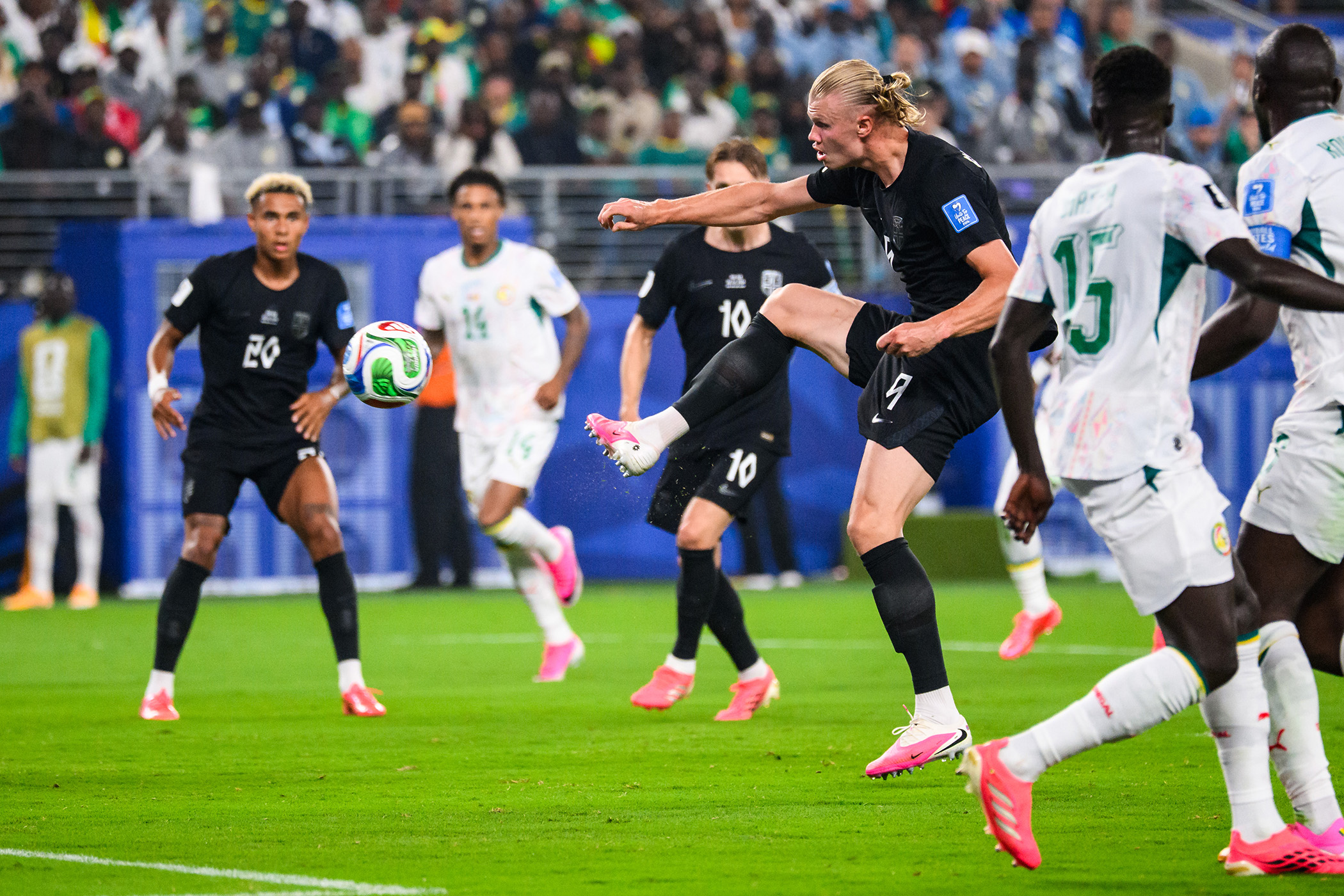


There’s a classic line about Sergio Busquets, attributed to Vicente Del Bosque but actually ripped off a fan forum, that if you watch him, you see the whole game. Well it turns out to watch just Erling Haaland is to miss the vast majority of the game, staring intently at a man ambling about near the centre circle, then jogging a bit, walking some more while remonstrating and whinging and waving his arms as though drowning. On a New Jersey night where greyness threatened to consume everything, here was the quintessential Haaland performance, a game that largely happened without him but which he defined and decided, as he guided his country to a 3-2 win over Senegal.
Haaland’s perceived roboticism has always been a misconception rooted in the idea that scoring so prolifically requires this impregnable yogic calm and balance, that he must not feel and fear, a facade he has often leant in to. And yet his basic state is exasperation, emotions see-sawing wildly, a life of extremes. Every misplaced pass or spurned opportunity infuriates his insatiable pursuit of perfection.
Take his second goal against Senegal. As Marcus Holmgren Pedersen scurried into the box, Haaland slunk away from Kalidou Koulibaly and took up residence on the penalty spot. Pedersen’s ball arrived two feet behind Haaland and he instantly started berating himself and Pedersen and fate, head fleetingly in hands while play continued behind him. Four seconds later he scored, contorting himself to manoeuvre a cross fizzed into his weak foot at knee-height from about eight yards onto the underside of the bar. The magic is in his ability to refocus and restart unburdened and instantly, to find equilibrium in the perfect moment.
It is often said of elite footballers that the numbers don’t do them justice, don’t fully explain their genius, yet Haaland is the opposite. The numbers tell the story, the numbers are the point, numbers that swell and bulge at the edges, numbers on the verge of a coronary. Fastest to 50 Premier League goals, then 100, breaking the single-season record in his debut season. Fastest to 50 Champions League goals, needing 43 goals in his next 64 games to break Lionel Messi’s record to 100. There’s no defining Haaland moment, just a series of archetypal goals amalgamating into this menacing mass of thundering left feet and cascading blonde hair.
International football, particularly major tournaments, always tells us something different about players, lets in a fresh light. For the first 45 minutes against Senegal Haaland was almost pathologically selfless. He helped create two brilliant chances for Martin Ødegaard, the first by distracting three defenders, the second with a deft leaping flick. His goals came by waiting for the right moment, an exhibition of patience and readiness, a reminder that he is oddly ego-less for someone in a selfish profession. Only 11 players have more Premier League assists since he joined Manchester City. He largely makes the decision that benefits the team – that just tends to be the one which involves him shooting, always in the most space with the most time.
To date his international career has seemed like a side-quest experienced only through headlines and occasional clips. His international record – now 59 goals in 52 games – is obnoxiously, almost unfathomably, good. He’s been Norway’s all-time top men’s scorer since October 2024, a 97-year-old record, and is already their record men’s World Cup goalscorer, doubling Kjetil Rekdal’s two. His 16 goals in qualification was also a record, doubling Harry Kane, Marko Arnautovic and Memphis Depay’s eight in joint-second. Haaland, Gerd Müller and Sándor Kocsis are the only three players to have scored at better than a goal per game over more than 20 caps post-war. Kocsis last played for Hungary in 1956, Muller for West Germany in 1974, both representing nations with reasonable claims to being the best in the world for significant parts of their respective careers.
There’s a reasonable argument that Haaland is already the most famous Norwegian ever, usurping Edvard Munch and Henrik Ibsen and Thor and A-ha. Journalist Eirik Grasaas-Stavenes called him “Norway’s most valuable commodity since oil, salmon, and the tripartite cooperation between trade unions, employers, and government,” while his Norwegian identity is largely underexplored. Last August he added his mother’s surname – Braut – to his Norway shirt, as per Norwegian custom. He and his dad (who the traditionally socialist Oslo set appear to have turned on after he moved to Switzerland to avoid paying tax) spent £100,000 on the only surviving copy of “Heimskringla” – a book of 16th-century Viking sagas – and then donated it to his hometown’s public library. He has said if he weren’t a footballer, he would work on a farm at home, still drinking raw milk every morning. He also has a Hermes handbag collection worth £650,000. A life of extremes.
Haaland appeals to something very base within us: the biggest and fastest and strongest and best, the Timotei advert hair, the eccentricities which hint at genius. The most legitimate criticism of him is that devoid of context, of the totality of the Haaland package, he rarely produces moments of extreme beauty or fun, unless the minutiae of striker-play really gets you going. He feels both like a product of a very modern world, the logical progression of a sport evolving and refining, but also an expression of a primal, pure ideal, the boy born to score, a life geared in service of goals. We have both watched him grow up and yet he never seems to age. There’s this beautiful discord between his status as a genuine footballing advancement who also doesn’t know how to take a throw-in, who you cannot imagine playing any other position or role.
English football resents superstars, an oddly egalitarian vehicle which makes players subsidiary to superclubs. But Haaland is this irrepressible combination of footballer and personality, an instantly recognisable and increasingly beloved global brand in himself, probably least appreciated in the country where he plays most of his football. “When people are speaking about you, it’s a good thing,” he told Gary Lineker last December. “If no-one is speaking about you, it’s not a good thing as a footballer.” His goals can become background music in the wider Premier League saga, a constant drumbeat.
But you only had to look around the MetLife on Monday evening at Ødegaard conducting the Norwegian players and fans rowing in unison, at the waves of euphoric red limbs, to find the joy in Haaland, find the magic and fun in his handiwork. To watch Haaland might not show you the whole game. But it will show you the parts that matter.
Newsletters
Choose the newsletters you want to receive
View more
For information about how The Observer protects your data, read our Privacy Policy
Photograph by Tom Weller/DPA