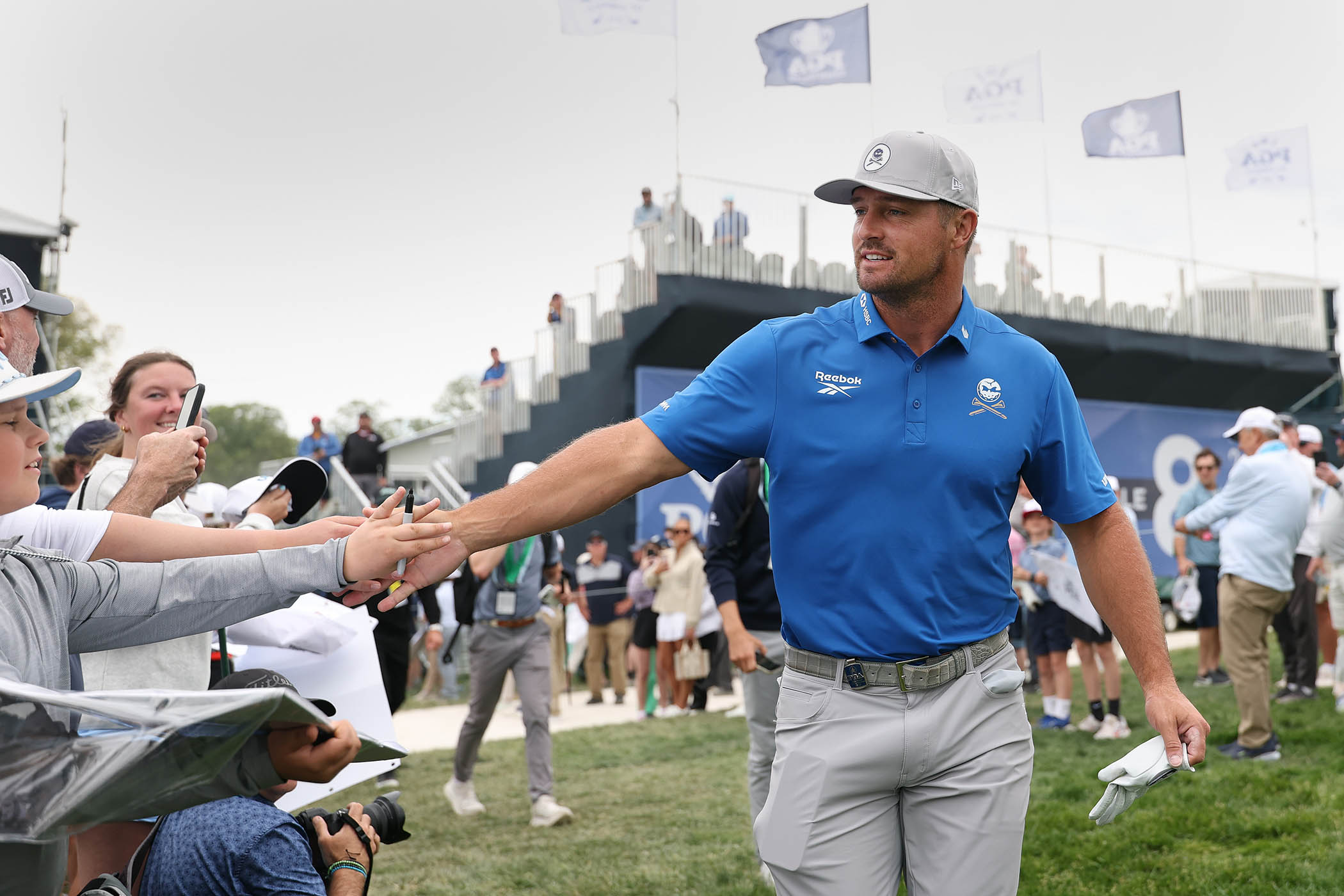
A few years ago, Bryson DeChambeau was asked about September 11. The all-American face of all-Saudi money was on CNN, repping the skull and crossbones of his LIV Golf team Crushers GC, the eternal symbol of the good guys.
After clarifying he did not want “anything like that” to happen again – always good to know – DeChambeau inexplicably continued talking: “We have to look towards the pathway of peace and forgiveness, especially if we are trying to mend the world and make it a better place. This is what LIV is trying to accomplish, the PIF [Saudi Arabian Public Investment Fund] is trying to accomplish, we’re all trying to accomplish: a better world for everybody.” His explanation for the murder of journalist Jamal Khashoggi? “Nobody’s perfect, but we’re all trying to improve in life.”
Somewhere in here, beneath the grandeur and naivete and fronting a regime like that of the Saudis, is the DeChambeau Doctrine: saving the world through golf, and golf through the world (it is largely unclear why golf needs saving. The world case is clearer).
In a soft light, Donald Trump’s favourite player is a tragic figure, desperate to be loved yet condemned by that same desperation to exist on the periphery, both blindly pliant and convinced of his own intellect and independence. A devout Christian, DeChambeau seemingly considers spreading the golfing gospel his moral imperative (when the putts weren’t dropping as a student at Southern Methodist University, he would ask his mother “why is God doing this to me?”). And after it became apparent that the PIF were an imperfect vessel through which to achieve his divine goal, withdrawing their funding in LIV at the end of this season, he has found a new mission: “Giving the world more reason to watch YouTube”.
Aside from being a two-time US Open champion, DeChambeau is among the most popular golf YouTubers, with 2.7 million subscribers. What started with the standard athlete-as-content-creator schtick (“A Week on Tour”, “WHATS (sic) IN MY UNIQUE BAG”) has become oddly watchable. He has filmed with Carlos Alcaraz, Stephen Curry, Adam Sandler and Trump, alongside such content behemoths as Rick Shiels, Grant Horvat and the Nelk Boys.
With his LIV contract expiring at the end of the season (he had been chasing a $500m deal) and his feud with the PGA Tour unresolved, DeChambeau said last week his ambition is to “grow my YouTube channel three times, maybe even more” and then “play tournaments that want me”. He talks a lot about the value of dubbing. Maybe he’s bluffing. But maybe he’s not. Those close to him reportedly believe he’s serious. He called the PGA Tour’s proposed rejoining penalty “quite unfortunate, considering what I could do for them,” genuinely followed by “egos need to get dropped”.
He has an exemption into the US Open until 2034, and the other three majors until 2029, a five-year clock which will restart if he wins another. But if the vast majority of his preparation is trying to break public course records and playing in Internet Invitationals, is that remotely possible? Can you be a full-time YouTuber and part-time professional golfer, and why would you want to? Whether he can earn close to the $225 million he has accumulated through prize money and contracts to date is largely irrelevant when you already have $225 million at 32.
And anyway, DeChambeau said last week his reason for filming videos is solely “to grow the game of golf”. By almost any metric more people watch golf YouTube content week-to-week than watch the PGA Tour; his round with Trump has been viewed 17m times, and almost every YouTube video he has filmed was watched more by more people than the average LIV Golf event. A majority of fans under 35 just watch majors, and fill the gaps with shorter-form content. Why not meet your audience where they are?
Perhaps this is a new model for player power, for regaining agency. Maybe, when everything is content, taking as much control of that content is just the logical play, both self-promotion and self-protection. Maybe this is what an increasingly significant number of viewers actually want from sport, everything on demand, only ever lasting an hour and featuring their favourite celebrities, controlled and predictable and easily comprehensible. But at what point does sport stop sport? At what point will golf content start eating its host, stripping its soul and meaning, and are we already there?
The clearest indicator of how this might go can be found by analysing DeChambeau’s history of big gambles. Both joining LIV, and then being the last player to leave the antitrust lawsuit against the PGA Tour. Not only believing everything the PIF told him, but betting his career and reputation on it, believing long after the music stopped. He has called Trump “a great golfer, and a better human being”. There was declaring Augusta National a “par 67” in 2020, since then he has carded a round below 67 once. He spent his late 20s believing he could break golf by bulking himself to the brink of a coronary. Perhaps worst of all, for years he thought he could pull off a flat cap.
Newsletters
Choose the newsletters you want to receive
View more
For information about how The Observer protects your data, read our Privacy Policy
Here he is again, betting everything on a new way to save first golf, then the world. As he often is, DeChambeau was the last man on the driving range at Aronimink on Tuesday evening ahead of the PGA Championship starting today, obsessively twitching and tweaking, never knowing when to stop so just swinging until he can swing no more. Perhaps he will miss once again, but I suppose nobody’s perfect. We’re all just trying to improve in life.
Photograph by Emilee Chinn/Getty Images