

Pretty much every team, as the kids say, could come with receipts. The videos had started to percolate while Chris Kavanagh was still watching what would have been West Ham’s equalising goal against Arsenal on Sunday at every available speed and from every possible angle: zoomed out, zoomed in, from the front, from the back, how it looked inside Declan Rice’s brain.
The speed with which they were unearthed says plenty about modern fandom, of course: there are, presumably, quite a few people out there with folders marked “Proof of PGMOL Conspiracy” on their desktops, ready to be deployed at a moment’s notice. But that should not be allowed to obscure the validity of the evidence they contained.
Manchester United fans immediately cited the very first day of the season, all the way back in August, when William Saliba seemed to impede Altay Bayindir for the goal that gave Arsenal a win at Old Trafford. That one was allowed to stand. In its immediate wake, Bayindir was replaced as United’s first-choice goalkeeper.
Their Aston Villa counterparts proffered Gabriel Magalhães’s opener for Arsenal in December, his arm splayed across Emiliano Martínez’s chest. That one stood, too, setting Arsenal on course for a resounding win and ending the brief, sputtering possibility of Unai Emery’s team challenging for the Premier League title.
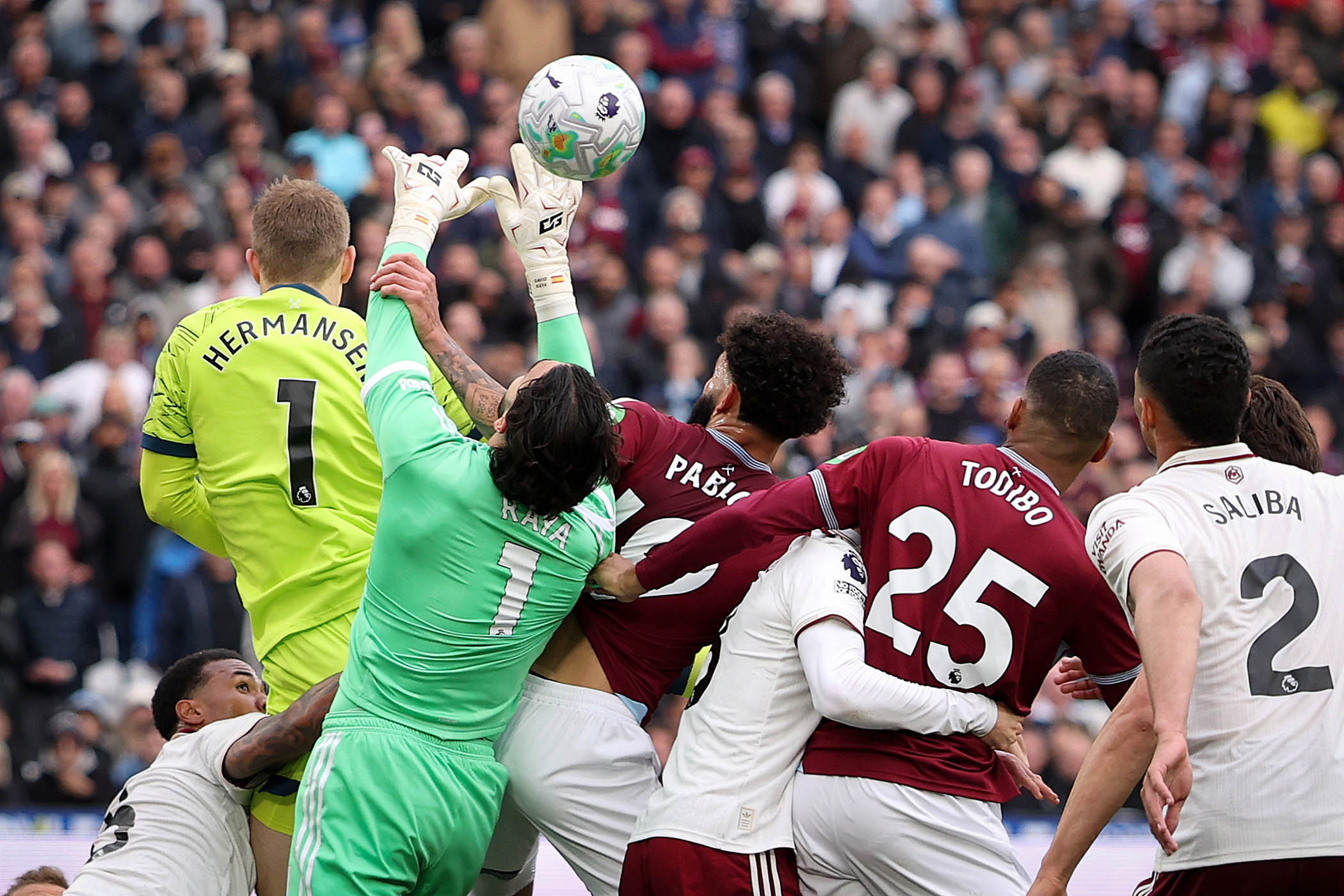
Everton’s claim was probably the most compelling, even if its consequences were least dramatic. When David Moyes’s team visited the London Stadium earlier this season, they conceded a goal that involved Pablo, the West Ham striker, using his arm to block their goalkeeper. The goal was passed as legitimate by the Video Assistant Referee (VAR). That happened less than three weeks ago.
Which brings us to the crux of the issue around what may well prove to be both the most consequential refereeing decision of the season – one that might prove decisive in Arsenal claiming the title and West Ham succumbing to relegation – and the most high-profile domestic intervention of VAR to date.
The question is not, really, whether Pablo committed a foul against David Raya immediately before Callum Wilson’s non-goal. Most interpretations of the rules would say he did. It is not even – although admittedly it could be – why that foul was deemed more important than all of the other fouls that were happening in the box at the exact same moment, at least one of them on Pablo himself.
It is not even, for that matter, why Chris Kavanagh eventually determined this specific one was a foul when so many offences over the course of the last few months – ones which are all technically different but to the layman appear at least closely related – were not.
No, the most pertinent question of all is why, before suddenly, jarringly clutching its pearls on Sunday, the Premier League has spent the better part of two seasons allowing set-pieces to become the sort of pitched battle that occasioned Pablo’s foul in the first place.
And the answer, as it so often is these days, is VAR. Not the mechanics of it. Not the implementation of it. Not the mission creep that appears to be inherent to it, or the particularly clumsy, fundamentalist form of justice it dispenses, its devout adherence to the letter of the laws rather than the spirit of it, its inability to unsee offences once spotted and its tendency to work backwards from there.
The issue, instead, is its existence. We tend to think about VAR only in those moments, as on Sunday, when the little booth at Stockley Park flashes up on screen, when the television stops showing sport and instead broadcasts a police procedural, played out in complete silence, when the technology intervenes directly.
But in reality its influence runs much deeper – and has a far more pernicious effect – than that. VAR might have actively settled the title race at the London Stadium. It has also, just as directly, determined the nature of the Premier League for the last two seasons.
The rise of what I have come to think of as Set Piece Britain is not only down to the tactical choices of Mikel Arteta or the Macchiavellian brilliance of Nicolas Jover or even because of the broad economic forces which have enabled the Premier League’s middle-class to close the gap on its aristocrats. It also bears the indelible mark of a league designed to service VAR.
In the summer of 2024, PGMOL – or the Professional Game Match Officials Limited, the not actually-that-shadowy body which provides the league’s referees – made a subtle tweak to the guidelines its officials must follow. Officially, they said, they were going to clamp down on the grappling and jostling that was already characterising set-pieces. (Referees love clamping down on stuff; it is something they have in common with traffic wardens.)
But they also made clear, in a document released to all 20 clubs and the media, that they wanted to retain a “high threshold” for what constituted an offence. This was not a matter of taste. It was purely practical, the act of refereeing being altered in order to suit its technological overseer.
A video assistant referee cannot summon an on-field colleague to examine an incident based on gut feel. They require, and this is the term used, actual evidence. They need to be able, effectively, to prosecute a case that the on-pitch official missed some vital proof that only the all-seeing, Sauronic eye can see.
Referees are not stupid. They knew it would not be feasible to do that for common-or-garden shoving. There is far too much of it, for one thing. The offences needed to be egregious, ones that could be clearly displayed on a monitor, ones that would appear to be incontrovertible. There was also an acknowledgement that VAR was trying to do too much, that referees were spending too much time engaged in forensic analysis of minor transgressions.
As a result, PGMOL set that high threshold.
We have all lived with the (let’s be generous) unforeseen consequences for two seasons, as the Premier League has descended – and that is the right word – into what can occasionally resemble a billion-pound bar fight, a place of headlocks and chokeholds, the league’s six-yard boxes churned up as players scramble and scrap to meet a corner or a long throw.
None of those offences met the bar necessary for video intervention. As a result, they all went unpunished, and 20 of the world’s richest teams ended up paying their superstars tens of millions of pounds a week to indulge in grinding, stultifying siege football. It will be of no solace to West Ham – or to Manchester City, for that matter – but perhaps Pablo’s foul on Sunday marks the end of that: the moment that VAR intervened, at last, to undo a problem all of its own making.
Photograph by Alex Pantling / Getty Images
Newsletters
Choose the newsletters you want to receive
View more
For information about how The Observer protects your data, read our Privacy Policy