
So close, Gianni, so close. With just two weeks of his World Cup to run, the Fifa president seemed to have ridden out the storm. His gamble, effectively, had paid off. Yes, the first few days had been soured by complaints about the number of games, the exorbitant ticket prices and the hydration breaks. But then the ball started to roll and they had melted away, as he always knew they would.
The stadiums had been full, or at least full enough that Fifa might explain it away relatively easily. The games had, by and large, been competitive, if not uniformly thrilling. The expanded field looked justifiable. The hydration breaks had been less of a hit, admittedly, but the boos they generated were fleeting compared to the carnival atmosphere and the public fascination that had enveloped North America. Gianni Infantino, it seemed, was Teflon.
Maybe, then, what happened on Sunday afternoon might be explained by complacency. Maybe Fifa had started to feel untouchable. Or maybe, as it looks an awful lot like it might be, it was the opposite: maybe it buckled under political pressure from the Trump administration; maybe Fifa’s control had all been an illusion. Either way, the clear blue sky has disappeared. The clouds have rolled in again.
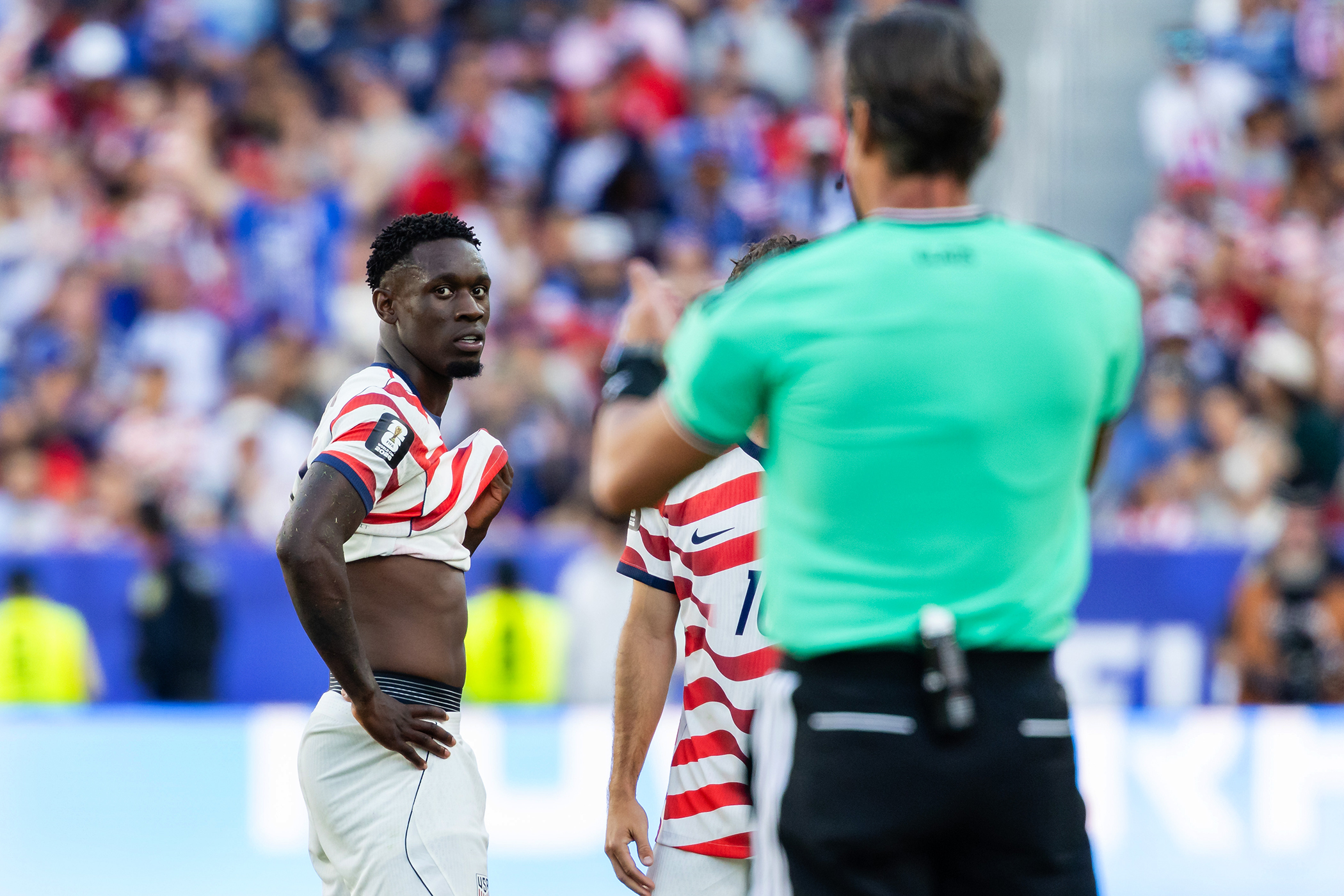
To recap: at some point yesterday morning, the Barstool Sports host Dave Portnoy sent out a not-very-cryptic tweet suggesting that the red card that was supposed to rule Folarin Balogun out of the United States’ last 16 tie with Belgium on Monday was going to be rescinded. Confirmation quickly followed: an independent panel had suspended the punishment for a year under Article 27 of the organisation’s statutes.
That was bad enough: it smacked of what Americans call “home cooking,” an attempt to place a thumb on the scales in favour of the tournament’s principle hosts. The Belgian football federation said it was “astonished” at the decision, suggesting that it directly contradicted Fifa’s own rules: a red card means an automatic one-game ban. It said it was exploring all options available.
But what came next was infinitely more pernicious. President Donald Trump posted on Truth Social, the social media platform that exists basically just for him, to congratulate Fifa on “doing what was right, and reversing a great injustice!” The New York Times reported that Trump had called Infantino within hours of Balogun being sent off in the round of 32 game against Bosnia to ask him to review the decision.
That may have only been the administration’s first involvement. There were, reports suggested, multiple calls after the initial contact; senior officials, including the commerce secretary Howard Lutnick and Andrew Giuliani, the executive director of the White House’s World Cup task force, recruited lawyers to assist with US Soccer’s appeal against the decision. Fifa’s rules do not, in theory, permit such appeals.
The game’s governing body, doubtless, would scotch the idea that any such political considerations made the slightest difference. The disciplinary committee is independent. Article 27 makes it clear this kind of judgment is very much in its remit; it was the same rule invoked to allow Cristiano Ronaldo to play in Portugal’s first two games here, following a red card picked up in qualifying.
The problem, of course, is that is not how it looks, and how it looks matters more than anything. This is, after all, an optics game. And the optics are that Infantino has spent years insinuating himself into Trump’s circle, and has now rewritten the rules of his own competition in order to do the bidding of his friend.
To be clear: the nature of Trump’s politics – no matter how repugnant they may be – is not relevant here, although it is ironic that it is less than a week since the Supreme Court rejected his attempt to change the rules on birthright citizenship that make Balogun eligible for the United States: his parents are Nigerian, and he grew up in London.
Newsletters
Choose the newsletters you want to receive
View more
For information about how The Observer protects your data, read our Privacy Policy
What matters is the impression that both Fifa’s rules and the game’s integrity have been made to seem malleable, shifting, vulnerable to influence and persuasion. The red card itself was, without question, harsh; it exposed, in the moment, the central flaw with VAR, which is that it is a tool to enforce the letter of the law but has absolutely no regard for the spirit of it.
But it was not a case of mistaken identity; it was controversial, rather than outrageous. The best case scenario is that, in overturning it, a craven and cynical Fifa have put the spectacle over the substance; they have proved willing to alter their own rules in order to put on a show. There is a precedent for this. The commuting of Ronaldo’s ban carried more than a hint of that same logic.
The worst case is that they have done that to keep a politician, of whatever stripe, sweet. That is not just a pernicious precedent – should other world leaders start to exert pressure to make sure they get what their countries want? – it is not far short of an existential threat to the game.
This is what Fifa does not seem capable of understanding: all of this, the great monetisable content factory of elite football, rests on the audience believing what we are seeing. It only works if we believe it is real. Any hint that it is weighted or rigged or in some way fungible presents a structural weakness to the entire edifice.
That is why it matters that Infantino is seen to be acting in good faith. It is why it matters that the rules are enforced, and enforced equally, without fear or favour. It is why it matters, on a much more minor scale, when Fifa – let’s be kind – exaggerate things like attendance figures. If they will massage the small stuff, what reason could there be to believe the big?
Nobody, with the possible exception of Trump, wins from this decision. Belgium have 24 hours to change their entire gameplan. The United States will know that if Balogun starts – Mauricio Pochettino, the coach, admitted that is not a straightforward decision – and they win, it will be with something of an asterisk, a lingering sense that this has not been a fair fight.
Trump will be delighted to bask in the presumed glory of saving his national side; he will delight in the apparent flexing of his power. Not a man to refuse a victory lap, he spoke to Pochettino yesterday. But it has come at a cost: souring whatever the United States go on to achieve at this tournament, and reminding everyone of the nature of Infantino’s Fifa. He was so, so close to staging the World Cup he imagined. It turns out, now, that he has created the World Cup we feared.
Photograph by Matthew Huang/Icon Sportswire via Getty Images