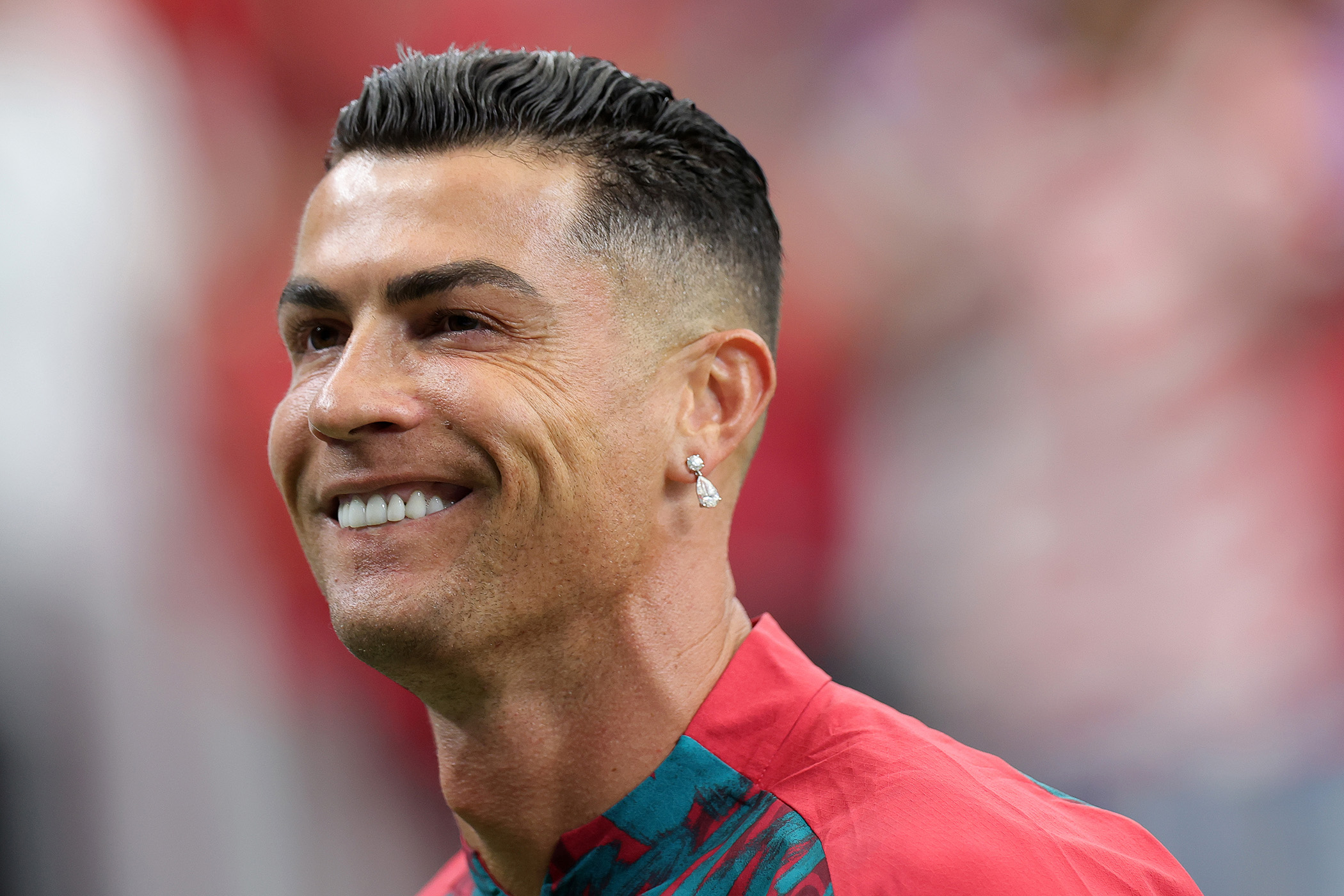

Cristiano Ronaldo must, by this stage, feel as though he is being bludgeoned with images of Lionel Messi every time he switches on his television. It is bad enough when Argentina are playing: there is the player who has always been his great counterweight, his repelling pole, his eternal rival, winning games, breaking records, capturing imaginations.
But it is worse when they are not. Even then, there is no escape. Every advert break on American television – of which there are many – is a chance for the Argentine to shift some crisps, some beer, some boots. Murals and billboards are devoted to him across the country. His shirts have become almost the default uniform for any football fan. Messi has attained a kind of cultural omnipresence.
And then there is Ronaldo, reduced to a strangely liminal status for someone with such pronounced Main Character energy that it has always felt like maybe it is a chronic condition.
It would be an exaggeration to say he has played a minor role. The 41-year-old still sells. Newsweek has produced a special edition devoted to his career; Forbes has profiled his journey to becoming a billionaire. He has a part in Nike’s star-studded advert, though it is curious that it is not as one of the players “ripping the script.” Instead, he sits with LeBron James in an anodyne boardroom.
And then, obviously, there is the discourse. The question of whether Ronaldo should be Portugal’s starting striker seemed to have been settled in 2022, when he was dropped for a last 16 game and his replacement, Gonçalo Ramos, immediately scored a hat-trick. No such luck: once again, there is far more discussion of whether Ronaldo is a has-been than presumably he would like.
It is hard to imagine this is the contribution he intended to make at his sixth World Cup. Portugal’s first game here – a 1-1 draw with Congo in which, from the outside, he seemed to be hindering his team’s attempts to score – marked the first time he had played in the United States for club or country for 12 years.
That absence has been assumed to be connected to an allegation of rape made against him in 2010. Ronaldo denies the allegations and has never been charged. His lawyers reached a civil settlement with his accuser, Kathryn Mayorga; who reportedly agreed not to go public with her accusations and for the settlement not to be treated as an admission of guilt. In 2017, following new legal advice, Mayorga made the accusation public and issued new civil proceedings. The criminal case was also reopened but subsequently closed soon after with no charges filed against Ronaldo.
Ronaldo always strenuously maintained his innocence – he described rape as an “abominable crime” – but, while a subsequent civil case was open, his previously frequent appearances in the United States stopped completely. That case was permanently dismissed in 2022.
Since then, of course, Ronaldo’s focus has moved further east. The deal that he signed at Al-Nassr, the Saudi club he joined after leaving Manchester United, is thought to make him the highest-paid athlete in the world. More significantly, it has made him both an actual ambassador for Saudi Arabia’s pivot into sport and tourism and a face of the country’s nation-building project.
Still, he would have regarded this World Cup as a chance to make up for lost time in the US. Fifa, certainly, seems to have been keen to harness his fame to sell its tournament: the game’s governing body surprisingly commuted a suspension he picked up in the final rounds of qualifying so that he would be eligible to play in Portugal’s opening games.
Newsletters
Choose the newsletters you want to receive
View more
For information about how The Observer protects your data, read our Privacy Policy
The United States certainly seemed like fertile territory for him. Earlier this month, a study led by Saifuddin Ahmed, an Associate Professor at Nanyang Technological University in Singapore, found that political ideology was the single best indicator of a person’s preference for Ronaldo over Messi, or vice versa.
“Demographic predictors (age, gender, education, social class) and political interest did not significantly predict preference,” the study, based on interviews with 10,661 respondents across 26 countries, found. “However, political ideology was found to be significant: respondents who were more liberal than the national mean were significantly more likely to prefer Messi over Ronaldo.”
The converse also held: in short, those who are more right-wing are more likely to prefer the Portuguese over the Argentine. “Ronaldo performs individual dominance, relentless self-promotion, and aspiration through sheer force of will,” Ahmed told The Observer. Those are “values that sit naturally on the conservative dispositional axis, where hierarchy, strength and individual achievement are prized.”
Ronaldo, he said, is the “clearest embodiment” of that archetype, something that is reinforced by the way his audience now consume their culture. “Political ideology has increasingly stopped staying in its box,” Ahmed said. “For a growing share of people it is a group membership that organises the rest of life: what you watch, what you buy, who you root for.”
That is “actively constructed” by the social media algorithms that feed us our information. “They bundle political and cultural content together in a way that feels organic but is not accidental,” he said. “A young conservative on TikTok sees alpha male content, gym culture and Ronaldo highlight edits sitting alongside each other.”
He is quick to clarify that the study does not suggest “all liberals prefer Messi and all conservatives prefer Ronaldo,” but stressed that the pattern it found is both clear and significant. “Knowing someone’s political ideology gives you a slightly better than random guess whether they prefer one or the other,” he said. “That’s a genuinely surprising finding: the question appears to have nothing to do with politics. The surprise is the point.”
It should also have augured well for Ronaldo upon his return to the US. Although he has always kept his own political leanings private – Republicans buy sneakers too, as Michael Jordan did not actually say – the Portuguese, as Ahmed and his colleagues found, has always held a particular appeal for the subset of conservatism now broadly thought of as the Manosphere.
Both Ronaldo’s aesthetic and his approach have always been alpha-coded: the Whoop bands, the workout videos, the belief that both the body and the self are projects that should be continually improved. On Reddit threads and 4Chan boards, Ronaldo is cast as the point at which the grindset mentality bleeds into a hyper-masculine vision of luxury, an aspirational narcissism.
His vibe – deliberately or not – is not a world apart from Andrew Tate’s. He has the approval of both the self-appointed “bio-hackers” chasing a form of waxen immortality and, it would appear, the looksmaxxers, that sub-community willing to take almost any measure to conform to a tightly-defined standard of beauty. It would, for example, not be a shock to learn that Ronaldo has tried mewing.
In the years since he last stepped onto American soil, much of that has drifted much closer to the country’s mainstream. The defining philosophy of Silicon Valley these days is to work hard and lift heavy. What looks like a fairly extreme form of wellness culture has made celebrities of Brian Johnson and Gary Brecka, a man seeking to become the “ultimate human” and an avowed fan of the Portuguese.
And, most importantly, Ronaldo has the apparent endorsement of the President himself. Last November, he attended a black-tie dinner at the White House, alongside Gianni Infantino and Mohamed Bin Salman, the crown prince and de facto ruler of Saudi Arabia. President Trump said his son Barron “respects his father a little bit more” for introducing him to the Portuguese.
This is a world, in other words, that seemed to have moved to meet Ronaldo, that seemed ready for him to exploit. That, perhaps, is what might sting the most: that even in what should have been his moment, he has still found himself caught in the shadow cast by the one player, the one person, he has never been able to escape.
Photograph by Alex Slitz/Getty Images