
This article is part of the Rory Smith on Football newsletter – a guide to help understand what is happening on the pitch, off the pitch, and why all of it matters.
Throughout the tournament, Rory will be travelling across America, delivering daily commentary on the biggest World Cup ever direct to subscribers. Never miss a newsletter, subscribe now here.
In a less scientific age it might be considered that there is enough evidence to suggest the existence of some sort of World Cup-winning curse. The most extreme victims of it are, by some distance, Italy. For a country that regards itself as one of the game’s great powers, their descent after claiming a fourth title in 2006 was both immediate and precipitous.
In 2010, they were eliminated at the group stage, although that does not quite capture it. The context here is important. They were placed in a group with Paraguay, New Zealand and Slovakia. They drew twice and lost once. They did no better in 2014, beaten by Uruguay and Costa Rica and knocked out at the first hurdle once again.
Still, at least that time they beat England. Also: by the standards of what came later, it was a positive golden age. Italy did not qualify in 2018. Or 2022. Or, thanks to a playoff defeat by Bosnia in March, 2026. The last knockout game Italy played in a World Cup, astonishingly, was the 2006 final. See? Cursed.
Exhibit two: Spain. The tiki-taka side that succeeded Italy as champions in 2010 rank as one of the greatest international teams of all. That crowning glory was bracketed by two imperious victories in the European Championship. There is a compelling – if not conclusive – argument that they are eclipsed only by Brazil’s 1970 team as the pinnacle of the game.
They have also not won a knockout game since lifting the trophy. They were humiliated by the Dutch in the group stage in 2014. They made it out of the groups in 2018 and 2022, only to fall as soon as the stakes rose: beaten on penalties by Russia, the hosts, in Moscow and then by Morocco, the eventual semi-finalists, in Qatar. See? Cursed.
And then the most recent: Germany. They won the World Cup in 2014. Common consensus held that they had created what was essentially an unceasing production line of smart, industrious, technically adept midfielders. The machine was rolling again. Guess what followed? Group stage exit in 2018, group stage exit in 2022, and then elimination to a deeply mediocre Paraguay side in New York on Monday.
All of which could, of course, be treated as a warning for Argentina – beat Cape Verde on Friday and Lionel Scaloni’s team will already have gone one better than most of their predecessors – but it might more pertinently be seen as a testament to the scale of what France have achieved since their triumph in Russia eight years ago.
Didier Deschamps’s side followed that by reaching the final in Qatar, where they were effectively a sprawling Emiliano Martínez save away from becoming the first team since Brazil in 1962 to retain the trophy. That alone made the French the most impressive defending champions since another Brazilian vintage: the one that claimed o tetra in 1994 and only lost at the last in 1998. (For historical completists: Argentina did the same in 1986 and 1990.)
Newsletters
Choose the newsletters you want to receive
View more
For information about how The Observer protects your data, read our Privacy Policy
At the current rate of progress, that may not be the end of it. France breezed through their group without dropping a point; on Tuesday, they swatted Sweden aside in New York and/or New Jersey. They have Paraguay, conquerors of an insipid Germany, in the last 16. Things, naturally, get more difficult from there – likely Morocco and then Spain – but there has been little reason to believe they will be fazed by it. They are, understandably, favourites to make a third final in a row.
That has happened just twice before: West Germany between 1982 and 1990, and Brazil between 1994 and 2002. France now play the same role at the World Cup as those two sides did in previous generations: they were a sort of default winner, the team that would emerge victorious if nobody emerged to usurp them.
Generally, that has been attributed to the industrial volume with which the country now forges talent, the boundless fertility of the banlieues that surround Paris and, to some extent, Marseille and Lyon. Producing Kylian Mbappé is one thing; adding Desiré Doué and Bradley Barcola and Michael Olise and Rayan Cherki and Ousmane Dembélé at the same time is so greedy it borders on gauche.
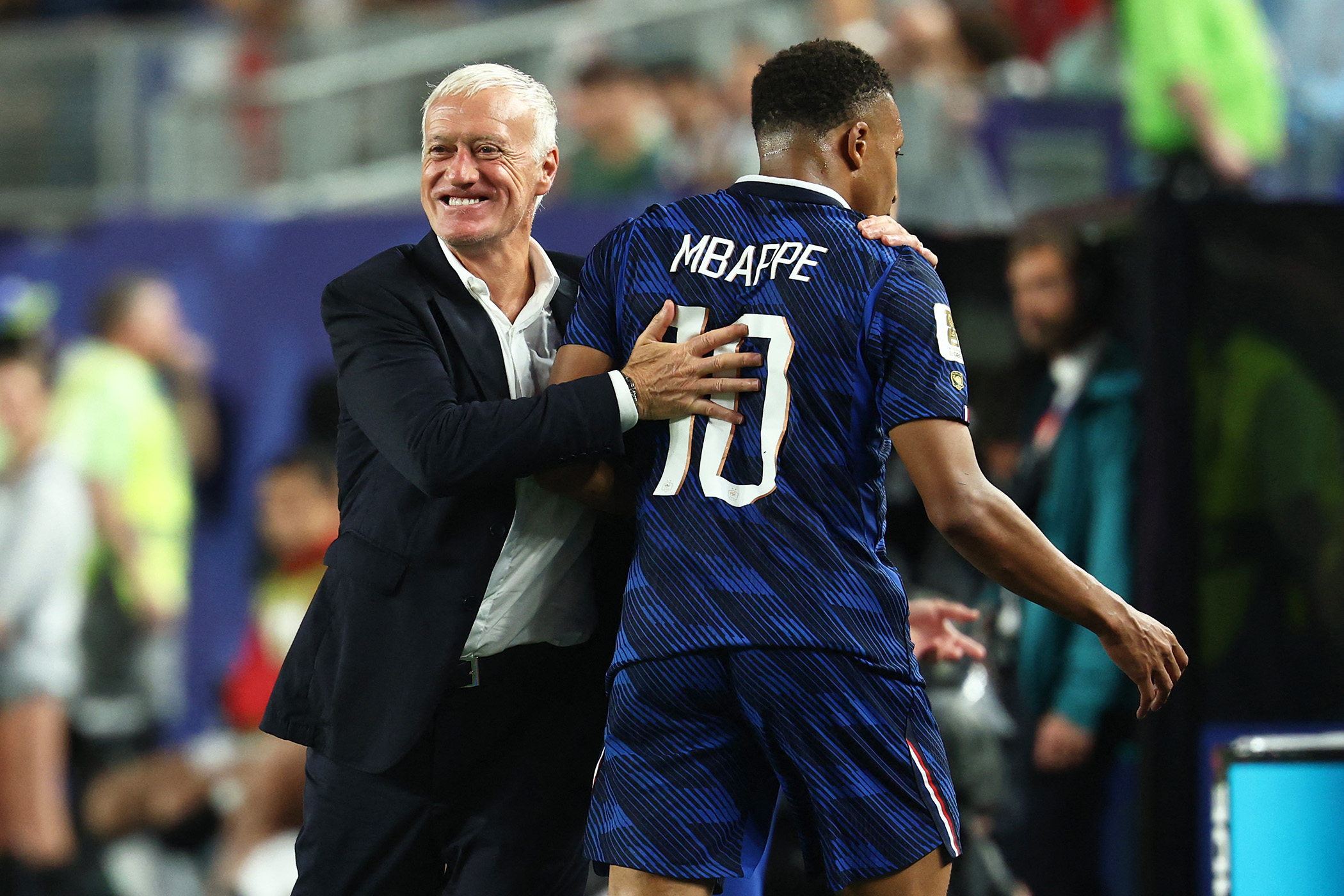
That theory is essentially correct; that is exactly what distinguishes France from all of its putative rivals. But it has always felt a little discordant that at least a slice of the credit for it does not make its way to Deschamps, the coach who has overseen what is without doubt the golden age of French football, at least at the international level.
Instead, the 57-year-old tends to be presented as almost an obstacle to France’s success; they have achieved all of this despite their dour, cautious and taciturn manager, rather than because of him. Imagine what they might have achieved since 2012 if they had been more expansive, more elaborate, more joyous?
Maybe there is some truth in that. Other than a silver medal on home soil in 2016, France’s record at the European Championship is curiously poor; even at the World Cup, the abiding impression has always been that France have always kept something back, that they have had something more to give.
Deschamps has never given the slightest hint he cares about that; his results have always been the only riposte he has ever needed. It is striking, though, that he has released the brake just a little in the United States. He has started four of his cavalcade of forwards in each of France’s games so far. This is his last World Cup. He knows that France are good enough to win, to secure their place as the game’s pre-eminent force. Maybe, at the end, he wants them to do it with style.