
As soon as the cameras panned to President Trump, his hand placed across his chest as he sang The Star Spangled Banner, Madison Square Garden filled with boos. Earlier this month, Trump had returned to New York to watch the third game of the New York Knicks’ attempt to win the NBA Championship. He was, the league’s commissioner Adam Silver said, a “genuine Knicks fan.”
Once he got inside the stadium, he was not treated as one. The jeers may have been a political statement. They might have merely been a practical one: fans had been forced to queue for hours to go through security checks instigated because of Trump’s presence. Or, in Trump’s telling, they might actually have been resounding cheers. “They were very loud, very enthusiastic,” he said later.
Either way, despite speculation that he might attend another game in the series, he did not go back. That was his penultimate sporting appointment: a few days later, he was present for the fight staged by the Ultimate Fighting Championship on the South Lawn of the White House on 14 June. He has, though, steadfastly ignored the one event many thought – or feared – he would dominate.
In the months and weeks leading up to the World Cup, Trump seemed inextricably bound to the World Cup. He appeared to consider Gianni Infantino, the Fifa President, a friend: “My Boy Johnny,” he had taken to calling him. Infantino was a regular guest in the Oval Office, beaming merely at being in Trump’s company.
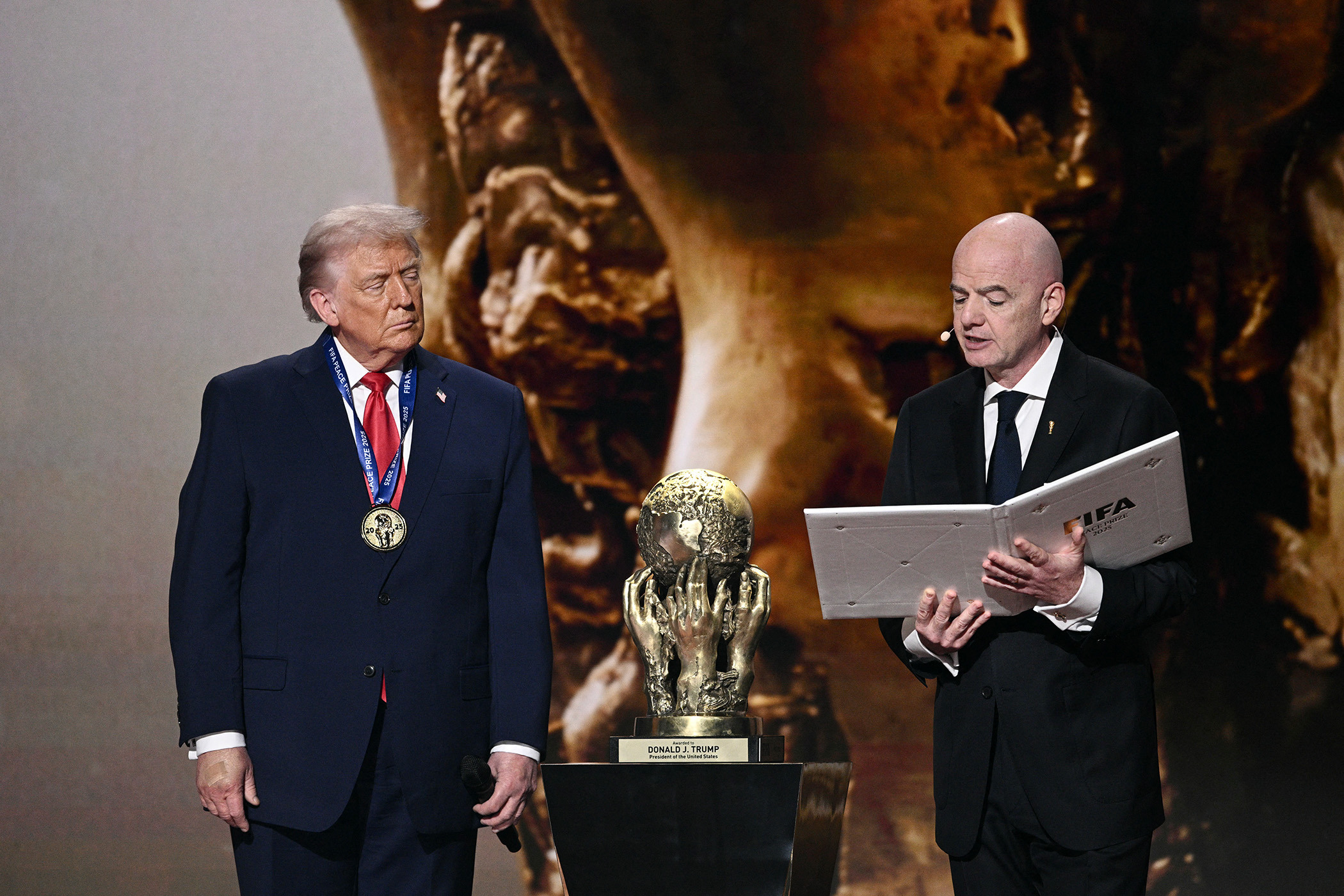
The draw for the tournament had been shifted in accordance with Trump’s wishes, staged at what was briefly the Trump and Kennedy Center in Washington, D.C., so that he might attend; Fifa had previously been considering holding it in Las Vegas. Infantino had presented him with the inaugural Fifa Peace Prize on stage, referring to him as the “President of Peace.” The trophy itself looked like the zombie hands of the undead reaching up to throttle the planet.
This World Cup was, it seemed, going to belong to Trump: the world’s greatest sporting event, its most unifying cultural moment, hijacked to further the aims of his MAGA movement. Trump himself said in January that he intended to go to “more than one” game. He promised to be “making the rounds. It’s a period of a month and it’s really top-of-the-line.”
Two weeks in, and that has not materialised. That is not to say it has not been an expressly political tournament, of course: the travel bans issued to fans and officials of various competing countries, the degrading searches of certain national teams when they first arrived on American soil, the shifting obstacles placed in the way of Iran have all been features, rather than bugs, the Trump administration flexing its muscles, playing to its base.
But Trump has, without question, been conspicuous by his absence. Infantino, clearly, has noticed that: earlier this week, he felt moved to reassert that the President would be presenting the trophy to the winner after the final in New York and/or New Jersey on 19 July. “We’re together all the time,” he said. He had the air, as much as anything, of someone trying to set his own mind at rest.
There is no definitive explanation for the no-show. He has, of course, been busy: as well as his commitment with the UFC the weekend before last, he spent part of last week at a G7 summit in Evian-les-Bains; he visited Joint Base Andrews, in Maryland, too, to cast his eye over a new presidential plane, a gift from Qatar; he was scheduled to meet with the general secretary of Nato, Mark Rutte, on Wednesday.
And then there have been matters both domestic and international to consider: the grinding peace talks with Iran, his surprise announcement this week that he was refusing to sign a long-anticipated housing bill until such a time as Congress passed a law on voter identification and mail-in ballots.
Newsletters
Choose the newsletters you want to receive
View more
For information about how The Observer protects your data, read our Privacy Policy
In most cases, that sort of workload would make it self-explanatory why he had broken with tradition and did not attend USA’s opening game against Paraguay in Los Angeles on 11 June, or even their second, the win against Australia in Seattle. He is not expected to be in Los Angeles on Thursday, either, for their third group match, against Turkey.
Neither of his fellow host leaders, Mexico’s Claudia Sheinbaum or Canada’s Evertonian Prime Minister, Mark Carney, were at their nation’s first games: the former having handed her ticket to a fan who would “otherwise not be able to go,” and the latter waiting until the second game to greet the team in the dressing room.
But then this is Trump, who last year excused himself from peace talks for Ukraine to take part in a Netflix interview about the wrestler Hulk Hogan. He will, clearly, make time if he wants to do so.
The general consensus is that it is worth enjoying his absence, while it lasts
The general consensus is that it is worth enjoying his absence, while it lasts
Why he has left the World Cup to his deputies – the vice-president, JD Vance, and the health secretary, Robert F. Kennedy Jr. have made fleeting appearances at games – is not clear; his only contribution so far has been calling the US players before the opener, offering the captain Tim Ream some words of encouragement.
Officials working on the tournament have privately theorised that, perhaps, the treatment he received at the Knicks game was more significant than he implied. Trump has attended plenty of sporting occasions during his second term as president but they have, as a rule, been in what he would almost definitely not call safe spaces: the Superbowl, various UFC events.
He knows that the optics of being booed are bad; he knows, too, that evidence broadcast live on television is hard to spin and to twist. He might be able to tolerate being jeered by foreign fans – in a way, it might even appeal to his core voters – but the prospect of seeing outright defiance from his own public is difficult for him to tolerate.
The fact that so few of the games are in his heartlands, too, may play a role. Every single one of the host cities lean Democrat, rather than Republican; Trump has been publicly critical of several, including his hometown, New York, as well as the two places where USA have played so far, Los Angeles and Seattle. If anything, his relationship with the team’s destination in the first knockout round, San Francisco, is even worse.
But there has also been speculation that perhaps the feel of the World Cup is not to his liking. For all the misgivings over the cost of tickets and the multifaceted price gouging the tournament has inspired, its mood has been celebratory, filial, unifying. Triangulating that to fit his worldview – or the worldview of the broader MAGA movement – takes some considerable mental gymnastics.
Most of those involved, none of whom wanted to speak publicly on the matter, expect that Trump will not stay away forever. Once the celebrations for America’s 250th anniversary are over, on 4 July many feel he will turn his gimlet eye to the tournament. Everyone expects him to take credit for its success; there is an awareness that might complicate its memory, its legacy. For now, though, the general consensus is that it is worth enjoying his absence, while it lasts.
Photograph by Brendan Smialowski/AFP via Getty Images