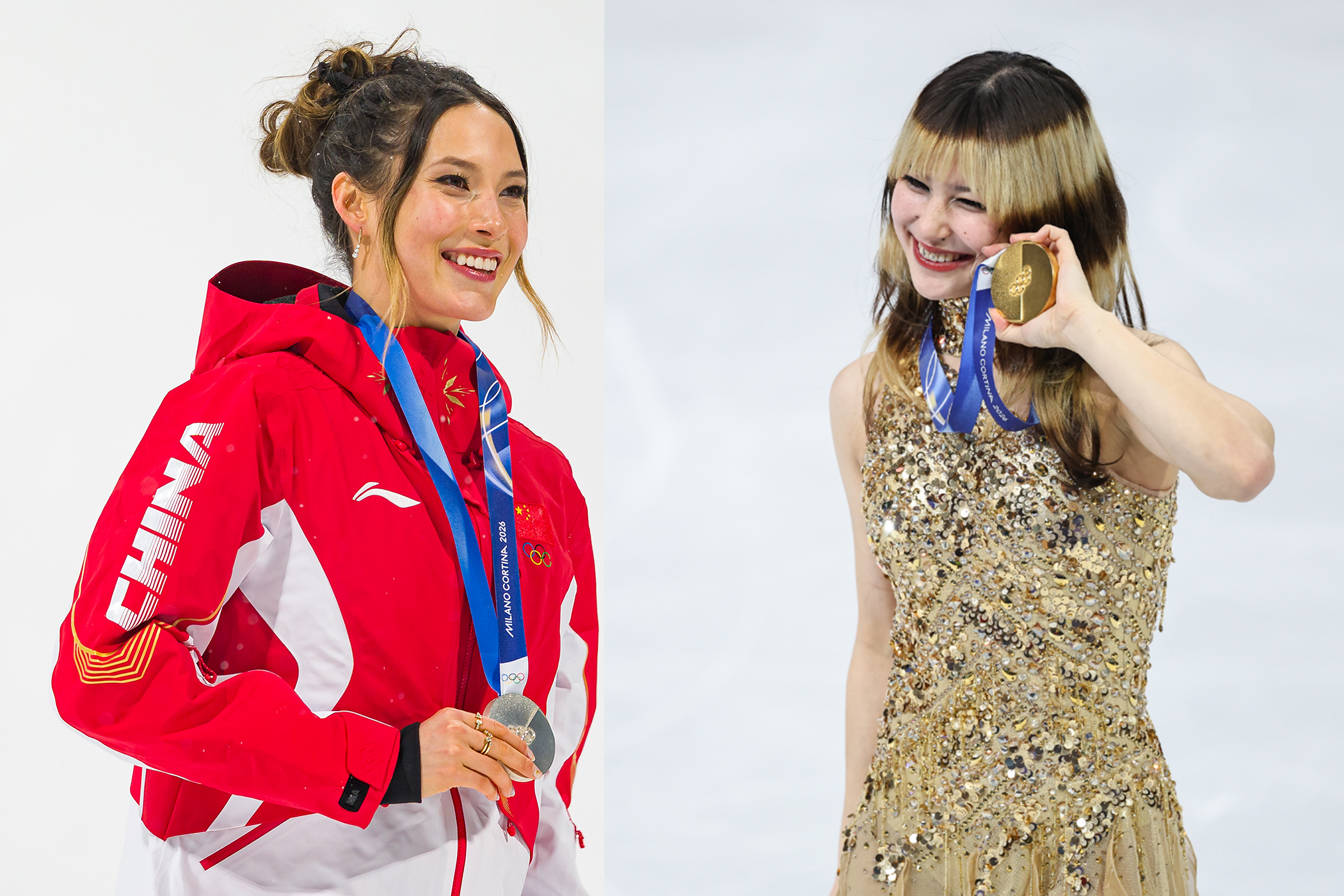

In September 2003, Eileen Gu was born in San Francisco, California. Almost exactly two years later, Alysa Liu was born three and a half hours’ drive south east in Clovis, California. Both girls had parents who emigrated to the United States from China and both would go on to become sporting superstars. Their paths to the top are similar – prodigious success, elite university education, Olympic medals – but differ in one crucial aspect: when Liu steps on to the top of a podium, The Star-Spangled Banner rings out; when Gu does the same, the Chinese anthem plays.
At Milano Cortina 2026, Gu became the most decorated Olympic freestyle skier. She added two silvers in the slopestyle and big air events to the two golds and silver she won in 2022. Liu danced to a gold medal in the women’s individual figure skating to go with a team event gold won last week. Beyond their sheer sporting talent, their strong personalities have led to them taking centre stage throughout the past fortnight.
In China’s ideal world, both athletes would be representing them. Ahead of the 2022 Winter Olympics in Beijing, Gu and Liu were identified as potential recruits to boost the home nation’s medal prospects. Their talent was already clear, with Liu winning her first national title as a 14-year-old in 2019, the youngest figure skater to win the US women’s senior crown. Two days after Liu had done that, Gu won her first World Cup gold in the slopestyle. But that would be the last time Gu won under the flag of the United States.
Gu’s childhood mixed time growing up in California with summers in Beijing. Raised by her Chinese mother and grandmother in a single parent household and fluent in Mandarin, it is clear she feels a very real affinity for the country she represents. “When I’m in the US, I’m American,” she once said. “When I’m in China, I’m Chinese.”
Liu’s relationship with the country is undoubtedly more complex given her father’s history. Arthur Liu left China as a 25-year-old, forced into political exile as a result of organising protests and hunger strikes around the same time as the Tiananmen Square massacre. He has continued to be spied on by the Chinese government throughout his time in the US as confirmed by the United States Department of Justice.
One spy posed as a member of the US Olympic Committee ahead of the 2022 Olympics and asked for his and his daughter’s passport numbers. Liu said at the time that he thought it was part of an attempt to “threaten us not to say anything … political or related to human rights violations in China”. At Beijing 2022, Alysa was escorted by at least two people at all times in order to ensure her safety.
One of five siblings all born via egg donors and surrogate mothers, Liu’s relationship with her father has its own complexities. She originally retired from figure skating at the age of 16 after Beijing. At the time, her coach Phillip DiGuglielmo said: “She felt she had kept up her side of the bargain with her father and the skating community, which was always to go to the Olympics and be the skater everyone wanted her to be. After she achieved those goals, it was time for her to leave the sport on her own terms.” Her condition on returning to the ice in 2024 was that she would do it her way. Watching her winning free skate on Thursday to Donna Summer’s Macarthur Park Suite, it was clear that she had done exactly that.
We will never know the exact ins and outs as to why Liu chose not to represent China and Gu did, even if it is possible to see traces of what might have prompted those decisions in their upbringings. They are just two examples of a significant number of athletes who are forced to choose between multiple national identities. For some that is a personal decision. For others it is a sporting one. But given the fractious relationship between the US and China, Gu’s decision is particularly controversial.
That is hardly a situation Gu could be ignorant of, particularly as she is majoring in international relations at Stanford University. But the debate around both athletes is played out through the lens of the “good” versus “bad” immigrant. Liu is portrayed as the grateful child of the US who has repaid the generosity of the country she grew up in with a shiny medal in figure skating, a sport in which they had not won an individual gold for 24 years. Meanwhile, Gu has been caricatured as someone who has turned her back on a nation that got her to where she is now.
Never one for nuance, US vice-president JD Vance articulated that view himself. “Somebody who grew up in the USA, who benefited from our education system, from the freedoms and liberties that make this country a great place, I would hope that they want to compete with the United States,” he said.
Newsletters
Choose the newsletters you want to receive
View more
For information about how The Observer protects your data, read our Privacy Policy
Gu hit back ahead of her final Olympic event, the freestyle ski halfpipe. “So many athletes compete for a different country,” she told USA Today. “People only have a problem with me because they lump China into this monolithic entity, and they just hate China.”
Athletes, particularly if they are non white, know you are America’s darling for as long as you keep your mouth shut
Athletes, particularly if they are non white, know you are America’s darling for as long as you keep your mouth shut
It is undeniable that the fact that it is China that Gu represents makes a difference. In her own event, there is another American-born athlete competing under a different flag whom Vance is yet to mention. Zoe Atkin was born in Massachusetts, grew up in Utah, and represents Britain, thanks to her English father.
It is hard to argue that Atkin’s recruitment was a strong soft power move from the British government, however. Her journey to competing under a different flag came through her sister Izzy, who won Britain’s first medal on skis with a bronze in 2018 in the freestyle ski slopestyle. Atkin’s family opted for Team GB because they felt the team set-up better suited her more reserved personality. Zoe consequently followed suit.
Atkin’s choice is not complicated by a mystery over her citizenship. Olympic athletes must hold citizenship of the country they are representing but China does not allow dual citizens. Gu has stayed tight-lipped on exactly what has enabled her eligibility for competition. Her name has never appeared on the quarterly public lists of Americans who have renounced their citizenship.
For Gu, the choice has come with massive financial benefits. According to Forbes, she was the fourth best paid female athlete in the world in 2026, raking in cash in a way that normally only tennis stars manage to do. Her estimated earnings in 2025 were $23.1m (£17m), with only a fraction coming from her actual sport. For context, the only other winter sports star on the Forbes list was American alpine skier Lindsey Vonn, who was in 18th with an estimated $8.2m (£6m).
Gu has appeared as the face of Louis Vuitton and Tiffany, among others, and can regularly be found on the Chinese covers of magazines like Vogue, Cosmopolitan and Elle. The question is what she is giving up in order to receive the wealth and acclaim that has come with her sporting success.
Plenty of athletes represent countries where they do not endorse their governments, as a number of American athletes have made clear during these Olympics. “Wearing the flag doesn’t mean I represent everything going on in the US,” said American freestyle skier Hunter Hess. Such comments might inflame the right wing American commentariat and Donald Trump, who called Hess a “loser”, but Americans are free to say it. That is unimaginable for Chinese people as both Gu and Liu well know.
This is the reality of the country that Gu has chosen to represent, and the pressures that come with that can be seen in her own public pronouncements. While she has been laudably outspoken on anti-Asian racism and abortion rights in America, she is less direct on human rights in China.
In an increasingly globalised world, which is also becoming more polarised, shared nationality and its complications will continue within sport. Gu is an articulate athlete who should by no means feel forced to represent the United States just because she grew up there.
She is also more than just a political pawn, even if she is used like that. But neither of those two realities mean there is not a valid criticism to be made in the endorsement of China that comes not with her choice to represent it, but her obvious silence on its politics. Equally, Liu is not giving an unequivocal endorsement of what it means to be American by picking them. Plenty of American athletes, particularly those who are not white, know that you are only mainstream America’s darling for as long as you keep your mouth shut.
Together the duo encapsulate exactly what makes the Winter Olympics so entrancing. Fearless, creative and the very best at what they do, they have that unique athletic ability to grab the viewer’s attention regardless of sporting expertise. They also sum up all the complexities of growing up as a young sportsperson in the world today, navigating geopolitical situations that might seem far removed until they end up being played out on the ice rink or ski slope.
Photography by Andy Cheung/Getty Images & Qian Jun/MB Media/Getty Images
• This article was amended on Tuesday 26 February. An earlier version stated Izzy Atkin was the first athlete to win a medal for Team GB on snow. This was the snowboarder Jenny Jones in 2014.