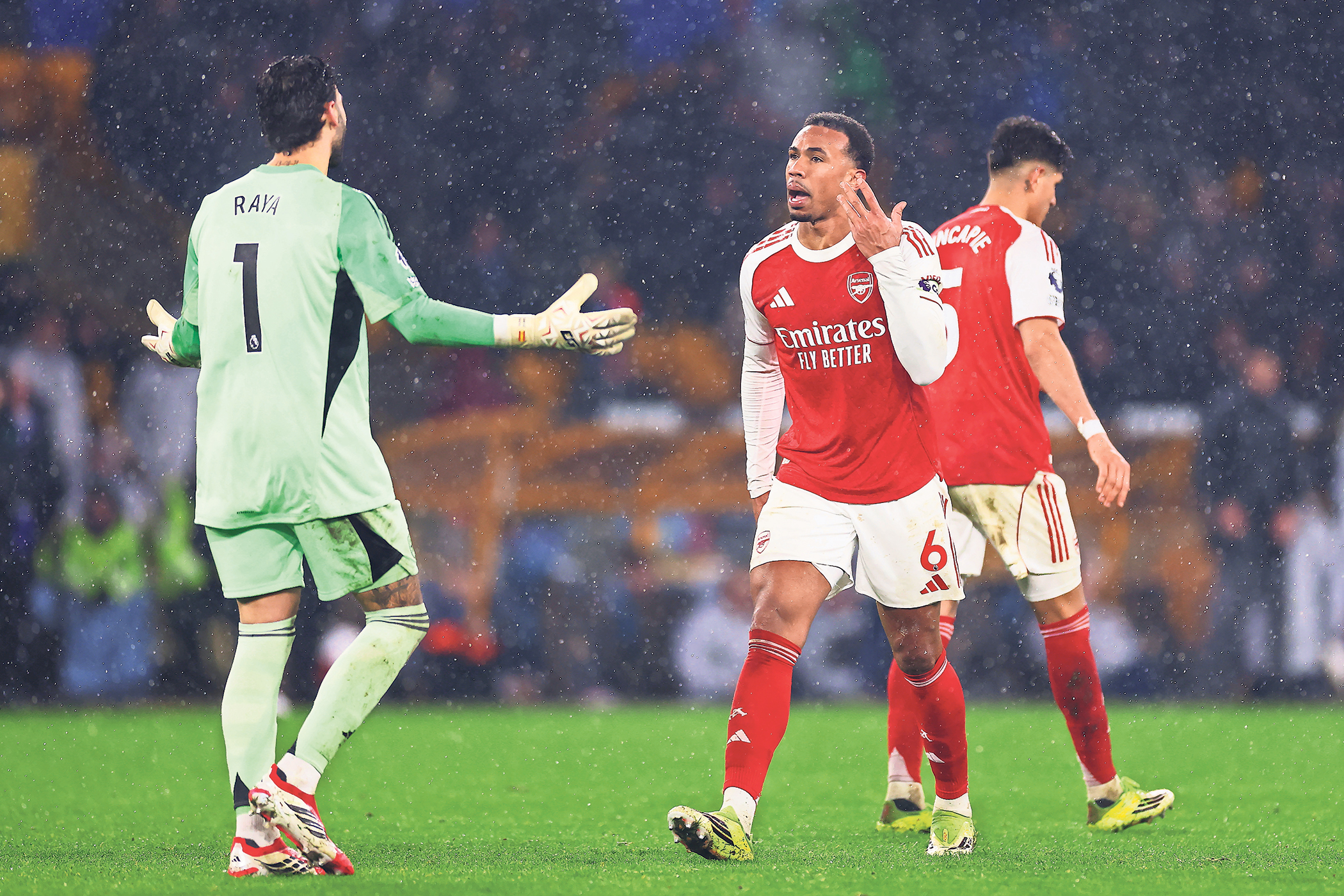

So it turns out life inside the Thunderdome is bleak and hostile and hellish. Who knew? Is anyone else sweating? Where is Viktor Gyökeres when you need him? And why are David Raya’s arms shrinking game by game? Only Arsenal could be top of the Premier League and racked by existential crisis, still in contention for all four major competitions and seemingly resigned to trophyless apathy. Mikel Arteta is prostrating himself in press conferences, talking about “having to blame ourselves” and taking “bullets” of criticism. One fan interviewed outside Molineux blamed “wind gusts up to 36mph” on the Wolves capitulation: North London Forever, whatever the weather, unless it’s windy, or raining, or unseasonably cold.
And yes, Wednesday’s draw was concerningly pathetic, the product of a complacency built on equal parts arrogance and timidity, with the cutting edge of Keir Starmer. This does not have to be a harbinger of the apocalypse. It can just be a warning light.
Any attempt to diagnose Arsenal’s psychological issues has to first ask whether they exist at all. The stock line of pub chat has somehow become that if Manchester City win their next 11 games, they will win the Premier League, as true as it is irrelevant. It strips Arsenal’s agency, a framing which doubles as a concession. Nothing indicates City are capable of conjuring such dominance – in their first eight league matches of 2026, both Arsenal and City won three, drew four and lost one. Arsenal’s supposed great choke, their world-melting psychological collapse, has entailed matching City to the point, with a better goal difference. They were two points clear in late December and their position has barely changed.
Arsenal have been top for five months despite never really pulling away; a failing in one light and a display of remarkable resilience in another. That they currently have the fewest points of a Premier League leader after 27 matches for a decade is ultimately little more than a statistical quirk, as easily attributable to the extraordinarily high level across the league as it is to any specific shortcoming.
On Sunday they will enter a toxic hate-fest of a north London derby, Tottenham’s first match under Igor Tudor, who they insist is a specialist interim head coach, a role they seem to have concocted. What they actually have is a coach who has lasted less than a year in his last 10 jobs and seemingly has some very good PR, a club telling themselves a lie they want to believe. This should be a chance for Arsenal to reassert themselves, to rebalance against a club who act as their counterweights as much as rivals.
The possibilities remain almost infinite. Everything is OK. So why does it feel like it isn’t?
The possibilities remain almost infinite. Everything is OK. So why does it feel like it isn’t?
For all they might loathe the comparison, Arsenal and Tottenham’s modern identities are built on failure, on prolonged proximity to achievement, forced repeatedly to watch parties they are never invited to. It might be beautiful failure; sprawling tragicomedy of Brechtian proportions, but it is failure nonetheless. Fans have spent so long wallowing in rage and resignation that they now find comfort in the familiar fixations, retreating into old patterns. They understand disappointment and crisis. It took seconds after Tom Edozie’s winner for #ArtetaOut to trend on X. For most fans under 30, the defining voices of the social media age, striving without success is all they have ever known. The same largely holds true for the players.
Of course, so much of the disproportionate reaction to recent results is a trauma response to a false image of Pep Guardiola’s side as this all-consuming destroyer of dreams, fresh scars still throbbing. Arsenal were eight points clear in 2022-23, only for City to win 12 consecutive matches. They reached 89 points in 2023-24 – one fewer than the Invincibles – only for City to manage 91. It is understandable how this would trigger deep neuroses in an already neurotic club. This is without getting into the master and prodigal son dynamic between Guardiola and Arteta.
It is easy to designate the Carabao Cup final (against City) and the league visit to the Etihad in mid-April as the watersheds of their season, but these are just noisy narrative crutches. The title will be won against West Ham and Newcastle and Crystal Palace – if Arsenal come close to repeating their results from the corresponding fixtures of their remaining 11 games (nine wins and two draws) then the City results will be irrelevant.
Arsenal’s problem, to whatever extent you believe it exists, is one of perception and expectation. Are we human, or are we bottler? Other European clubs consider them a model for operational brilliance, the paragons of modern football.
They clearly have the strongest squad and highest ceiling in the Premier League, in the strongest position. But imposter syndrome can only really be cured by the hard evidence of silverware. You only really learn how to win by doing it. This group have now spent four seasons on the edge of something with no catharsis, a constant striving and hoping and pushing which must be utterly exhausting.
Newsletters
Choose the newsletters you want to receive
View more
For information about how The Observer protects your data, read our Privacy Policy
The players and Arteta have staked so much of their self-worth and reputation on this project that if they do fall apart, it is hard to imagine how this team recover, how they find it in themselves to go again and remain united. Next season would only be more difficult and pressurised. The most concerning trend is Arteta appearing to become more insecure and obsessive and perfectionist, less inclined to loosen the reins and trust anyone other than himself.
And so Arsenal are contending not just against their long-term psychological tormentors, led by Arteta’s managerial father, but against themselves, against history and their sense of self and everything they have ever known. In spite of this, they have lost three matches all season. They are still top of the Premier League. Starting strong and falling over the line is as valid an approach as pacing yourself and kicking for the finish.
Arsenal are still in control, quite possibly the best team in the world. The possibilities remain almost infinite. Everything is OK. So why does it feel like it isn’t?
Photography by Carl Recine/Getty Images