

Blackadder: “Our battles are directed, sir?”
Melchett: “Well, of course they are, Blackadder, directed according to the Grand Plan.”
Blackadder: “Would that be the plan to continue with total slaughter until everyone’s dead except Field Marshal Haig, Lady Haig and their tortoise Alan?”
Rob Key, ECB managing director: “There is a difference between not planning and getting it wrong.”
Half a length, half a length, half a length onward, all in the valley of Death were smashed for 500. Of the England squad that landed in Perth two months ago, Josh Tongue, Brydon Carse and Matthew Potts were the three least experienced seamers at Test level, then 22 caps between them, now 31, but Carse the oldest at 30 years old.
Maybe they learned something today, simmering in the Sydney sun, but all everyone else got was confirmation of what we already knew. Steve Smith is Australia’s finest batter since Don Bradman, Travis Head a tornado of a cricketer, everything the vast majority of this England squad dream of being and more. And having dedicated the past 18 months to fostering and forging a bowling attack of unimpeachable pace for this series, Ben Stokes and Brendon McCullum seem less clear than ever of what they want their bowlers to achieve and how they want them to achieve it.
Just before James Anderson’s involuntary defenestration, Rob Key told the Telegraph: “I don’t care how many wickets you take – I want to know how hard you are running in, how hard you are hitting the pitch, and are you able to sustain pace at 85-88mph?” And yet to that point, Stokes’ modus operandi has always been to take 20 wickets by any means necessary, something his team managed with remarkable consistency. They have only hit that mark twice this series. Maybe taking wickets is worth caring about.
This group have had three different bowling coaches in the post-Anderson era: Anderson himself, Tim Southee and David Saker, who only got the gig for a second consecutive Ashes series because Brendon McCullum left calling Dale Steyn so late he was unavailable. Southee had pledged availability for ten months of the year rather than 12, and Key and McCullum decided that was good enough, as fair a representation as any of the “that’ll do” approach of negligent nonchalance which appears to have applied to so much of England’s supposed preparation for this series.
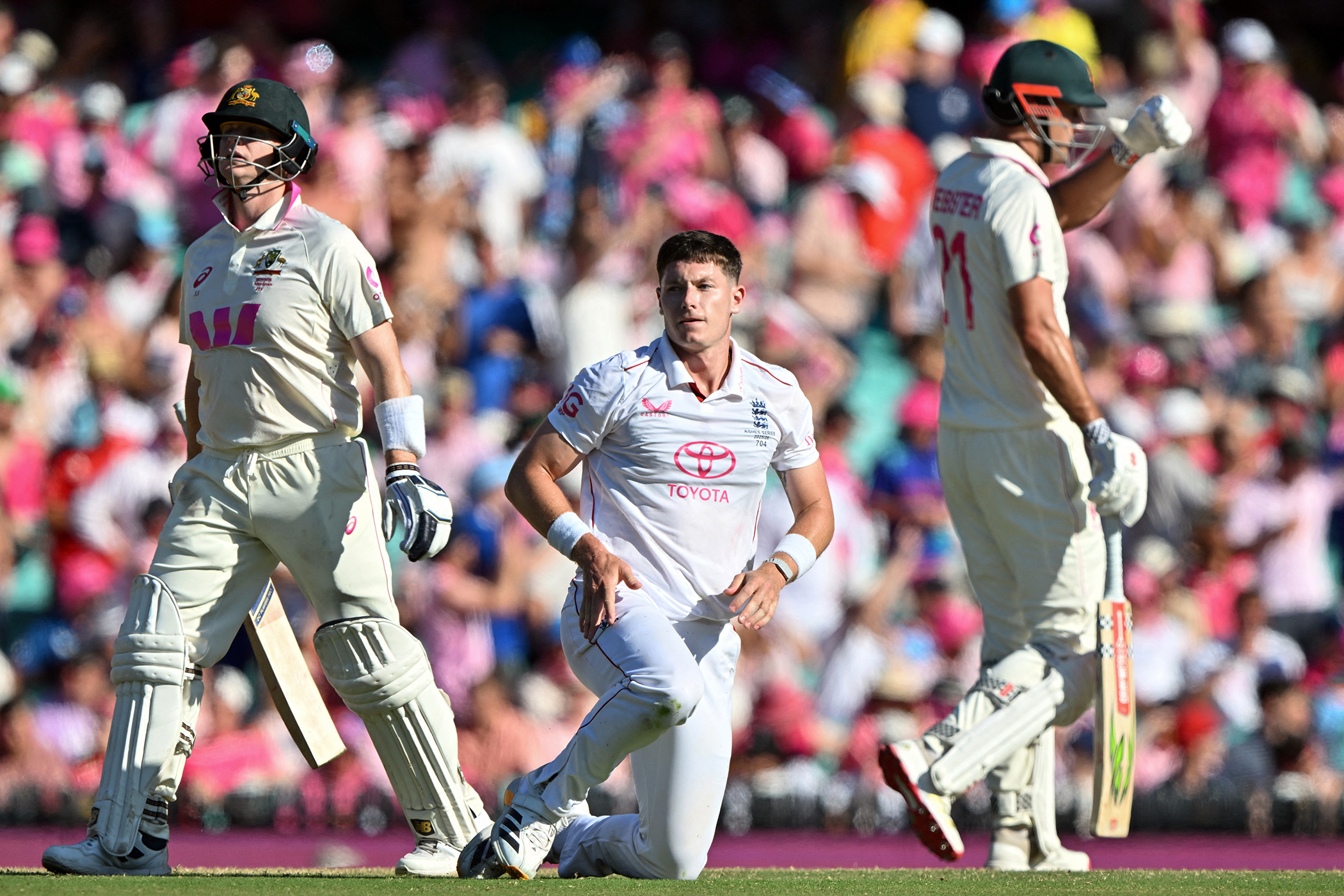
Potts was supposed to be unspectacular if consistent, a “break-glass-in-case-of-emergency” option, but the fire extinguisher hasn’t been needed for so long it has gone out of date, thumped around the SCG here with no catharsis or redemption. Head condemned him with a disdainful six to bring up three figures in the bowler’s runs conceded column.
“He’ll give Ben Stokes a bit of control,” Stuart Broad said before the Test. “He’s not someone who will bowl both sides of the surface, you can just set a field to him, plug him in and let him go.” Really, he was reliable in the only way England have been throughout this series: reliably terrible, reliably loose and lax and chaotic, simultaneously underprepared and exhausted.
Newsletters
Choose the newsletters you want to receive
View more
For information about how The Observer protects your data, read our Privacy Policy
But for a lot of Tuesday Potts was seemingly inspired by Marnus Labuschagne’s heroic filth the day prior, bouncing in short balls at 78mph and betting on, or blindly hoping for, Australian idiocy. Starting the third day having gone for 58 from seven overs, he ended it with the worst economy rate of any English bowler to have bowled 25 overs in a Test, 5.64. Carse’s Brisbane stint, a similar feat of relentless inaccuracy, is third on that list.
There almost certainly will be no accountability from this series
There almost certainly will be no accountability from this series
Then there’s the spin fiasco, which has somewhat been explained away as a consequence of the death of spin bowling more generally, rather than a lack of trusted spinners on either side with Nathan Lyon injured. Bowling for the first time this series, Jacob Bethell trapped Head lbw on 163 with the first ball of his second over, and ended the day with the second-best economy rate of any English bowler. Bar an astonishingly poor catch attempt early in the first session, Will Jacks was fine in the only way you can expect effectively a part-time spinner to be fine.
England’s handling of Shoaib Bashir throughout this series has bordered on cruel; constant proclamations of trust while their actions show the opposite, plying him with unwarranted hope. In Adelaide, spin coach Jeetan Patel called Bashir “our No 1 guy” and praised the “fantastic job” he does, while Stokes also called him “our best, No 1 spinner”. His inclusion as 12th man in Melbourne and Sydney has felt like Stokes and McCullum doing everything they can to maintain the illusion that he is not just selectable, but only a 50/50 call from playing. The reality is he has had one of the longer and more miserable holidays of his life.
Somewhere in here is a failure to understand what it takes to prepare and nurture bowlers. There is a provable sweet spot of warm-up and grounding, the right amount of miles in the legs that this cohort simply were not given. You could argue that losing three frontline quicks in four Tests despite playing far less cricket than they ever expected is unfortunate, but this could also be the consequence of inadequate support.
As a bowler Stokes should know this, but he has reached a point in his career where he is trying to operate with the least possible strain on his failing body, basically held together by skin and naked ambition. He might also be corrupted by the latter years of Anderson and Broad’s careers, when they also did not require the same time and groundwork as younger and more vulnerable players.
One day this Test might be considered a formative moment for Carse and Tongue as Test bowlers, although it feels like an ignominious end to Potts’ intermittent stints as a theoretically reliable back-up. Their inexperience is not their fault, the obvious consequence of England’s prior riches, of losing 1,500 wickets’ worth of Test experience since the 2023 Ashes in Broad, Anderson and Chris Woakes. But that only makes it more painful that they have been so clearly sent into battle with some words of vague encouragement and a butter knife.
There almost certainly will be no accountability from this series, because there is no remotely viable alternative captain to Stokes, McCullum has a T20 World Cup to oversee and Key could talk his way out of a locked box. So all we can focus on are lessons to learn, changes to make. Having the resources to bowl line and length on occasion, knowing to sometimes target the stumps when three of the first five Australian wickets have been lbw, seems like a decent place to start.
As Key said, there is a difference between not planning and getting it wrong, between preparing to fail and failing to prepare. But both of them still end like this.
Photograph by Saeed Khan / AFP via Getty Images