

This article is part of the Rory Smith on Football newsletter – a guide to help understand what is happening on the pitch, off the pitch, and why all of it matters.
Throughout the tournament, Rory will be travelling across America, delivering daily commentary on the biggest World Cup ever direct to subscribers. Never miss a newsletter, subscribe now here.
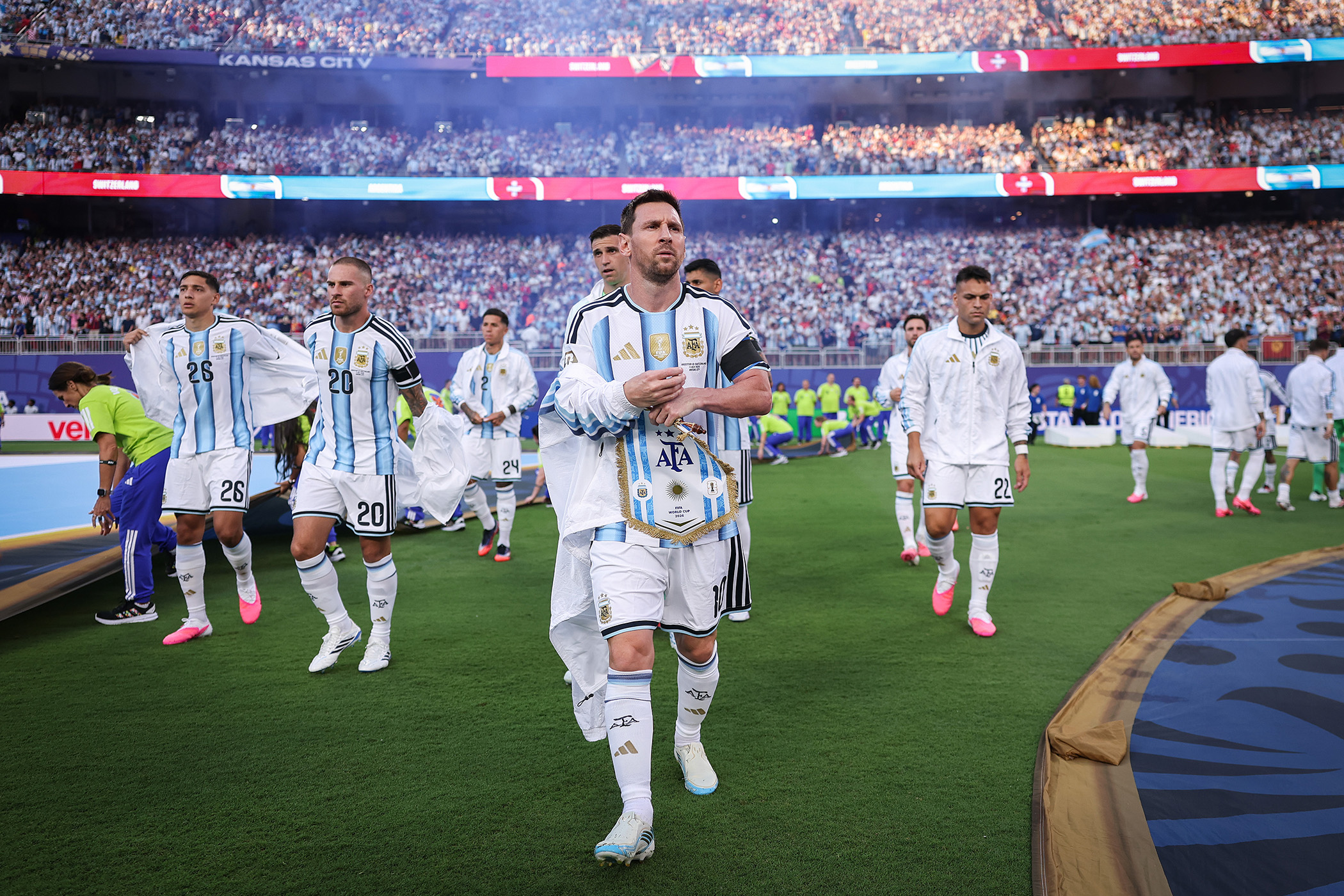
It does not take long, watching Argentina watch Argentina, to feel you are witnessing something other than a sporting spectacle. For tens of thousands of fans, following their nation to a World Cup is a kind of pilgrimage; being present to see them play takes the form of a religious ritual, a collective frenzy giving way to a sacred ecstasy.
That gives the chants that emanate from the sea of blue-and-white invariably gathered behind one goal the quality of hymns. Some are paeans to the country’s secular idols; they are, by and large, dedicated to Lionel Messi, Diego Maradona and often both; occasionally, the figure of La Tota, Maradona’s mother, will appear, too. (No other country, Argentinian fans will occasionally boast, have a song dedicated to someone’s mum.)
And, increasingly, many pay tribute to its martyrs, too. Muchachos, the soundtrack to Argentina’s victory in the 2022 World Cup, included a specific reference to los pibes de las Malvinas*, the teenage conscripts sent to and killed in the Falkland Islands in 1982. So does La Cuarta Estrella, the semi-official anthem for this World Cup.
The same leitmotif appears in pretty much every song that has emerged organically in the days since it was confirmed that Argentina would face England in Atlanta on Wednesday, a place in the World Cup final at stake, the first competitive meeting between the teams since 2002. Por Argentina, yo dejo la vida/como los pibes en las Malvinas, as one put it: I lay down my life for Argentina, like the kids in the Malvinas.
Coaches and players on both sides have been understandably keen to stress that Wednesday’s game is just that: a football match of rare significance and intense passion, of course, but still just a football match. Even the midfield player, Rodrigo De Paul, not exactly a wallflower, made it clear that the Malvinas issue should be discussed “in other places.”
It is an admirable attempt. It will probably not work. The issue of the Malvinas remains livid in Argentina; it is, as Federico Lorenz, author of Malvinas: Una Guerra Argentina, put it, “especially prominent around World Cups.” Fifa might have issued an edict that flags bearing the image of the Falklands – shaped like a pair of angels’ wings – will not be allowed inside the Mercedes-Benz stadium. But that word, Malvinas, will ring out again and again, however the game itself goes.
That is, in itself, a relatively new phenomenon. “For a long time, the chants of the national team were very basic,” Manuel Soriano, author of Cantan, Putos!, a history of the music of Argentinian football. “Chants in Argentinian club football have a lot of history; they are very rich, very creative. That was not the same with the national team.”
(The exception is El que no salta es un inglés, which has been a standard for clubs and country since 1982, although the original version dates to 1978, and referenced the Dutch, not the English.)
Newsletters
Choose the newsletters you want to receive
View more
For information about how The Observer protects your data, read our Privacy Policy
Soriano believes that started to change in 2014, when fans turned the Creedence Clearwater Revival song Bad Moon Rising into Brasil, Decime Que Se Siente – Brazil, Tell Me How It Feels – for a World Cup on South American soil. “That started a new generation of creativity,” he said, though it did not contain an explicit mention of the conflict. By 2022, when Muchachos caught on, that had changed.
“It is a subject that has always been very closely related to the fans and to fandom,” Soriano said. “If you go to games in Argentina, you will see flags of the Malvinas at stadiums. But there was not much direct reference before Muchachos. [One song in Russia 2018 did contain a similar line.] Now, when they come up with a new song, and they do that a lot, there are certain things that the fans feel they have to reference: Diego, Leo, the Malvinas. They’re like standards.”
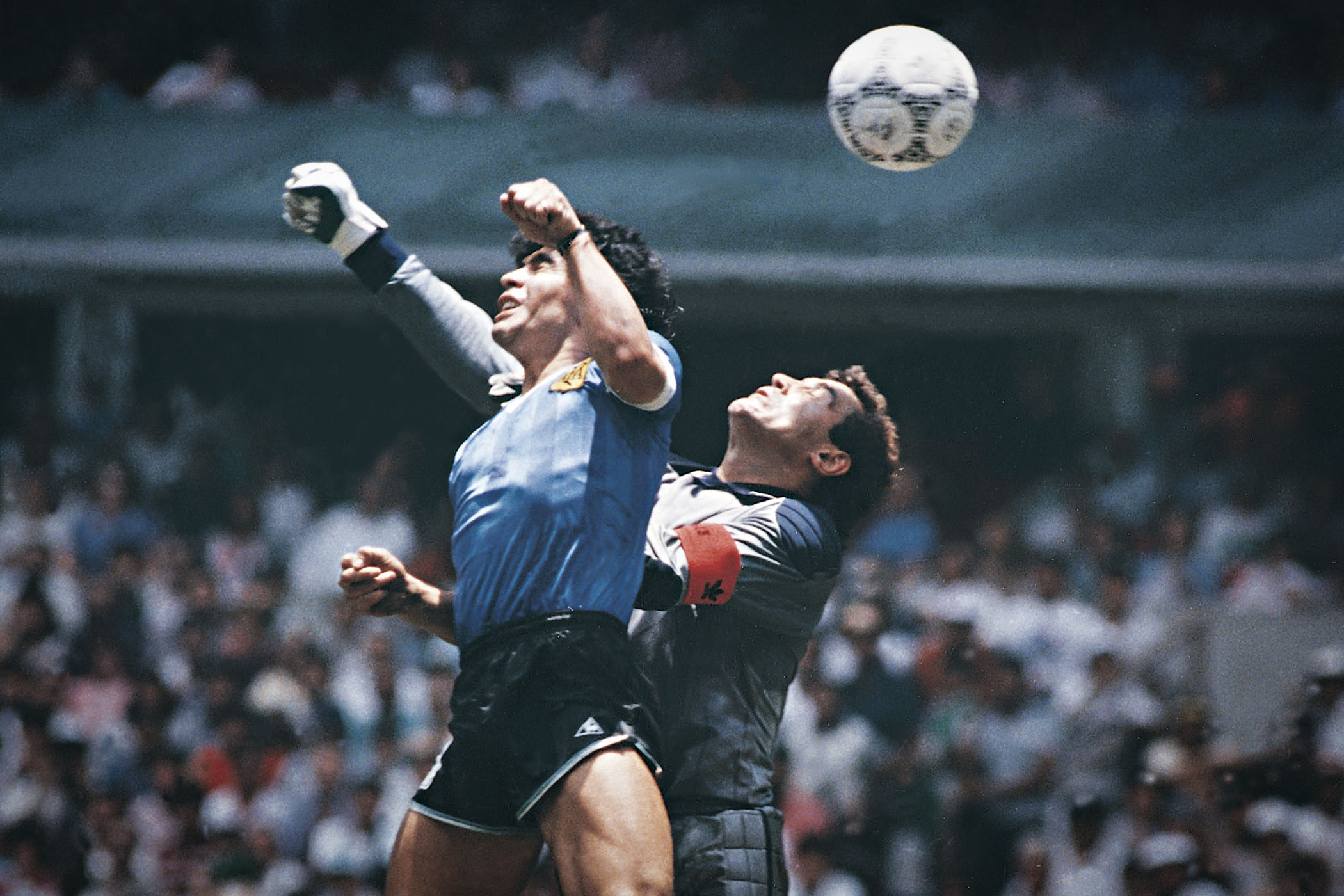
Maradona himself made that connection, between the death of more than 650 Argentinian troops, sent like “little birds” to the islands by the country’s brutal military dictatorship; in the aftermath of Argentina’s win against England in 1986 – Hand of God, barrilete cósmico, all that – he described it as “revenge” for the war.
But the link runs far deeper than that. Edgardo Esteban, a veteran of the Malvinas, wrote in Página 12 this week that “the war and the national team are the two things that unite Argentina”. Against England, he wrote, “history inevitably surfaces in the collective memory”.
It is a popular view, but may be an oversimplification. The Falklands, as Matthew Brown, Professor in Latin American history at the University of Bristol, sits at the “sweet spot” of Argentinian national unity; to the right, it has long been a matter of patriotic pride; to the left, it fits into an anti-colonialist worldview, in which the troops who died were “victims both of the British and Argentina’s dictatorship.”
Lorenz believes that Argentina has a broader identity than Esteban suggested: there are, he said, “lots of other traditions that unify the country” besides the war and the greatness of Messi. But he agreed that football and the Falklands are inseparable in the Argentinian imagination. “Conflation of the two is inevitable,” he said.
“Football has become the space in which public mourning is done most effectively,” said Professor Brown. “You will see Falklands veterans doing laps of honour at games. The clubs aren’t private companies; they reflect the needs of their members. There was an unmet need for research into what happened to fans who disappeared during the dictatorship; the clubs have taken a lot of that on.”
All of this, of course, is distinct from the way that Britain – and, most pertinently, England – understands the conflict in the South Atlantic. Even if there remains a conviction that the Falklands remain British, it would be disingenuous to suggest it is as prominent in our thinking as it is in Argentina. It is not, as Brown said, necessarily even a mandatory part of our national curriculum.
To us, it is a war that happened almost half a century ago; to them, it is more than just a grievance, it is both a personal loss and a national agony. It is “really vividly present” in the Argentinian psyche, to use Brown’s words; intimately bound up, as Lorenz said, with the most difficult period of the country’s history, with trying to confront the realities not just of defeat but the years of brutal military rule that led to it.
“It is something unifying,” Lorenz said. “But without consensus on what exactly it signifies.” All of that is played out at the World Cup, laced into the hymns intoned by the devoted, amid the frenzy and the fervour of watching Argentina.
*Just a note, seeing as Gary Lineker got in trouble for this: I’ve used the Argentinian term when in an Argentinian context, and the British one in all others. We’re all grownups here. This isn’t the Telegraph.
Photograph by El Grafico via Getty Images