
On 5 June, an anonymous German man boarded a Delta Air Lines flight from Dublin Airport, bound for Atlanta. He was travelling with two friends. They had flown to the Irish capital the previous day from Frankfurt. All three were carrying only hand luggage: small rucksacks filled with pint-sized toiletries and a surprising number of football shirts.
The ages of the party are not entirely clear at this stage, but for the sake of argument we can imagine that they are in their early or mid-20s. We do not know their names or what they look like; although they have posted photos since landing in the United States, they have consistently obscured their faces.
All we know is that the leader of the group maintains an account on X, a social media platform so toxic and corrupted that its substantial userbase of football fans could probably claim to be its well-balanced and normal community. This does not speak volumes for everyone else on the site. His handle is @FreddyLA7. His profile photo depicts Cristiano Ronaldo.
Prior to landing in the United States, his account was modestly successful if essentially unremarkable. His contributions in May suggest that he is a reasonably prominent member of what might be called Ronaldo Twitter. His verified posts glorifying the Portuguese’s extremely important achievements at Al-Nassr, his Saudi club, regularly attracted one or two thousand likes.
Late in May, though, the tone of the account changed. Freddy has been consumed, for the last three weeks, by his adventures in the United States. He and his companions had tickets to seven World Cup games, starting with Germany’s opener against Curaçao in Houston last Sunday, taking in two Portugal fixtures and culminating in a quarter-final in Kansas City.
Their plan was to use the tournament as an excuse for a road-trip: starting out in Atlanta, they would visit six states – Georgia, Louisiana, Florida, Alabama, Mississippi and Texas – before arriving in Houston, site of their first two games.
It was, presumably, intended to be a bucket-list adventure, rather than a perfect encapsulation both of the baffling mechanics of fame in the social-media era and a chilling example of how our dysfunctional information ecosystem means everything is ultimately hijacked, co-opted and repackaged as material for a cynical and craven culture war. But that’s the risk you take when you go on holiday.
It started innocently enough. As they travelled through Georgia and into Louisiana, Freddy and his friends revelled in their encounters with that stripe of American culture that is both curiously familiar but inherently exotic to Europeans. They went to a college football game. They ate at Waffle House. They saw a petrol station the size of a small Dutch city.
As Freddy tweeted each of his new discoveries, their wide-eyed enthusiasm for the more mundane facets of American existence endeared him to his hosts.
In a country largely dog-tired of the constant sense of conflict engendered by its government, it is probably not a coincidence that much of what has gone viral in the early days of the World Cup has felt soft and wholesome; seeing Europeans revel in kitschy Americana has reminded Americans, on some level, of what it is to be liked.
Newsletters
Choose the newsletters you want to receive
View more
For information about how The Observer protects your data, read our Privacy Policy
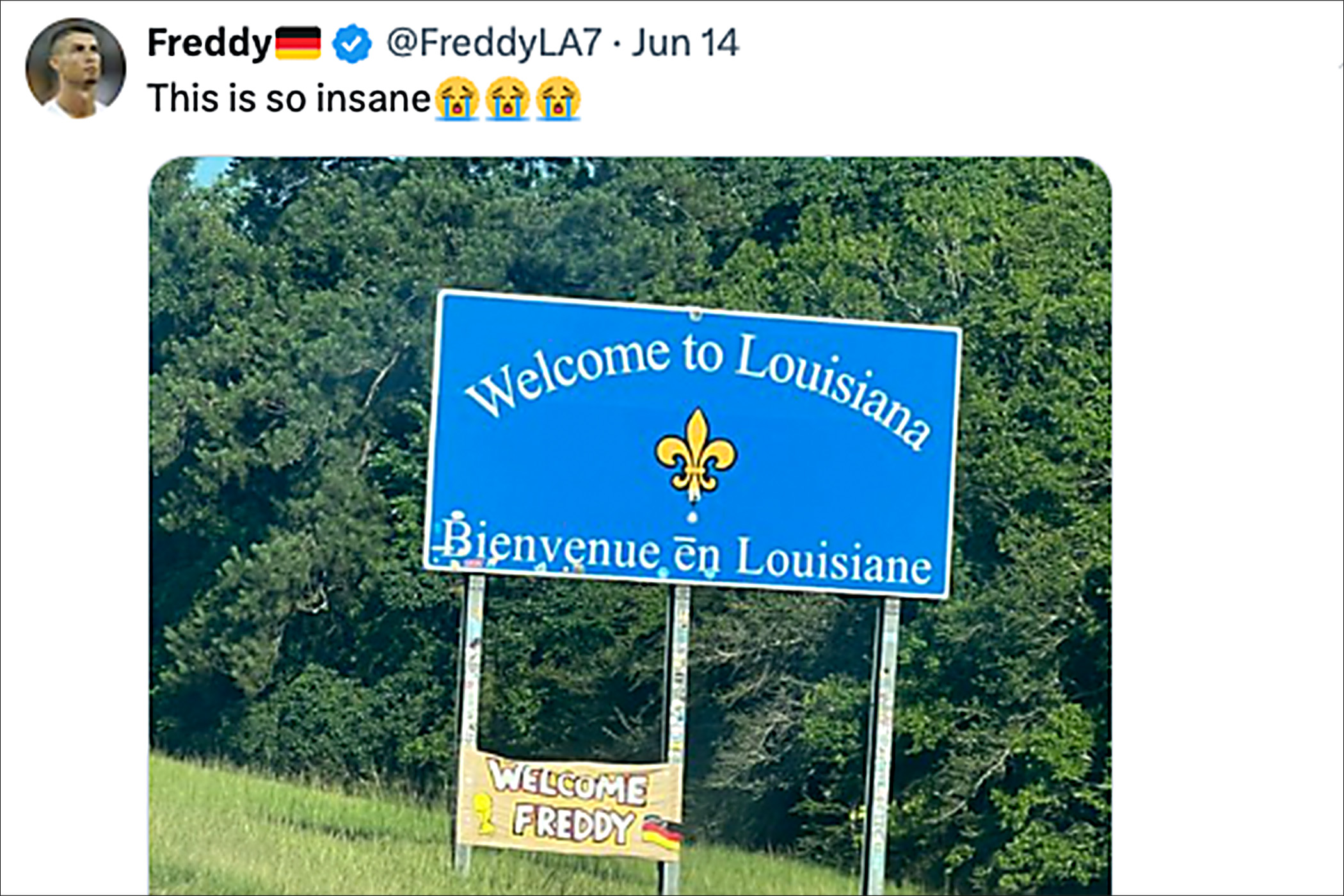
Freddy was duly inundated with suggestions of places to go on his journey. His follower count spiked. Someone left a placard to welcome him to Louisiana on the road sign that marks the boundary of the state. Pretty soon, he was being offered tours of local universities and police departments.
So far, so heartwarming: man who appears to radiate positivity, who actively embraces the culture of the place he is visiting, is rewarded with kindness in return; his delight at simply going to Wendy’s brings out the best in America, which then projects that vision of itself to the world. This is how these things are meant to work. The story of FreddyLA7 should be one of hands stretching across the ocean, clutching a stacked plate of chicken and waffles.
Predictably enough, it is at this point that things take a turn. First, there are the imitators. As soon as it became clear that the algorithms liked the genre “European goes to Chick-Fil-A”, there was a sudden deluge. Some, undoubtedly, were real tourists, experiencing precisely the same emotions at precisely the same triggers as Freddy.
Others felt more deliberate, less authentic: attempts either to claim some of the benefits apparently up for grabs – the freebies, the gifts, the plentiful interview slots available on America’s patchwork of local news channels – or, worse, nothing but grifts, empty plays for monetised engagement. That is no shock. This is the incentive structure we have allowed the social-media platforms to build.
People are not stupid, though: in short order, there was a general awareness that not all of this content was real. Indeed, as the academic Andrew Elrick told The Observer recently, much of our media climate is now predicated on our operating assumption being that nothing is real.
Alas, that soon applied to Freddy too. In an age dominated and defined by the selfie, his refusal to show his face was deemed to be suspicious. Freddy has not, at the time of writing, assented to a mainstream media interview. Perhaps he was not real either? (This is, it has to be said, possible.)
But that is not the worst of it. The algorithms were not the only things paying attention to the sudden surge of feelgood World Cup content; the European mind, as the saying goes, cannot comprehend just how quickly the ravenous footsoldiers of the influencer American right are to descend on anything that can be contorted into the rage-bait upon which their relevance depends.
And so, as Freddy and his friends ate their way through the South, various blue-tick demagogues began to explain how his amazement at such base forms of American life illustrated the poverty endemic to Europe, the economic malaise of the immigration-addled social democracies of the old world, the manifest and inarguable supremacy of the economic model of the United States. The wealth of the US, they said, were unimaginable to – in their terminology – these “Europoors”. It did not seem to occur to anyone that sometimes people have a nice time on holiday.
The whole process – from “German man starts road trip” through “perhaps this is guerrilla marketing” to “Europe has fallen” – might not even have taken a week.
There has, in the interests of transparency, been a subsequent salvo: equally odious European nationalists suggesting that America’s delight is, in fact, a measure of how desperate they are for European approval, but it feels like a relatively minor skirmish. The damage has already been done; FreddyLA7’s parallel journeys through both America and our poisoned media ecosystem have depicted that perfectly.