
This article is part of the Rory Smith on Football newsletter – a guide to help understand what is happening on the pitch, off the pitch, and why all of it matters.
Throughout the tournament, Rory will be travelling across America, delivering daily commentary on the biggest World Cup ever direct to subscribers. Never miss a newsletter, subscribe now here.
Of the many and varied faults that afflict humanity – envy, greed, the continued existence of Dubai chocolate – a lack of flexibility is not among them. The speed with which we, as a species, can adjust to and then internalise the existence of some wholly new thing is admirable.
There was only a matter of days, for example, between the arrival of AI, a technology conceived with the aim of transforming the very experience of what it is to be human and which consumes vast quantities of planet-destroying power, and people harnessing it in order to dress the Pope up in a big weird coat. We’re good at this.
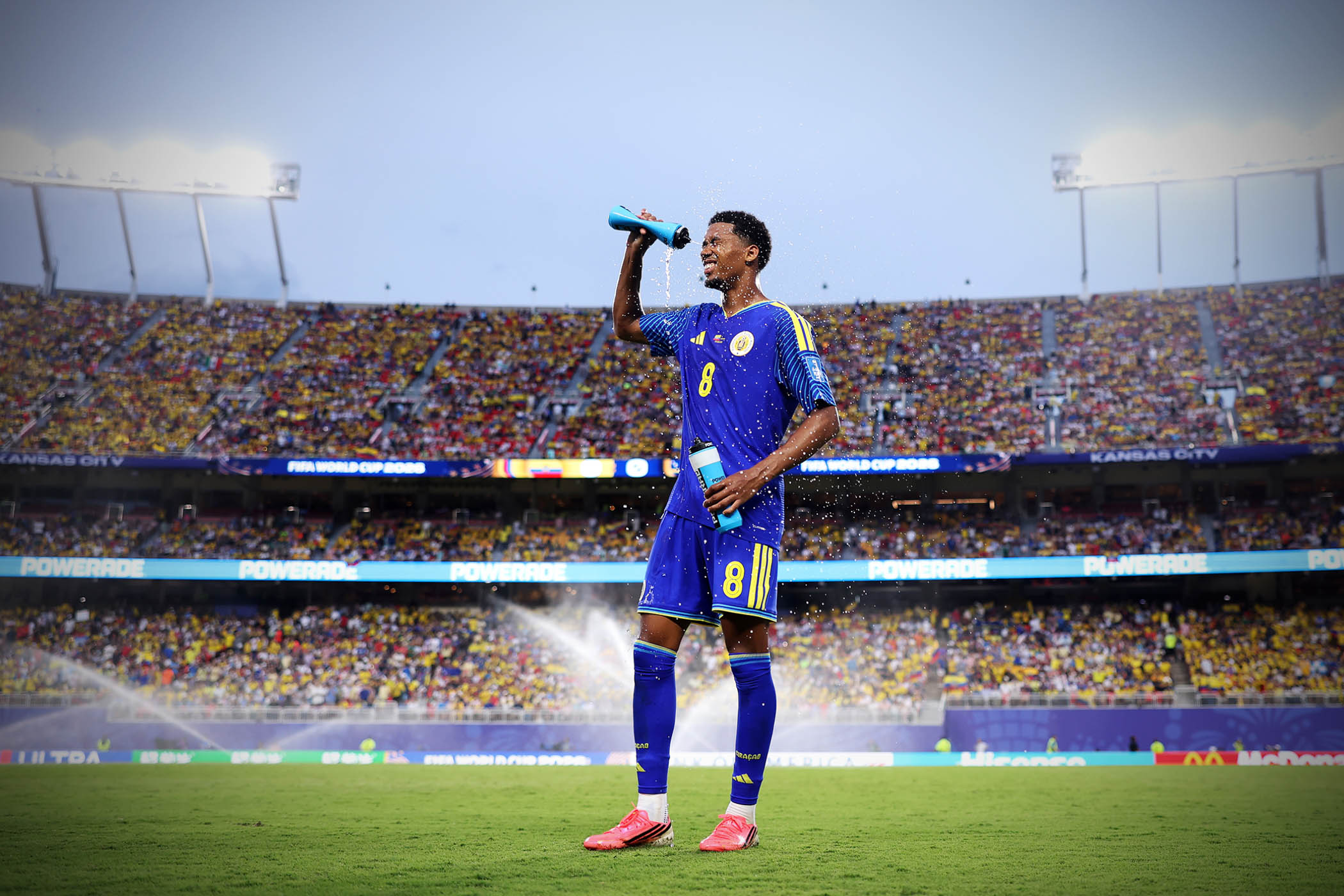
And so it should be no surprise that, within roughly three days of this World Cup, one commentator on Fox Sports – the tournament’s English-language broadcaster in the United States – was already referring to a game entering its second quarter. He did so perfectly naturally. He did not pretend it was a metaphor. The idea of the hydration break had already permeated our skulls.
With the possible exception of the scandal over ticket prices, nothing about this World Cup has made people angrier than the three-minute intermissions that have suddenly intruded on the games.
They are, according to the Telegraph, “irritating,” “ludicrous” and a form of “lunacy.” The general consensus is that these interruptions are a scourge, imposed on the world by the dastardly Americans.
This argument, unfortunately, rather ignores the fact that Americans hate them, too. They are well aware of the very obvious reason for their existence. They are a chance for Fox to cram in nearly three minutes of money-spinning adverts, the equivalent of what is known in the NFL as the “television timeout.”
This has been done with not just the permission but the connivance of Fifa; it seems to represent yet another aspect of the game that has been packaged up and sold off by the very people who are meant to protect it. And that, of course, is pretty hard to dispute. This is football being contorted to fit the shape of television, not the other way around.
Some of the other complaints, though, seem either overblown or undercooked. The main objection seems to be that the breaks either rob games of their momentum, or alter it in some fundamental way.
Newsletters
Choose the newsletters you want to receive
View more
For information about how The Observer protects your data, read our Privacy Policy
The best example of this came in the first round of games, when the hydration break came not long after Curaçao had equalised against Germany. They went on to lose the game 7-1; at the precise moment that the smallest nation in the tournament’s history had the four-time winners on the ropes, they were forced to stop so that we could all watch Christian Pulisic advertising Wells Fargo.
This is not, in truth, the most compelling evidence imaginable. Curaçao would almost certainly have lost that game anyway. There are plenty of other things that might have slowed their momentum: an injury, a staccato period of play, Germany deciding to keep the ball for that very purpose. The breaks have not made such a pronounced difference in other games.
And besides, how the breaks play out in one individual fixture – one in which the exact extent of its influence is difficult to gauge – is far less important than the broader impact they can have.
The first of these, obviously, is that they accelerate the influence of coaches on the game. The breaks might exist for commercial reasons, and the mask might be player welfare, but managers have seen them exclusively as a chance to pass on tactical messaging to their players. For them, this is a welcome opportunity to ensure the game runs according to their vision; for those who might think that the systemisation of the game has robbed it of individuality, ingenuity and imagination, it represents another step on a journey that is already too far advanced.
The second is that it reduces the element of fatigue. That is, on the surface, a good thing; not only does it help protect players, it should enable them to perform at their best for as long as possible. In that context, it really should be no great burden for us to pause for a few minutes to allow them to have a drink.
Except that fatigue is a part of football; the game is a test of endurance as much as it is of skill. Players make mistakes when they get tired; in lots of cases, that is when things happen, the things that give us, as fans, the entertainment we seek. By trying to chase fatigue from the game, either by extending substitutions or by allowing players to rest, there is a risk that we end up reducing what happens in all four quarters.
Photograph by Alex Pantling /FIFA via Getty Images