At the end of the day, Gary, people just want to feel something, want something they can love and trust and talk to their dad about. International management is as much about appearances and illusions, shapes and vibes, as exploiting half-spaces and inverting full-backs. Fans will forgive most things if they’re having a good time, which explains everything from Ange Postecoglou to ticket-gouging and hydration breaks. By the end, Gareth Southgate’s greatest defect was the anaesthetic football, football that begged you to think of anything else, Phil Foden pirouetting then passing backwards ad nauseum.
ITV’s peak audience for England’s giddy, sparkling 4-2 win over Croatia was 15.4m, with more than 14m watching the full match, the most-watched thing on British TV since the Euro 2024 final despite kicking off at 9pm. At a crude estimate, 10m of those will not have seen a minute of England under Thomas Tuchel, who knows he has two or three World Cup matches to convince the masses he is worth believing in, that this is going somewhere. For all players and coaches claim otherwise, public perception matters: it leaks into camp through friends and families and surreptitious midnight doomscrolls.
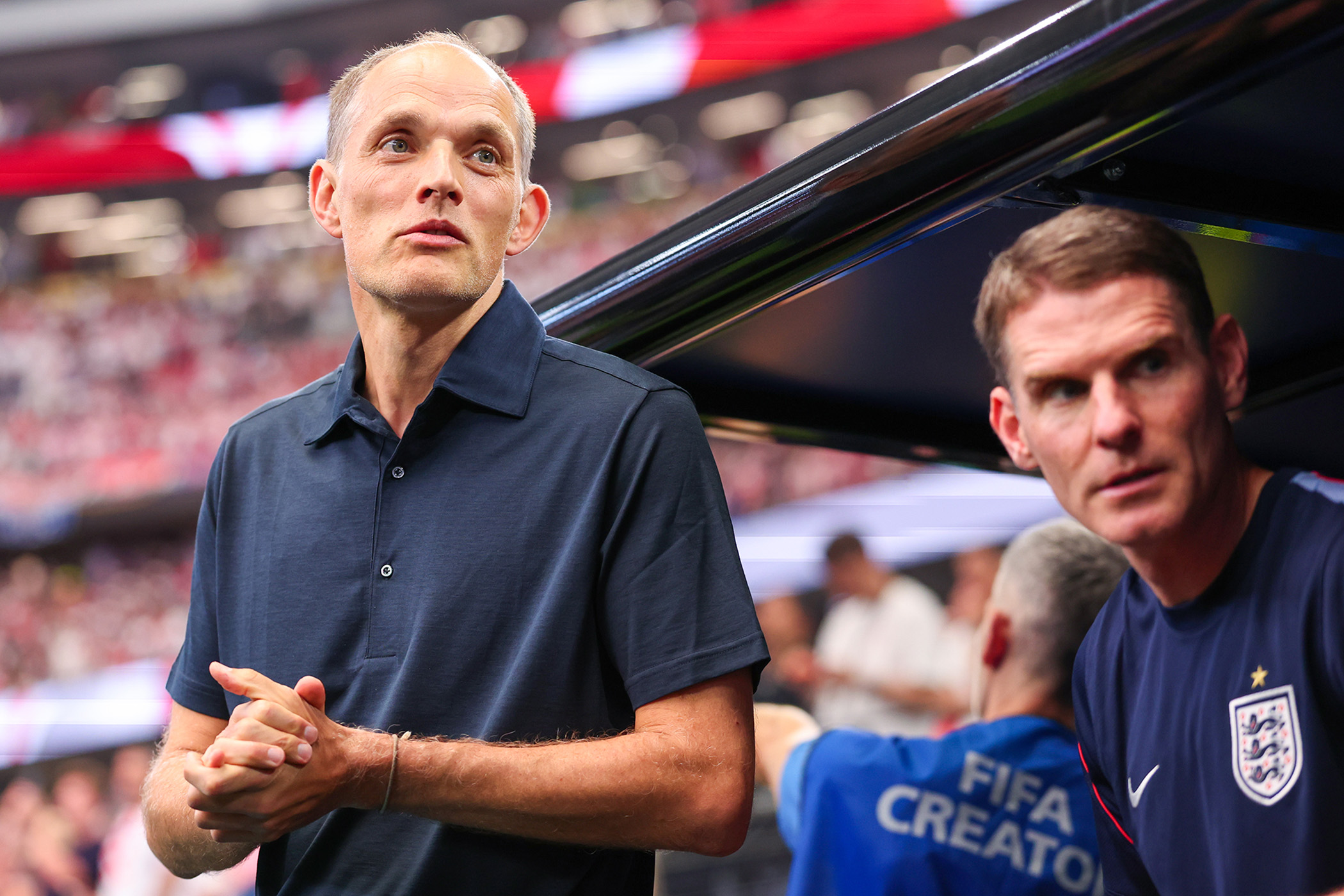
“I had thought in the second half: ‘People in the pubs will like this’,” Tuchel said. “Hopefully everybody enjoyed it, and it brings a connection.” While he has little interest in uniting a fractured nation, saving our lost boys, he understands that at a base level people need to enjoy this, that sport is supposed to be fun. There’s a lightness and childish charm to him not immediately obvious.
On the night before the match, Harry Kane had sat alongside Tuchel on a Fifa-branded dais and produced 30 minutes of platitudes so mind-numbing it somehow became absorbing, almost therapeutic, like watching someone deep clean a bathroom, really getting into the grout. This is what we have come to expect from half-time and post-match interviews, a necessary irritation, a process that only serves the content machine.
And so Tuchel’s, and his assistant, Anthony Barry’s, basic honesty in Dallas was so alien it felt radical, admitting that players get nervous, that the bad football you just watched was actually bad, rejecting the Mikel Arteta school of gaslighting. “The leads we took, both leads, did not make us more free,” Tuchel said. “We had more the impression we had to protect something, and got punished for it,” as close as he will get to sub-tweeting Gareth Southgate.
“He was top at half-time, the words he used and what he said settled everyone,” Declan Rice said. “I can’t say too much, it was just one of those moments where you’re like: ‘Wow, what a top manager’.”
His retelling of his half-time speech, already adopting semi-mythical status, is that he told the players: “I want them to do it their way, our way. I wanted them to be brave, courageous, intense, on the front foot, do it together… There is nothing to fear. Just go for the win.” For comparison, before Southgate’s first World Cup match, a nervy yet oddly thrilling 2-1 win over Tunisia, he said: “[England] want to be a bold and attacking team. They have a hunger to press, win the ball back and play brave football. Stick to your principles. We keep probing, looking for the win.”
Players and fans seem to have been almost instantly convinced by Tuchel, decided that he is something entirely different from Southgate, whose England beat a stronger Croatia in their Euro 2020 opener, and also won their first match of the 2022 World Cup 6-2 against an Iran side ranked 20th in the world. This is, of course, because he is different, existing in the sweet spot of easy confidence and established reputation that Southgate didn’t, ultimately sincere to a fault. It’s not that Tuchel is saying anything revolutionary, it’s that he can seemingly alchemise those words into actions. He made substitutions that weren’t geared towards having 11 players on the goal-line in a human shield, that weren’t informed by self-preservation or fear. It bears saying that much of this should be relatively simple for Tuchel, building on solid foundations, solving prosaic problems.
It remains among football’s most fascinating quirks that no team has ever won a World Cup with a foreign manager. The obvious explanation is that most major nations have historically only hired domestic coaches – neither Germany nor West Germany have ever appointed a non-German, the same for Italy. Argentina haven’t hired a non-Argentinian since the 1934 World Cup, France has only been led by Frenchmen since 1975, the Netherlands by a Dutchman since 1978 (when they reached the final under Austrian Ernst Happel). Carlo Ancelotti is Brazil’s first significant non-Brazilian manager. Really, we don’t know whether it works because it has so rarely been tried.
There’s a sense this could be the right coach with the right squad at the right time
There’s a sense this could be the right coach with the right squad at the right time
It’s less than a decade since the FA decided that then 61-year-old Sam Allardyce was the nation’s great hope because he ticked two key boxes: he had just hauled Sunderland from 19th to 17th in seven months, and was born in Dudley. But English football is now actually Premier League football, a borderless super league, and Tuchel is a Premier League manager – his Anglophilia is a fun sidenote but basically irrelevant. He understands how these unfathomable super-footballers function and think, one of a few Dr Doolittles for the genius athlete class. His distance from the English psyche feels crucial, not burdened by the same national neuroses and inferiority complexes, by the same learned responses. He is not learning and growing with his squad as Southgate was, all in this together, but guiding and shaping them from his extraordinary experience. This is why you hire someone who understands how to manipulate and mould unique minds and egos like Bellingham’s, who has watched talent eat and fight itself before and knows how to release it from itself.
Newsletters
Choose the newsletters you want to receive
View more
For information about how The Observer protects your data, read our Privacy Policy
Of course, this swirling positivity’s roots are shallow and vulnerable, but there’s a burgeoning sense of cosmic alignment, that this could be the right coach with the right squad at the right time. Only Spain and France’s playing corps have comparable depth and generational talents. Tuchel has this faintly glowing messiah energy about him. The cruelty of the major-tournament format is how dependent it often is on luck – Tuchel might well have inherited the European champions if Kane had been fully fit in 2024. Rice looked uncharacteristically uncomfortable against Croatia and eventually came off injured. Bukayo Saka is managing an Achilles injury, although Tuchel hopes he will start the Panama match. Six of the starting XI on Wednesday are irreplaceable. This is a squad so finely balanced, it could snap at any moment.
What became obvious on Wednesday was that Rice’s incomparable set-piece deliveries are perhaps the biggest value-add of any single skill within this group, a genuine World Cup-winning weapon. There will inevitably be more halves where England struggle for clarity and coherence, and yet the opening penalty directly followed a Rice corner, before Kane’s header from a floating out-swinger. The weight and spin of his delivery produces an unwaveringly accurate and approachable ball; England could have beaten Croatia through corners alone, Nico O’Reilly heading one wide and one straight at Dominik Livaković.
Perhaps the greatest cause for optimism is how much was wasted against Croatia, England still deeply flawed and disjointed, a team that operated at the lower limit of their capabilities for 60 minutes or so and still won comfortably. Tuchel has repeatedly mentioned the need to build into tournaments, which there is plenty of scope to do, a team yet to discover their ceiling, to understand what might be possible.
Ghana and Panama are unhelpful opponents in that they are a step down from Croatia, but should allow Tuchel to protect what needs protecting, to allow his defence to settle into themselves. But they can be perfect vessels for the proliferation of vibes and goodwill, for feeling something, for – imagine this – everyone enjoying themselves.
Photograph by Marc Atkins/Getty Images