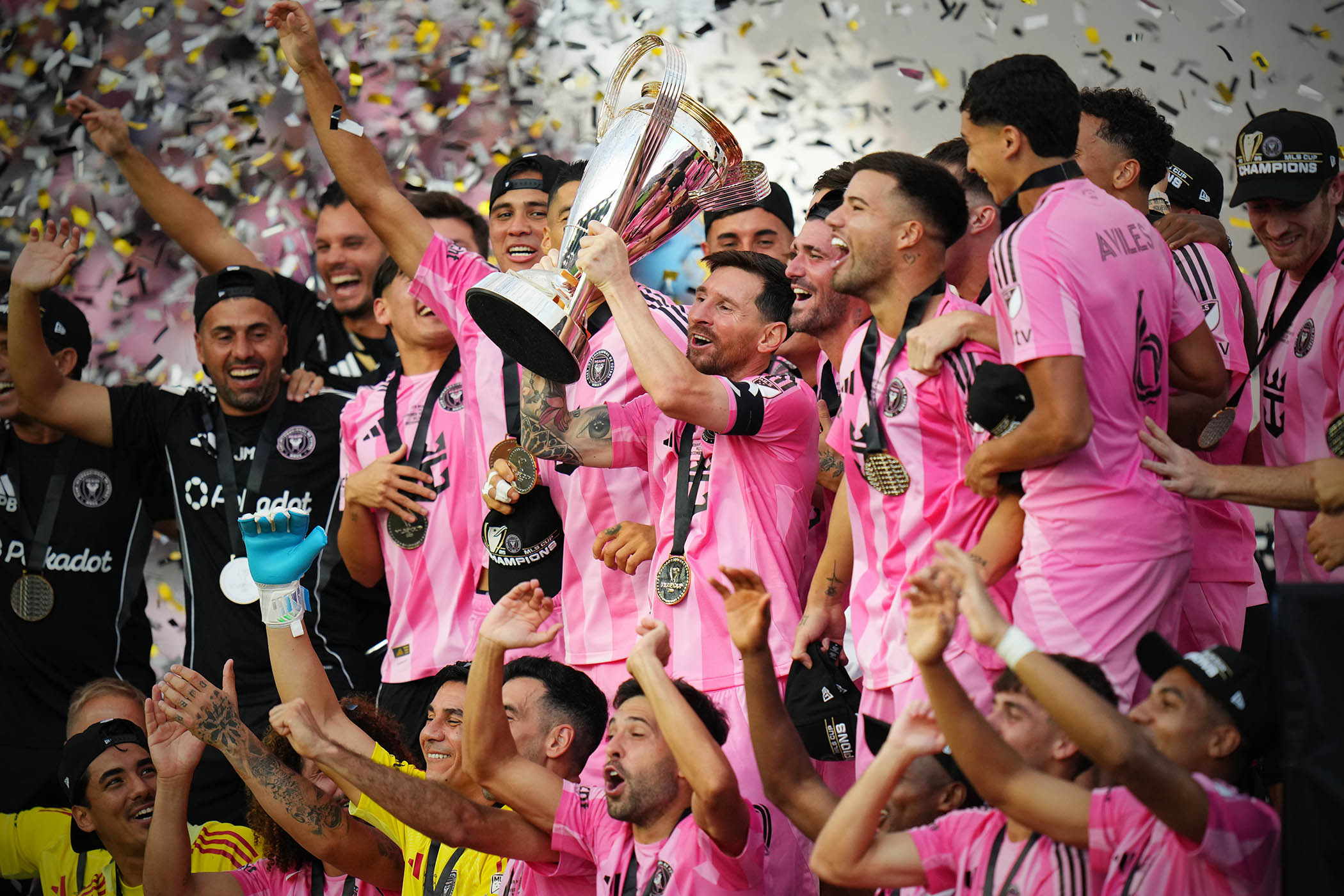

Lionel Messi had enough energy in reserve for a final coup de grace. He had long since stopped running, dispensing with the pretence that dirty work was in his job description. His Inter Miami teammates were busily closing down opponents, cutting off angles of attack, protecting their slender lead in the MLS Cup final. Messi was upfield, ambling with intent.
Then, five minutes into seven minutes of injury time, Jordi Alba spotted him in a pocket of space: just like old times. The full-back, in the last game of his career, lofted the ball onto Messi’s chest. He cushioned it and instantly clipped a pass over a defender and into the path of Tadeo Allende. Miami’s Argentine striker took two touches and rolled a shot home.
Pink smoke billowed from the stands at the Chase Stadium. In the owners’ box, David Beckham beamed with pride, and relief, at the sight of Inter Miami – the club he helped to found – becoming Major League Soccer champions for the first time, five years after the team first took to the field and, more to the point, three years after Messi arrived.
The best measure of Messi’s significance came half an hour or so later, once the rest of Miami’s players had filed onto the podium and been presented with their medals by a variety of dignitaries, Beckham among them. Only Messi, the captain, was left. He was waiting a short distance away, next to the plinth where the MLS Cup trophy had been placed.
He did not have to move. Instead, the luminaries came to him: Beckham and his co-owners, the Mas brothers; Don Garber, MLS’ Commissioner; Cindy Parlow Cone, the head of US Soccer. It was impossible to miss the articulation of the power dynamics. Messi is, now, the star around which all of his team, his club and now Major League Soccer itself revolves.
In a nation that adores boiling the magic of sport down to numbers, Messi managed 2.18 goal contributions per 90 minutes
In a nation that adores boiling the magic of sport down to numbers, Messi managed 2.18 goal contributions per 90 minutes
He is not, for example, an MLS champion because his ageing, aching limbs have been carried by much younger teammates. At the age of 38, Messi has, by common consensus, just produced the finest individual season by any player in MLS’ three decades of existence. In a nation that adores boiling the magic of sport down to numbers, he managed 2.18 goal contributions per 90 minutes.
If that does not quite elicit a sense of wonder: he scored more goals than anyone else, and recorded the joint most assists in the regular season. He created two of the three goals Miami scored to beat the Vancouver Whitecaps – featuring another old soldier, Thomas Müller – on home turf to win the MLS Cup.
Even if he had not, it is hard to understate the scale of Messi’s influence on the startup club he joined in the aftermath of the 2022 World Cup. Some of it is obvious: the coach, Javier Mascherano, was his teammate at Barcelona. The same goes for Sergio Busquets and Alba – this may prove a swansong for both – and Luis Suárez, once his neighbour in Castelldefells, the resort town just south of Barcelona where Messi lived for the prime years of his career. Rodrigo De Paul, scorer of Miami’s second goal, has long functioned as Messi’s on-pitch bodyguard.
It runs, though, much deeper. Oscar Ustari, the reserve goalkeeper, is one of Messi’s oldest friends; they first met when playing together in Argentina’s youth teams. Ustari’s shirt always used to hang in pride of place in the room where the finest player of all time displayed the mementoes of his career.
And then there is the atmosphere at the stadium. Miami has a large Argentinean – or at least Argentinean-descended – population, of course: the joke runs that the best thing about the city is that it is close to the United States. The crowd was, then, always likely to borrow the aesthetics and attitudes of South American stadiums.
Newsletters
Choose the newsletters you want to receive
View more
For information about how The Observer protects your data, read our Privacy Policy
That Saturday’s final was soundtracked by a chant to the tune of Muchachos, by the Argentinean group La Mosca, though, felt very much like Messi’s influence. The same song accompanied him to glory in Qatar. As he said in an interview after the game, Beckham had dreamed of bringing elite football to Miami for “19 years”. He deserves immense credit for doing so. But he should not be under any illusions that this is a club built on Messi’s shoulders.
That process will only accelerate from here. If all goes to plan, this will be the last MLS game the club plays in its makeshift stadium in Fort Lauderdale; Miami Freedom Park, the team’s purpose-built home, is supposed to open in time for the start of next season. Jorge Mas, the team’s principle benefactor, has suggested that Alba and Busquets will be replaced by players of similar stature; the next aim is to win North America’s equivalent to the Champions League.
The benefit of that ambition will be felt outside Miami. When Messi first announced he was moving to MLS, the club’s shirt became so popular that Adidas, the manufacturer, struggled to meet demand. (It is in a bespoke shade of pink, one that even the company’s colossal supply chain found hard to locate in sufficient quantity.)
In the years since, those shirts have become a familiar sight not just in North America and Argentina but in Europe, too. They, and Messi, have helped turn Inter Miami into the first MLS team with any sort of global cut-through; even in Beckham’s playing days, his LA Galaxy shirt was not quite such a must-have item.
While it is true that the MLS Cup final may not have commanded the same sort of audience that the culmination of the Premier League or Champions League might – or even, in truth, an average game in an average week – that is not the only gauge of a league’s growth.
In terms of brand and name recognition, Miami’s first five years have been an extraordinary success story. How much of that is down to Messi, to the adoration he inspires and the interest he generates, is somewhere between most and all. The sellout crowd at Chase Stadium was there to see him. The deal with Apple TV that carries MLS around the world was signed, in no small part, because of him. Messi is not just a franchise player for his club. He is the franchise player for the city, the league, the whole idea of domestic soccer in the United States.
Garber said as much, once he and the other grandees had made their way over to Messi. “It has been an honour that none of us can truly understand to have you in our league,” he said, as the greatest player of all time listened patiently, beatifically, silently. Messi never says much. He does not need to.
Once the Commissioner had finished, he picked up the trophy, took it over to his teammates, and, as plumes of glitter and smoke exploded at his back, lifted it above his head, the league itself in his hands.
Photograph by Rich Storry/Getty