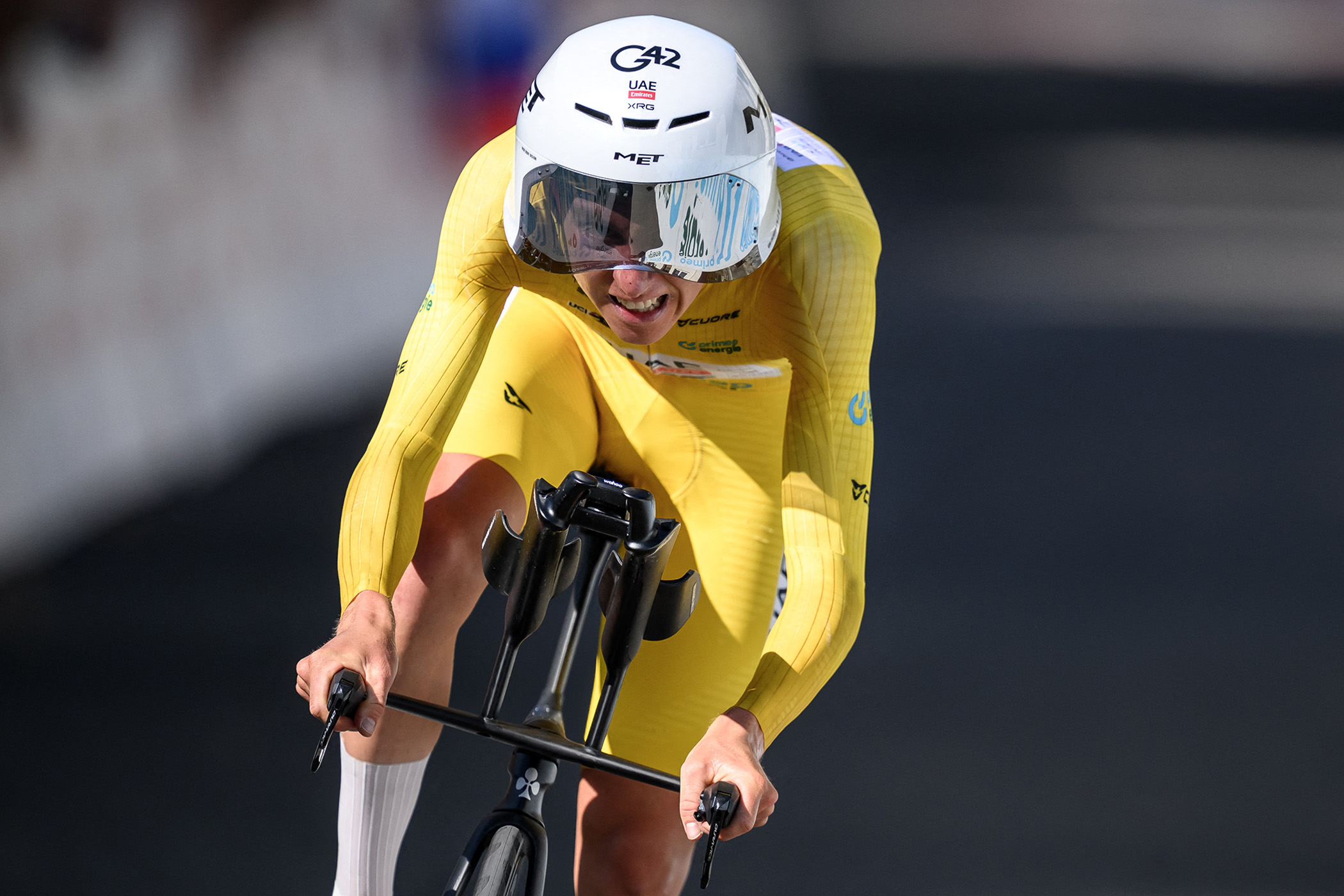
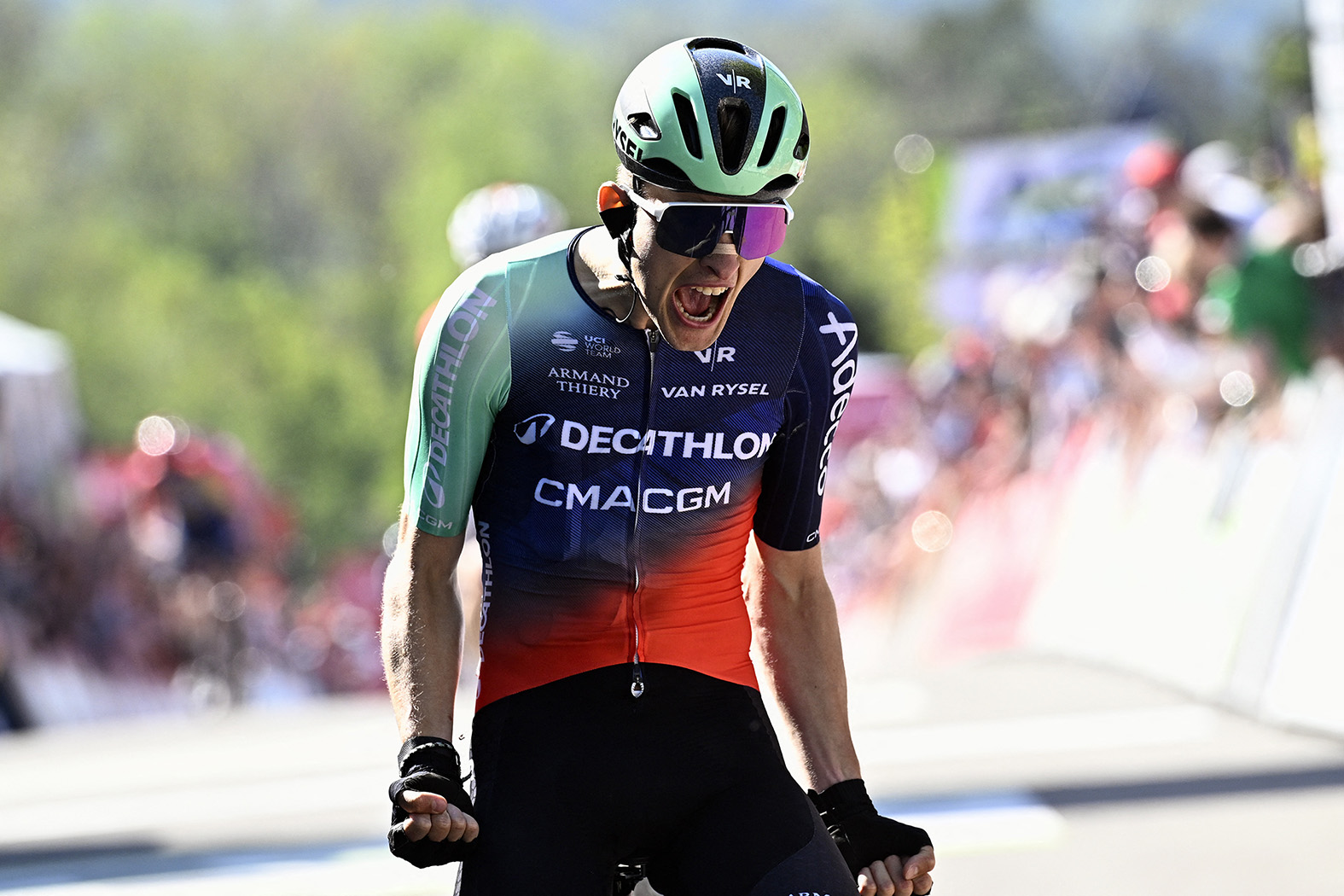
Hopes of a French revolution in this year’s Tour de France are fading after Tadej Pogačar crushed all comers in his final build-up race at the Tour de Suisse, while Paul Seixas, his teenage dauphin, is still nursing wounds sustained in a high-speed crash two weeks ago at the Tour Auvergne-Rhône-Alpes.
The plotline that saw Pogačar cast as Goliath, and 19-year-old Seixas as David, finally slaying a champion who French TV commentators have taken to labelling a “monster”, appears to have now been scrapped.
Maybe you don’t win anything with kids, but the French are now desperate to end their long wait for a new champion. When Seixas crashed, at 70kph, on an Alpine descent, Pogačar’s chances of pulling off a record-equalling fifth Tour win immediately ramped up.
It’s more than 40 years since a Frenchman last won the Tour. Back in the day, in July 1985, a home win seemed almost de rigueur. Between 1978 and 1985, there were seven French wins, Hinault taking five and rival, Laurent Fignon, two.
Since then, nothing.
Hinault, now regularly wheeled out in an ambassadorial role at major races including the Tour, has grown weary of slapping the backs of foreigners and congratulating them on their success.
Danes, an American, a Slovenian, a German and even three Brits have now won the Tour, albeit occasionally in questionable circumstances. That explains why, when the prodigious Seixas announced his intention to start this year’s Tour, back in May, L’Equipe fuelled the fever dream with a headline that read: “Vivement Juillet! (I can’t wait for July!)”
Seixas offered fresh hope. Despite his relative inexperience, he has been the only rider to put Pogačar under pressure this season, and will still line up in Barcelona for the Tour’s Grand Départ with the hopes of a nation on his angular shoulders.
Racing since the age of eight, a national under-17 champion aged 14, and the youngest-ever winner of the Tour de l’Avenir at 18, the 19-year-old is poised to become the youngest rider to start the Tour since 1937. But his crash gave pause for thought.
The French depicted that mishap as a rite of passage, “un mal pour un bien” – a blessing in disguise – hoping that the chastening experience of riding off the edge of a mountain might have honed his racing sensibilities, rather than instilled the fear of God in him.
Newsletters
Choose the newsletters you want to receive
View more
For information about how The Observer protects your data, read our Privacy Policy
Others saw it as revealing an achilles heel.
“He’s still an apprentice,” Thomas Voeckler, a former French national champion, said, while Cyrille Guimard, the management sage who guided both Hinault and Fignon to their greatest wins, believes that Seixas remains a rough diamond.
“He leaves no margin for error,” Guimard said of Seixas’s thrilling but knife-edge descending. “If he makes a mistake, he can’t recover.” Despite the time lost to recuperating from his crash, the hope lives on.
Seixas announced his Tour debut in a homespun video, featuring the family cat, shot in the cluttered gite-like interior of his grandparents’ house in the Alps, at a dining table surrounded by teenage trophies and racing jerseys.
He then spent most of May training at altitude at Sierra Nevada in Andalusia, amassing almost 35,000 metres of altitude riding, and is now training at Les Arcs, in the heart of the Savoie.
The decision to ride the Tour, ostensibly to win, at such a tender age, provoked some criticism in France. Pogačar won his first Tour at 21, while Eddy Merckx was 24 and Hinault 23. But young cyclists are now en vogue, and it’s easy to understand why his team, Decathlon CMA CGM, would want him to start the Tour.
His contract is under review and it’s uncertain just how long he will be their rider; he has been in flying form throughout the spring and lastly, his sponsors will get huge coverage, just from his presence at the race.
Pogačar also has other emerging rivals. Seixas’s crash, during the Tour Auvergne-Rhône-Alpes, was won by the Slovenian’s teammate Isaac del Toro. The 22-year-old Mexican stood on the top step of the youngest-ever podium in the history of that race, with Juan Ayuso, 23, and Luke Tuckwell, now 22, either side of him. Meanwhile, Netcompany Ineos were dealt a huge blow on Thursday as British rider Oscar Onley pulled out following a shoulder injury, also sustained at Tour Auvergne-Rhône-Alpes.
There’s no doubt however that the momentum has swung back towards Pogačar, who was on a roll at the Tour de Suisse, taking three stage wins (out of five) and the overall title.
He also retained his focus, despite worrying about his partner, Urška Žigart, who had crashed and fractured her jaw while racing in the women’s race.
By the end of last year’s Tour, Pogačar had seemed fed up, weary of the racing, bored by the media, sated and satisfied by his serial success. But the suggestions of burnout and disenchantment that shadowed the final days of that fourth Tour win now seem a distant memory.
“I would say I’m stronger,” he said after his Swiss victory.
For all Pogačar’s domination, Seixas is now the most valuable young rider in the sport. A few years ago, when he stormed to victory in the 2020 Tour, Pogačar was the benchmark. Now it feels that even he, faced by the gathering momentum of a younger generation, is edging towards the exit despite his current dominance.
Meanwhile, Seixas fever, fuelled by compatriot Pauline Ferrand-Prevot’s ground-breaking win in the Tour de France Femmes last year, is still alive. “It’s not my mindset or my vision of cycling to line up at the Tour de France simply to gain experience,” he said in May. “I will aim for the best possible overall result.”
Photograph by Fabrice Coffrini/AFP via Getty Images