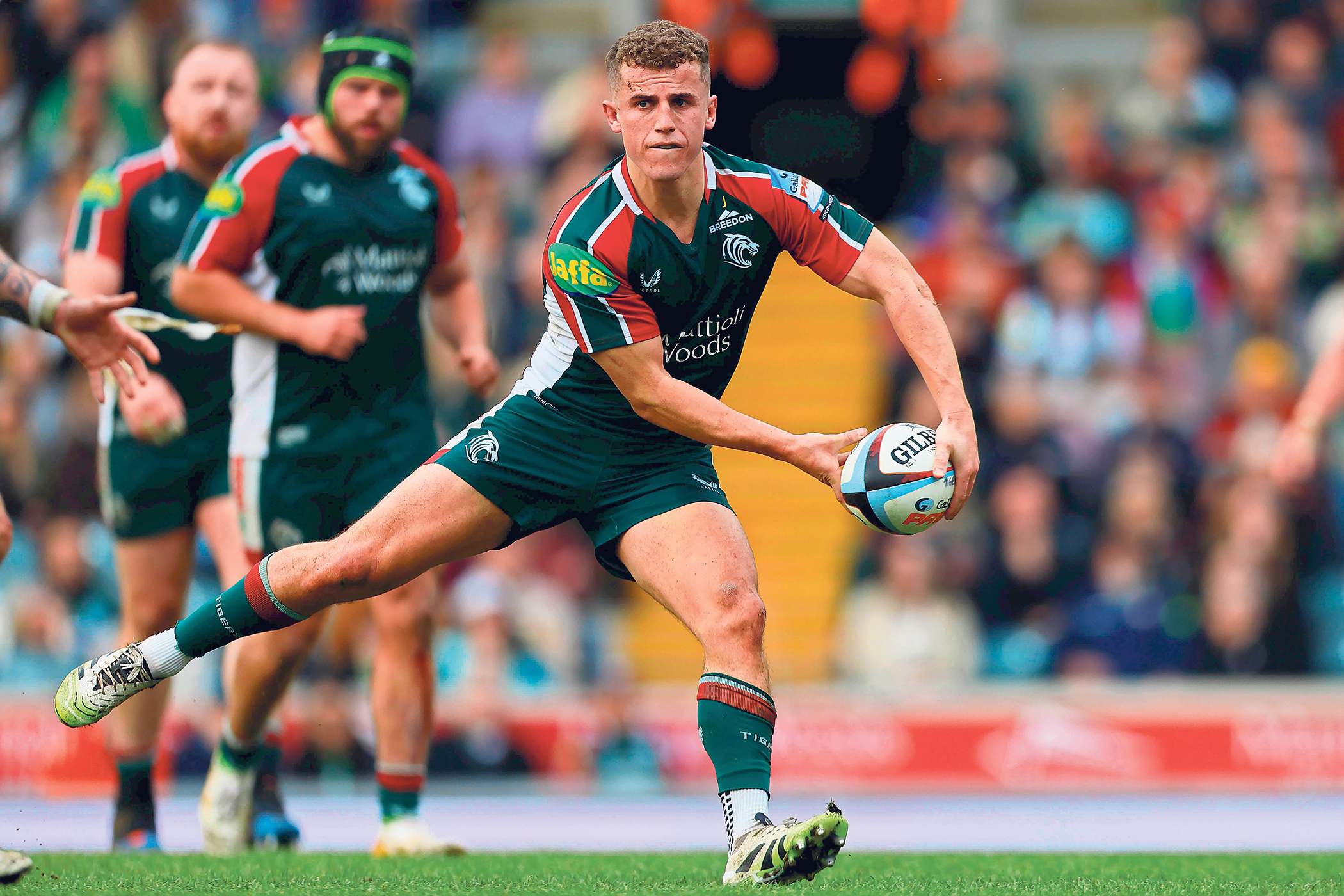




Hopes for the away sides going into this weekend’s Champions Cup last-16 matches were not exactly high. Perhaps in a season where Leicester Tigers have confounded plenty of expectations, they could prove to be the exception.
The suggestion back in the summer, even though Leicester reached last season’s Prem final, was that the club may need a year to settle before challenging again.
They began this campaign with a new head coach in Geoff Parling, replacing the revered Michael Cheika, a leadership drain with the retirements of Ben Youngs, Dan Cole and Mike Brown, plus the departures of Julián Montoya and Handré Pollard, and an open competition at fly-half between three new signings. And with one of their star forwards, George Martin, sidelined by injury.
Parling, a 42-year-old first-time head coach who landed in England only in mid-August after his time with Australia wrapped up following the British and Irish Lions tour, has been in the deep end ever since. Thriving in it, actually, even in a week in which his name has been in the headlines for unusual reasons, following his disagreement with the TNT Sports presenter Craig Doyle before kick-off last weekend.
If you missed it, a ball was kicked by a TNT presenter towards where the Leicester players were warming up, an unexpected development from a Leicester perspective having not been briefed, and Parling took exception. Recognising that shoving and swearing at a TNT presenter probably was not a great look on live TV – even if Parling was well within his rights to be annoyed – Parling and Leicester apologised the next day, conscious that the incident should not distract from the Slater Cup, the trophy contested between Gloucester and Leicester to raise funds for former player Ed Slater, who is suffering from motor neurone disease. “The biggest frustration is we had a great spectacle there, and the Slater Cup means a lot,” said Parling this week.
Quite right too. Although I reckon Leicester supporters enjoyed their new head coach sticking up for his players, in the same manner as a couple of his predecessors, Cheika and Richard Cockerill, would have probably reacted. Parling was right; the disagreement should also not distract from just how well Leicester have played this season, particularly in attack. Leicester’s wingers have not had to keep their hands warm waiting for any action, with the Tigers moving the ball with purpose and scoring the fastest try bonus point of the Prem season against Gloucester last weekend, with four tries inside 16 minutes. The return in time for the play-offs of Adam Radwan, their electric wing with nine tries in 13 starts until he was sidelined by a foot injury, could not be better timed.
“Previous seasons and years we’ve maybe shied away from it a bit. With the backs we’ve got, you have to use them. It suits our team,” said Hanro Liebenberg, the Leicester forward who will leave the club at the end of this season to return to South Africa with the Bulls. “When you have wingers like we have on the edge, you’re always in a good space.”
Key to that approach, complementing Leicester’s traditional set-piece power, has been Billy Searle at fly-half. Searle, Orlando Bailey and veteran James O’Connor were all signed to provide a solution at a key position after the exit of Pollard, the double World Cup winner with South Africa.
Since the end of November, the position of fly-half has no longer been a concern. Searle has played with such attacking intent, so flat to the gain line to keep defences guessing. He bounced around France following the collapse of Worcester Warriors. Now he has settled so well with Leicester that he was named Prem player of the month in January.
Listing Searle’s qualities, Parling said this week: “The ability to move the ball well, some real confidence to take the game on, and good goal-kicking. Maybe his time at lots of different clubs [means that] he has built up a knowledge of lots of different systems and ways he can use that in a positive way, and now he’s found a place where he probably feels more settled and aligns to the way we’re playing. Of course those experiences in the past will definitely have helped him.”
Newsletters
Choose the newsletters you want to receive
View more
For information about how The Observer protects your data, read our Privacy Policy
It is not just Searle who has exceeded expectations. Will Wand at outside centre would be another. Gabriel Hamer-Webb, filling in more than capably on the wing for Radwan in recent weeks, has impressed. Hamish Watson, the Scotland flanker, has been picked up on a short-term loan, which looks like an inspired move.
When players perform at a higher level than expected, the answer is usually down to good coaching. “I’m always open to players and want to see how they can improve, what their ceiling is,” Parling said.
Still, few will give Leicester much hope going into Sunday. They have travelled to France having had to rest their England forwards Joe Heyes and Ollie Chessum, and facing a Bordeaux-Bègles side packed with French stars from the Six Nations, including the uncatchable Louis Bielle-Biarrey.
When asked how you prepare for a game against the defending European champions in their own backyard, Parling provided an interesting detail.
“The tunnel walk there is one of the longest in the game,” he said. “I know it sounds like a small thing, but when you’re walking out to the pitch, it takes two minutes longer than normal. That’s different. I don’t want them to overthink it. I want them to just express themselves. Go and rip in for each other, while knowing that we have to be right on it because we are a good team.”
Wand, when asked about Parling by RugbyPass, mentioned this quality. “The rest of the lads would say the same. Geoff has been really good at supporting the lads on a personal level.”
As a former England and Lions lock, Parling can relate to what they are going through. The youngest head coach in the league has made a big impact. Perhaps Leicester can spring another surprise on Sunday.
Photograph by Malcolm Couzens/Getty Images
Can anyone beat England to title in the Six Nations?

There are two ways to look ahead to this year’s Women’s Six Nations, which begins next Saturday. The first is to marvel at the sell-out crowds and the bigger audience that will engage with this tournament, off the back of a World Cup that set records across the board. It is to wonder at the start of a new World Cup cycle which began with Ellie Kildunne, the Red Roses back, finishing as runner-up at the BBC Sports Personality of the Year – a reminder, if one is needed, about women’s rugby’s growing status.
But the other way is to consider that the outcome of this tournament is beyond predictable. England have not lost a Six Nations match since 2018 and have won the past seven editions of the tournament, and 21 in total, including when the tournament was called the Five Nations. They are on a world-record winning run of 33 games. Their only truly competitive fixtures are against Ireland and France – the two games that bookend England’s fixtures.
The tournament begins with France vs Italy (12.25pm, BBC iPlayer), which Les Bleues are expected to win under new head coach François Ratier, the coach who led Canada to the 2014 World Cup final. Watch out for scrum-half Pauline Bourdon Sansus and exciting full-back Émilie Boulard.
Italy are a team of tempo, so expect ambitious, stylish play – but without the clinical finishing of France. Keep an eye on Harlequins prop Silvia Turani, who has the speed to act as an additional loose forward for Italy.
Next up is England v Ireland at the Allianz Stadium (2.25pm, BBC One). The Red Roses are without three of their World Cup-winning squad due to pregnancy: captain Zoe Stratford, hooker Lark Atkin-Davies and second row Abbie Ward. Head coach John Mitchell says that this is a chance for England to showcase some of the talent who did not star in their incredible run to winning the World Cup. Ireland, coached by former England coach Scott Bemand, are focused on creating gaps in England’s wide channels, the weakest part of their game.
To cap off round one, Wales play Scotland at the Principality Stadium (4.40pm, BBC Two).
This fixture is always close; Scotland won by three points in 2025 and by two points the year before. Watch out for Welsh prop Sisilia Tuipulotu and Scotland back Helen Nelson, who has a strong rugby IQ.
Photograph by Mike Hewitt/Getty Images