

The preamble might have lasted an hour. It may have been much more. So percussive, so overwhelming, so violent was Fifa’s attempt to sell itself and its wares to the mass of the American people – or at least one American person – that it had, after a while, a desensitising effect, the impression that this was an assault of deliberate shock and awe.
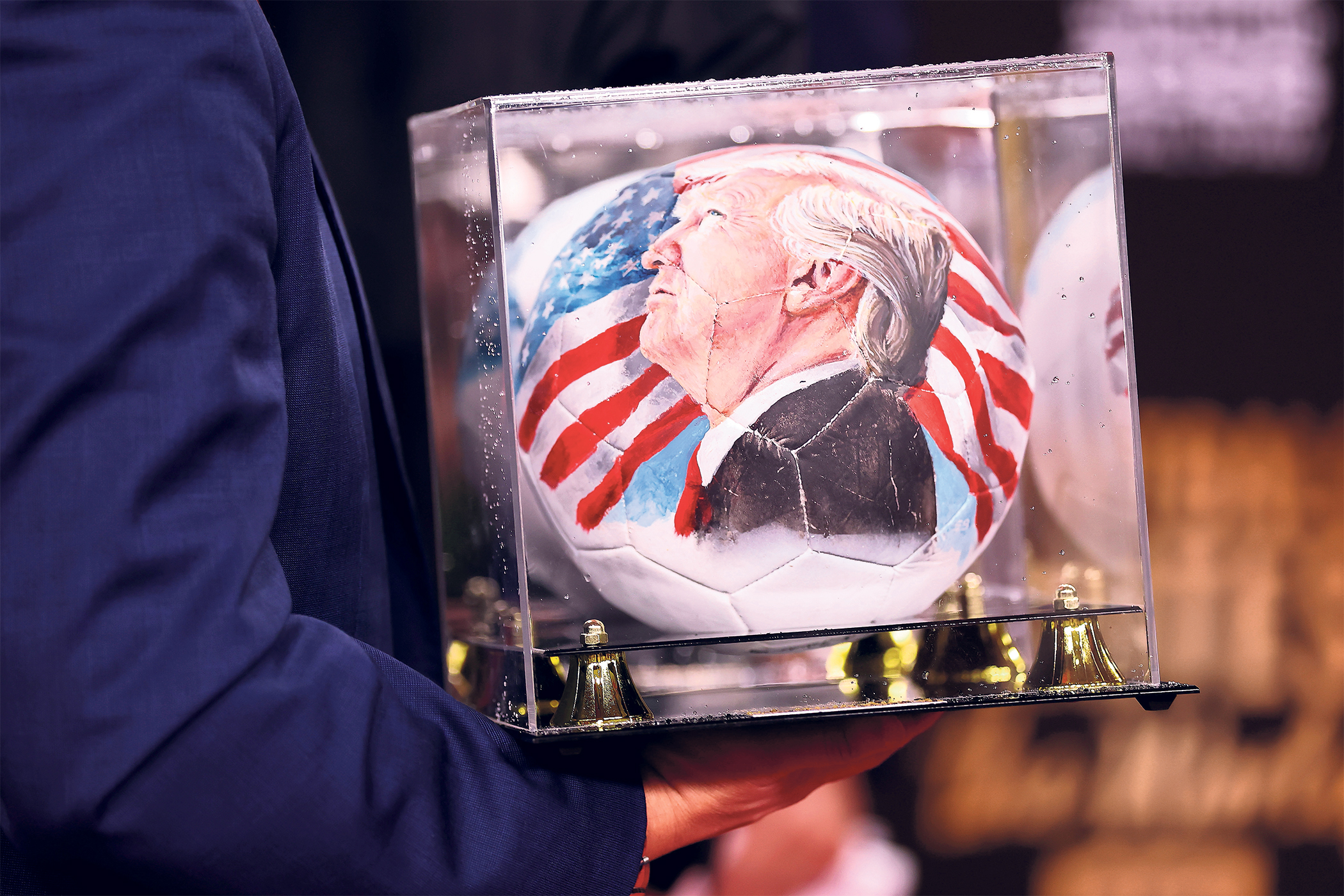
It was hard to know where to start, to identify which bit was, in fact, the worst. Maybe the peace prize, presented to President Donald Trump, which appeared to take as its inspiration the grasping hands of the undead reaching up from the crypt to throttle the planet.
Or maybe it was Gianni Infantino anointing Fifa as the world’s “official provider of happiness,” a description that defies the lived experience of basically any actual football fan. It could have been his nakedly political fawning over his adult male best friend. It should have been his decision to cast himself in a short and unnecessary film to introduce Rio Ferdinand. Infantino seems to be determined to turn himself into what is known in the entertainment industry, now, as a “multi-hyphenate”. He is a president, an influencer, an actor, a content creator.
Scoffing at the pomp and pageantry of these occasions is low-hanging fruit, of course, an easy way of signalling sophistication and purity.
Even allowing for that, though, what unfurled at the Kennedy Center on Friday felt painfully undignified, an occasion that served to diminish rather than embellish the world’s greatest sporting event.
When the United States last hosted the draw for the World Cup, ahead of the 1994 tournament, Fifa felt compelled to put on a spectacle. It was held in Caesar’s Palace in December 1993. Robin Williams and Barry Manilow were among the guests, their star power weaponised to try to help what felt then like a minority sport crack the resistant American mainstream.
Watching the footage back is awkward, vaguely cringe-inducing, a selection of stuffy sporting bureaucrats vamping with evident desperation to sell a product that had never previously needed selling in the company of a roster of celebrities who have little to no clue what is going on. America was still terra incognita back then.
It is not any more. It would be nice to think that is because Americans have learned to love the sport, and many of them have: depending on how and who you count, it is now the most or second-most popular participation sport in the country; European and South American games are on television constantly; touring club sides regularly attract sellout crowds. Portraits of Lionel Messi, Luis Díaz and Raúl Jiménez adorn the Adidas store on Fifth Avenue in New York.
Probably just as importantly, in the world’s most media-loving nation, they know valuable content when they see it. NBC and Paramount have committed billions for the rights to show Premier League and Champions League games. Netflix has taken time out of buying Warner Bros to engage Gary Lineker to produce a nightly World Cup streaming show. Football has long since won its struggle for acceptance. Nobody really wants to admit it, but what it is engaged in now is a battle for dominance.
It is not, in other words, 1993 any more; there is no need for the hard sell these days. Infantino’s grinning insistence on vocalising football’s greatness had the opposite effect: self-praise, after all, is no praise. Amid all the gaudiness, the desperation, it was possible to lose sight of the gravitas, the meaning of the World Cup.
Newsletters
Choose the newsletters you want to receive
View more
For information about how The Observer protects your data, read our Privacy Policy
And then, at last, a selection of American sporting greats started pulling balls out of bowls, and somehow, through the fog of ambition and self-promotion, a little thrill of anticipation flickered. Brazil against Morocco. Portugal against Colombia. France against Norway. England against Croatia.
Quite what lies at the root of that phenomenon – what exactly it is that makes the placement of one flag next to another seem so exciting – is something of a mystery. Perhaps it is the memories that come flooding back, unbidden and instant. Mexico will open the tournament against South Africa, just as they did in 2010. Scotland will face Brazil and Morocco, just as they did the last time they qualified in 1998. Croatia and England have history; so do France and Senegal.
Football is nostalgia, after all: for the lore that is passed down through the generations, for the sense of how it felt and what it meant when we were children. The rematches, the accidental sequels, do not just connect the modern game to its past, linking now with then, but they serve to transport us back to when all of this felt magical.
Or perhaps the true power is in the sense of possibility, of wondering what is to come. Using a draw as a chance to map out a route to the final appears to be a largely English phenomenon – a brief and unscientific survey of various foreign media outlets suggests that the Argentines and Spanish and Brazilians did not take a look at their groups and immediately wonder who they would play in the final – but it is true that the tournament now has a shape.
Until the draw, the 2026 World Cup felt like a concept; now it has form. Those nations who have never been here before – Curaçao and Uzbekistan and Jordan – and those who have not been for some time, like Haiti, can now daydream about what it will be like to take on Germany and Argentina and Brazil.
It will not all be romance and hope and excitement. However any of us feel about the tournament’s expansion, there will be games that feel like filler, games that peter out into stalemates, games that end in dispiriting routs. That is true of all World Cups; they rarely feel as we imagine them to feel.
But that is not what we come to remember. It is not what we allow ourselves to imagine. And, thankfully, it is not something that can be diluted by Fifa’s pomposity and ostentation.
That is what makes the World Cup so special, so powerful: that its wonder endures no matter how much the game’s authorities contrive to demean it.
Photograph by Scott Taetsch – FIFA via Getty Images