
How far can you bend reality until it snaps? How far can you stretch credibility until the human mind simply cannot process it, reverts to factory settings? This was football escaping the matrix, developing a consciousness of its own and gleefully sprinting free of the laboratory, football that was simultaneously migraine and orgasm and stab wound.
There are days you can forget why sport is one of humanity’s great inventions, its capacity to broil you and pull you apart, to create self-contained worlds of such intensity you lose yourself. But then most fans devote entire lives in search of 10 minutes like Rochdale and York concocted at a soft blue Spotland, and never come close.
Some might have vague memories of the first 92 minutes, but really they might as well have not happened, a match that only really started with a corner being flicked on to the Rochdale bar by a flailing York City head. Was it six minutes added time, or eight? Body parts began sweating that had never sweated before.
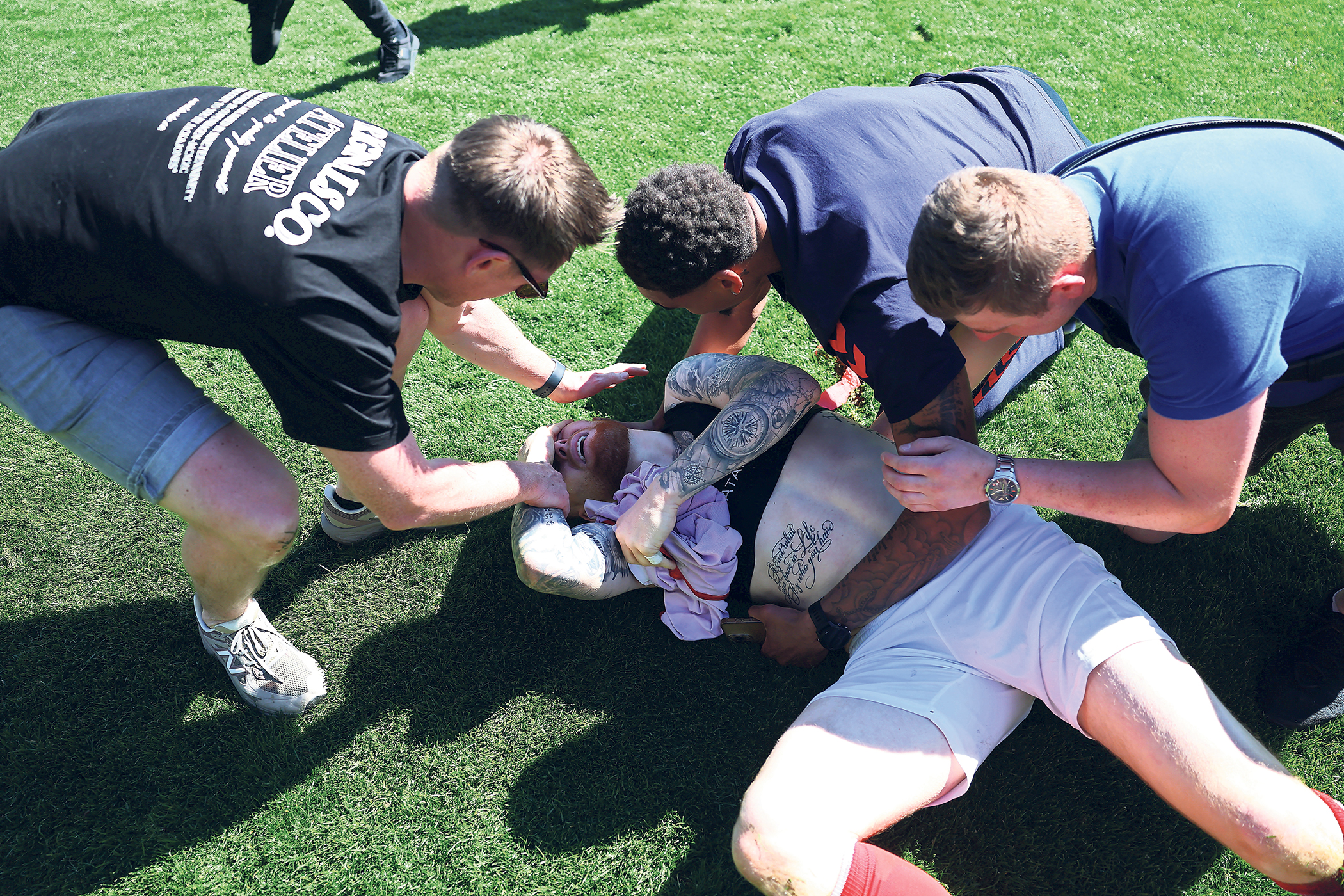
Three minutes later, 41-year-old Ian Henderson, with what could have been his final kick as a professional footballer after a collective 11 years at Rochdale, floated a cross with the outside of his boot, and it seemed to hang for ever. Emmanuel Dieseruvwe leaps, and meets it, and suddenly everything speeds up again and might never slow down, home fans flooding a pitch they never want to leave. Some are sobbing, some screaming. Some can’t look and some can’t look away. For a moment, it was everything they have ever wanted.
Rochdale think they have won it a hundred times in the ensuing minutes, and perhaps they have. Except suddenly a York header is pushed away and Josh Stones thumps the ball goalwards. 103 minutes have passed. A flag goes up and bodies become blurs. From one angle it looks over the line, from another it doesn’t. But really it doesn’t matter, because York have stolen Rochdale’s magic, their joy, their future, their moment.
Every stage of grief was draped around Spotland, a fresco of human anguish; denial (“It never went in lino. Never!”); anger rising and curdling; bargaining with the play-offs; a depression almost indistinguishable from acceptance.
With both teams on more than 100 points and Rochdale needing to win to steal the only automatic promotion spot from leaders York, their captain Ethan Ebanks-Landell said in the week: “I don’t think there’s been anything like it in the history of football,” though perhaps he didn’t know how right he was.
The last final-day match to decide a league title in English football’s top five tiers was Swansea drawing 1-1 at Rotherham to win the Third Division in 2000. And yet comparing this beautiful chaos with anything that came before undervalues it, a moment of such depth and agony and ecstasy as to be truly unique, the totality of the human experience in 10 minutes, endless little births and little deaths. There were two winners, two pitch invasions, two opposing timelines and worlds scrapping for supremacy.
Winning the play-offs in the wake of this would be one of football’s great psychological achievements
Winning the play-offs in the wake of this would be one of football’s great psychological achievements
Pre-match, Dale’s ultra contingent (average age: 14¾) claimed one corner of this heightened mini-world as their own, a throbbing drum consumed somewhere within the writhing, joyous mass, repeatedly and relentlessly informing the away fans of Lancashire’s brilliance and their possession of Super Jim McNulty.
But occasionally one would stop and glaze over, momentarily elsewhere, devoured by the sheer size of the day, of the opportunity; an anxiety shallowly buried. Programmes sold out 45 minutes before kick-off, despite the shop ordering 1,350, more than three times their usual allocation. One fan admitted he has had the shakes all week, as close as you suspect he ever got to acknowledging the existence of man feelings.
Newsletters
Choose the newsletters you want to receive
View more
For information about how The Observer protects your data, read our Privacy Policy
Somewhere in here was the eerie sensation of a major sporting event that wasn’t trying to exploit you, not actively encouraging you to flog a kidney, an odd little rebellion against the rising trend of disassociation football. Rochdale’s most expensive standard ticket was £24, a rate frozen from last season.
Of course, broadcasters Dazn still charged £14.99 to watch it online, an insight into the commercial genius of a company which has lost billions in a decade. But all still felt grounded in a tangible community and humanity, a moment you could grab and feel and drown in.
Yet any of it only happened because of a rule somewhere between arcane and anti-competitive – the single automatic promotion spot to League Two. Rochdale finished on 106 points, York 108. Both clubs released a joint statement on Thursday which called the National League “no longer a non-League competition” and “effectively a League Three, with fully professional clubs operating at a level equal to or higher than many of those in League Two”.
No team promoted from the National League has been relegated the following season since the league adopted its current format in 2002-03. And yet of the 23 teams to have finished second in that period, only six have been promoted through the play-offs. Wrexham, Stockport and Bromley have all been promoted to League One within two seasons of escaping the National League, while Notts County have qualified for this season’s League Two play-offs.
And yet the idea Rochdale must now reassemble something resembling their former selves from the wreckage of this soft blue afternoon is unimaginable, cruel almost. Winning the play-offs in the wake of this would be one of football’s great psychological achievements. But how far can you bend reality until it snaps?
Photograph by Carl Recine/Getty Images